Particles on Slopes (Leaving Cert Applied Maths): Revision Notes
📚Revision Notes
Particles on Slopes
When dealing with particles on inclined planes connected by pulleys, we're looking at one of the most important applications of Newton's laws in mechanics. These problems combine several key physics concepts including force resolution, tension, and connected motion systems.
Understanding the setup
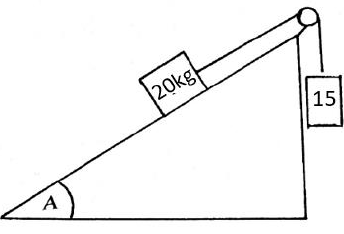
A typical particles on slopes problem involves two masses connected by a light, inextensible string passing over a smooth pulley. One mass sits on an inclined plane while the other hangs vertically. The key insight is that both masses are connected, so they share the same acceleration magnitude.
Important
The fundamental principle here is that when the string is inextensible (cannot stretch), both masses must accelerate at the same rate. If one mass moves a certain distance, the other must move the same distance in the opposite direction along the string.
Force analysis on inclined planes
When a mass sits on an inclined plane, its weight doesn't act along the slope - it acts vertically downward. This means we must resolve the weight into two components:
Weight resolution
The process of breaking down forces is crucial for solving these problems effectively.
Note
Component resolution for inclined planes:
- Component parallel to the slope: This causes the mass to slide down the incline
- Component perpendicular to the slope: This presses the mass against the surface, creating the normal reaction force
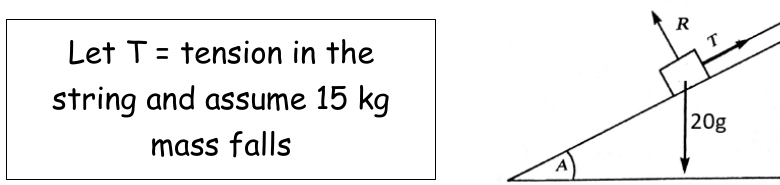
For an incline at angle A to the horizontal:
- Parallel component = (down the slope)
- Perpendicular component = (into the surface)
- Normal reaction
Setting up the equations
The problem-solving approach involves applying Newton's second law to each mass separately, then combining the resulting equations.
For the mass on the incline (Mass M)
We consider forces parallel and perpendicular to the slope:
Perpendicular to the plane: The normal reaction balances the perpendicular component of weight, giving us our first equation.
Parallel to the plane: The net force down the slope equals mass times acceleration. Tension acts up the slope, while the parallel component of weight acts down the slope.
For the hanging mass (Mass 2M)
For the vertically hanging mass, we simply apply Newton's second law in the vertical direction. Weight acts downward, tension acts upward, and the net force equals mass times acceleration.
Worked example approach
Let's examine how to tackle a typical problem systematically using a structured approach:
Example
Systematic Problem-Solving Method:
Step 1: Identify the system Determine which masses are connected and how they move relative to each other
Step 2: Draw force diagrams Show all forces acting on each mass separately
Step 3: Resolve forces Break down the weight of the mass on the incline into parallel and perpendicular components
Step 4: Apply Newton's second law Write equations for each mass, remembering that connected masses have the same acceleration magnitude
Step 5: Solve simultaneous equations Combine your equations to find the acceleration and determine the direction of motion
Problem-solving strategy
When solving these problems, always remember that the direction you initially assume for acceleration might be wrong. If you get a negative value for acceleration, it simply means the system moves in the opposite direction to what you assumed.
Note
Essential Strategy Points:
- Set up clear force diagrams for each mass
- Resolve the weight on the inclined mass appropriately
- Remember that tension is the same throughout the string
- Apply consistently to each mass
- Solve the resulting simultaneous equations methodically
Exam tips
Summary
Essential Exam Strategy:
- Always start by drawing clear diagrams showing all forces
- Label your angle clearly and resolve forces carefully
- Remember that connected masses accelerate with the same magnitude
- Check your answer makes physical sense - does the heavier mass accelerate in the expected direction?
- Show your working clearly, as partial marks are often available for correct method even if the final answer is wrong
Summary
Key Points to Remember:
- Weight must be resolved into parallel and perpendicular components when dealing with inclined planes
- Connected masses via inextensible strings have equal acceleration magnitudes
- Tension remains constant throughout a light, inextensible string
- Apply Newton's second law separately to each mass before combining equations
- A negative acceleration result indicates motion in the opposite direction to your initial assumption