Overview (Leaving Cert Applied Maths): Revision Notes
📚Revision Notes
Overview
Finding the most efficient path through a network is a fundamental problem in applied mathematics. Whether you're routing data through the internet, planning project timelines, or optimising delivery routes, understanding optimal path algorithms is essential. This topic covers several key methods that help solve these real-world problems.
Note
These algorithms form the backbone of many modern technologies - from GPS navigation systems to project management software and network routing protocols.
Dijkstra's algorithm
Dijkstra's algorithm is a powerful method for finding the shortest route between any two points in a network. Think of it like finding the quickest way to travel between two cities, considering all possible routes and their distances.
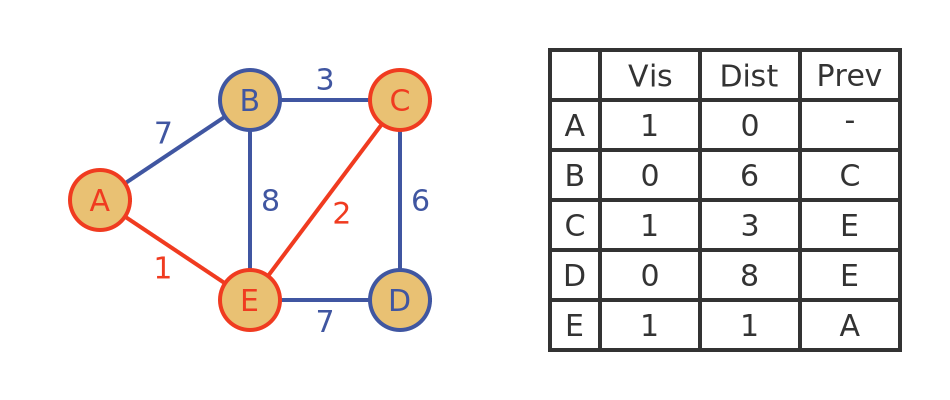
How the algorithm works
The algorithm follows a systematic labelling process. You maintain a tracking table to organise your work effectively.
The process begins at your starting point (source node) and methodically explores all connected routes. Here's how it operates:
Example
Step-by-step process:
- Begin at the source node and assign it a permanent label of zero
- Calculate provisional distances to all directly connected nodes
- Select the node with the smallest provisional distance and make it permanent
- Update distances to connected nodes if shorter paths are discovered
- Repeat until you reach your destination (sink node)
Important
The beauty of this algorithm lies in its guarantee - it always finds the truly shortest path, not just a good approximation.
Critical paths and activities
When managing complex projects, some tasks are more crucial than others. Critical path analysis helps identify which activities cannot be delayed without affecting the entire project timeline.
Understanding project timing
Every activity in a project has timing constraints. The early time represents the earliest possible moment an activity can begin, assuming all prerequisite tasks finish as quickly as possible. Conversely, the late time shows the latest an activity can start without delaying the whole project.
Note
Understanding these timing concepts is essential for effective project management and helps identify potential bottlenecks before they become problems.
Float and flexibility
The difference between early and late times creates what we call float - essentially breathing room in your schedule. Activities with zero float lie on the critical path because any delay directly impacts project completion.
Float calculation:
When you connect all zero-float activities from start to finish, you create the critical path. This sequence determines your minimum project duration.
Finding critical activities
Start by creating a precedence table showing which tasks depend on others. Then work through the network twice:
Example
Finding Critical Activities Process:
Step 1: Forwards pass - Calculate early times from start to finish
Step 2: Backwards pass - Calculate late times from finish to start
Step 3: Identify critical activities - Activities where early time equals late time are critical and need careful monitoring
Scheduling
Once you've identified critical activities, effective scheduling becomes crucial for project success. Visual tools help managers track progress and allocate resources efficiently.
Gantt charts
A Gantt chart displays your project timeline visually, showing when each activity occurs and how they relate to each other.
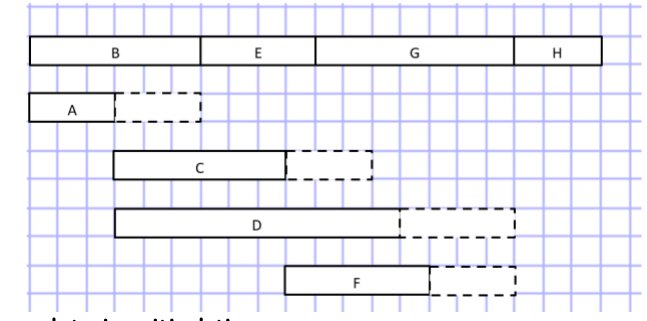
These charts reveal several important aspects:
- Activity durations and their timing
- Dependencies between different tasks
- Available float time for non-critical activities
- Overlapping activities that might compete for resources
Note
Gantt charts are particularly valuable for communicating project status to stakeholders and identifying potential resource conflicts before they occur.
Resource optimisation
When you have limited workers or resources, smart assignment strategies become essential. The goal is minimising idle time while ensuring critical activities stay on schedule.
Important
Key strategies:
- Assign workers to critical activities first
- For multiple activity options, choose those with the earliest late times
- Consider the impact of your final assignments on remaining activities
Lower bound calculations
Mathematical techniques help establish theoretical limits for project completion. The lower bound formula provides a baseline for comparison:

This calculation assumes perfect resource utilisation - reality often requires more time due to scheduling constraints and resource conflicts.
Bellman's principle
For more complex routing problems, Bellman's principle offers an elegant solution approach. This method works particularly well when you need to make sequential decisions through multiple stages.
The principle of optimality
Bellman's key insight states that any segment of an optimal path must itself be optimal. If you're taking the best route from A to C via B, then the section from B to C must be the best possible route between those points.
Important
This principle forms the foundation of dynamic programming and allows us to break complex problems into simpler subproblems.
Multi-stage networks
These networks organise decision points into stages, where each stage represents a step in your journey. Stages group nodes by their distance from the destination, while states represent possible positions at each stage.
Example
Solution Process:
- Create a table with columns for stage, state, action, and value
- Start from the final destination and work backwards
- Find the optimal choice at each state using previously calculated values
- Mark optimal decisions and trace forwards to find the complete path
This backwards working approach ensures you always make decisions with complete information about future consequences.
Practical applications
Bellman's principle applies to numerous real-world scenarios:
- Route planning with multiple waypoints
- Investment decisions over time
- Resource allocation across projects
- Dynamic programming problems
Note
The method excels when future decisions depend on current choices, making it invaluable for sequential optimisation problems.
Summary
Summary
Key Points to Remember:
-
Dijkstra's algorithm systematically finds shortest paths by permanently labelling nodes in order of increasing distance from the source
-
Critical path analysis identifies activities with zero float that directly impact project completion time - these need careful monitoring
-
Gantt charts provide visual project timelines showing activity relationships, durations, and available scheduling flexibility
-
Lower bound calculations establish theoretical minimum completion times based on total work and critical path duration
-
Bellman's principle solves complex multi-stage problems by working backwards from the destination, ensuring each path segment is optimal