Equations of Motion (Leaving Cert Applied Maths): Revision Notes
📚Revision Notes
Equations of Motion
Understanding uniform acceleration
Acceleration is the change in speed of a body over a period of time. We typically measure acceleration in metres per second squared (m/s²).
When an object moves with uniform acceleration, it means the object's velocity changes by the same amount every second. This creates a constant rate of change.
Note
Uniform acceleration is different from variable acceleration, where the rate of change varies over time. In physics problems, we often assume uniform acceleration to simplify calculations.
Time-velocity graphs
Consider a vehicle moving at 8 m/s that increases its speed to 10 m/s after 1 second. After 2 seconds total, it reaches 12 m/s, and after 3 seconds it reaches 14 m/s.
This vehicle increases its speed by 2 m/s every second, meaning it accelerates at 2 metres per second per second (2 m/s²).
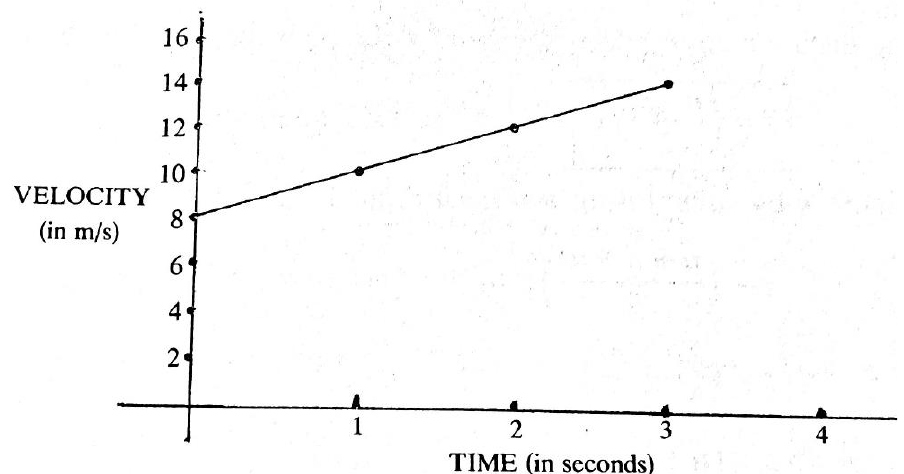
When we plot this motion on a velocity-time graph, we get a straight line. This straight line indicates that the vehicle is accelerating at a steady, constant rate - what we call uniform acceleration.
Note
The slope of a velocity-time graph represents the acceleration. A steeper slope means greater acceleration, while a horizontal line means zero acceleration (constant velocity).
The five key variables
Before exploring the equations, we need to understand the five important variables used in motion problems:
- u = initial velocity (starting speed)
- v = final velocity (ending speed)
- a = acceleration
- t = time taken
- s = distance travelled
Important
These five variables are the foundation of all motion calculations. Memorising what each symbol represents will make solving problems much easier.
The four equations of motion
Scientists have developed four key equations that connect these variables together. These equations allow us to solve motion problems when we know some variables and need to find others.
The four fundamental equations are:
Equation 1:
This equation connects final velocity, initial velocity, acceleration, and time. It comes directly from the basic definition of acceleration rearranged to solve for final velocity.
Equation 2:
This equation finds distance by multiplying the average velocity by the time taken. The average velocity is simply the initial and final velocities added together and divided by 2.
Equation 3:
This equation calculates distance using initial velocity, time, and acceleration. It's particularly useful when you don't know the final velocity.
Equation 4:
This equation connects velocities, acceleration, and distance without involving time. It's especially helpful when time is unknown.
Important
These equations only work for motion with constant acceleration. They cannot be used when acceleration changes over time or when dealing with circular motion.
Understanding positive and negative acceleration
The sign of acceleration tells us about the motion:
- Positive acceleration means the object is speeding up
- Negative acceleration means the object is slowing down (decelerating)
For example, if acceleration equals -3 m/s², we can say the acceleration is -3 m/s² or the deceleration is 3 m/s².
Note
Remember that negative acceleration doesn't always mean the object is moving backwards - it could be moving forwards but slowing down, or moving backwards and speeding up.
Using the equations - worked examples
Example
Worked Example 1: Cyclist Problem
A cyclist speeds up uniformly from 2 m/s to 10 m/s over a 4-second period. Calculate the distance travelled.
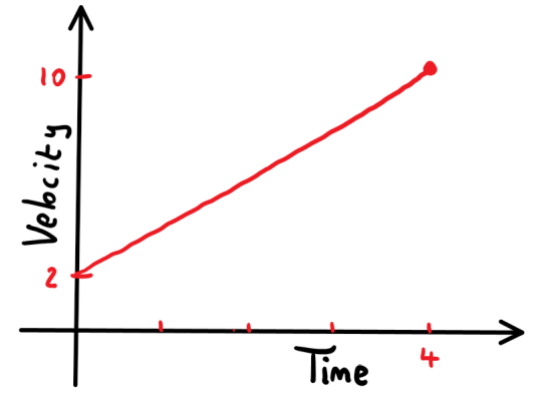
Given information:
- m/s
- m/s
- s
Solution: Using equation 2:
m
Example
Worked Example 2: Truck Braking Problem
A truck slows down from 50 m/s to rest, covering 150 m. Find:
- The time taken
- The deceleration
- The stopping distance if deceleration doubled
Part 1 - Finding time:
- m/s, m/s, m
Using equation 2:
seconds
Part 2 - Finding acceleration: Using equation 1:
m/s²
The deceleration is 8.33 m/s².
Part 3 - Doubled deceleration: If deceleration doubles: m/s²
Using equation 4:
m
Choosing the right equation
When solving problems, you need to identify which three variables you know, then select the equation containing those three variables plus the unknown you want to find.
Important
Problem-Solving Strategy:
- List all given information
- Identify what you need to find
- Choose the equation that contains three known variables and one unknown
- Substitute values and solve
Remember that if you know any three of the five variables (u, v, a, t, s), you can always find the other two using these equations.
Summary
Key Points to Remember:
- Uniform acceleration means velocity changes by the same amount each second, creating a straight line on a velocity-time graph
- The four equations of motion connect the five key variables: u, v, a, t, and s
- Positive acceleration means speeding up, while negative acceleration means slowing down
- Choose your equation based on which three variables you know and which one you need to find
- These equations only work for motion with constant acceleration - they don't apply when acceleration changes over time