Overtaking (Leaving Cert Applied Maths): Revision Notes
📚Revision Notes
Overtaking
Note
Overtaking problems are a common type of kinematics question that involves two objects (usually cars) with different motion characteristics. Understanding how to solve these problems requires grasping one fundamental principle and applying kinematic equations systematically.
The key principle
The most important concept to remember when solving overtaking problems is that at the moment when one car overtakes another, both cars have travelled exactly the same distance from their starting point. This principle forms the foundation for setting up and solving all overtaking problems.
Setting up the problem
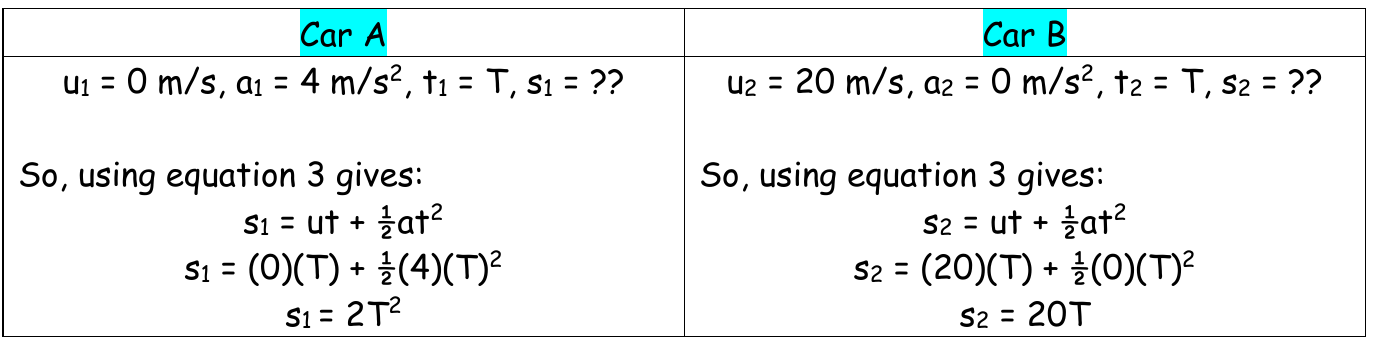
In a typical overtaking scenario, you'll encounter two cars with different motion characteristics:
- Car A: Usually starts from rest (initial velocity = 0) but has constant acceleration
- Car B: Usually has an initial velocity but moves at constant speed (acceleration = 0)
Let's examine how to analyse each car separately using kinematic equations.
Important
For any overtaking problem, you should:
- Identify the motion parameters for each car (initial velocity, acceleration)
- Apply the appropriate kinematic equation (usually )
- Express the displacement of each car in terms of time T
- Set the displacements equal when overtaking occurs
Solving the equations
When the cars overtake each other, their displacements from the starting point are equal. This gives us an equation we can solve for time.
Example
Worked Example: Solving the Overtaking Problem
The algebraic solution typically involves:
- Setting up the equation: distance of Car A = distance of Car B
- For this problem: and
- When overtaking: , so
- Rearranging:
- Factoring:
- Solutions: or seconds
In most problems, you'll get two solutions for T:
- T = 0: This represents the initial moment when both cars were at the starting point
- T = (positive value): This is the time when overtaking actually occurs
Calculating the overtaking distance
Once you've found the time of overtaking, you can substitute this value back into either car's displacement equation to find how far from the starting point the overtaking occurs.
For our example: metres
Understanding velocity-time graphs
Note
Drawing a velocity-time graph can help visualise what's happening in an overtaking problem. The graph would show:
- Car A starting from rest and accelerating (sloped line from origin)
- Car B maintaining constant velocity (horizontal line)
- The point where their velocities become equal
Greatest distance between cars
Sometimes you may be asked to find the greatest distance between the two cars during their motion. This occurs when both cars have the same velocity, which happens before the actual overtaking takes place.
Exam tips
Note
Essential Exam Strategy:
- Always clearly define your variables and what each car's motion characteristics are
- Remember that overtaking means equal distances travelled from the starting point
- Check your quadratic equation solutions - T = 0 should always be one solution
- Show all algebraic steps clearly when solving the quadratic equation
- Don't forget to calculate the final distance if the question asks for it
- Consider sketching a velocity-time graph to help visualise the problem
Summary
Key Points to Remember:
- When cars overtake, they have travelled the same distance from their starting point
- Use the kinematic equation for each car separately
- Set the distances equal and solve the resulting quadratic equation
- T = 0 represents the initial position, while the other solution gives the overtaking time
- Always substitute back to find the overtaking distance if required