Work, Energy, Power (Leaving Cert Applied Maths): Revision Notes
📚Revision Notes
Conservation of Momentum
Understanding the principle of conservation of momentum
The principle of conservation of momentum is one of the most fundamental concepts in physics. It states that when no external forces act on a system, the total momentum of that system remains constant. This principle comes directly from Newton's Second Law, which tells us that the rate of change of momentum is proportional to the applied force.
Note
The conservation of momentum is a direct consequence of Newton's laws of motion. When Newton formulated his second law as "the rate of change of momentum equals the applied force," he laid the foundation for understanding how momentum behaves in isolated systems.
Momentum is defined as the product of an object's mass and velocity:
Where:
- = momentum
- = mass (kg)
- = velocity (m/s)
- Units: kg m/s
When external forces are absent, momentum is conserved. This means the total momentum before an event (like a collision) equals the total momentum after the event.
What is impulse?
Impulse represents the change in momentum of an object. When a force acts on an object for a certain time, it changes the object's momentum. This change is called impulse.
The impulse-momentum relationship can be expressed as:
Where:
- = impulse
- = change in momentum
- = final momentum
- = initial momentum
- Units: newton-seconds (Ns)
Understanding impulse helps us analyse collisions and impacts. In any collision, the impulses experienced by the colliding objects are equal and opposite, following Newton's Third Law.
Important
Newton's Third Law and Impulse: During any collision, the impulse experienced by object A is equal in magnitude but opposite in direction to the impulse experienced by object B. This is why momentum is conserved in isolated systems.

Applying conservation of momentum in one dimension
Let's examine how conservation of momentum works in a simple collision scenario. When a hammer strikes a stake, we can apply the conservation principle to find the final velocities after impact.
The key steps are:
- Calculate the momentum of each object before collision
- Apply conservation: total momentum before = total momentum after
- Solve for unknown final velocities
- Calculate impulse for each object
For the hammer and stake example, the hammer initially moves downward at 2 m/s while the stake is initially at rest. After collision, momentum is conserved between both objects, and the impulse on each object is equal in magnitude but opposite in direction.
Example
Worked Example: Hammer and Stake Collision
Given:
- Hammer: mass = 2 kg, initial velocity = 2 m/s downward
- Stake: mass = 0.5 kg, initial velocity = 0 m/s
Step 1: Calculate initial momentum
Step 2: Apply conservation of momentum If they stick together after collision:
Two-dimensional collisions
Conservation of momentum also applies when objects collide at angles. In these cases, we must consider momentum components in both horizontal and vertical directions separately.
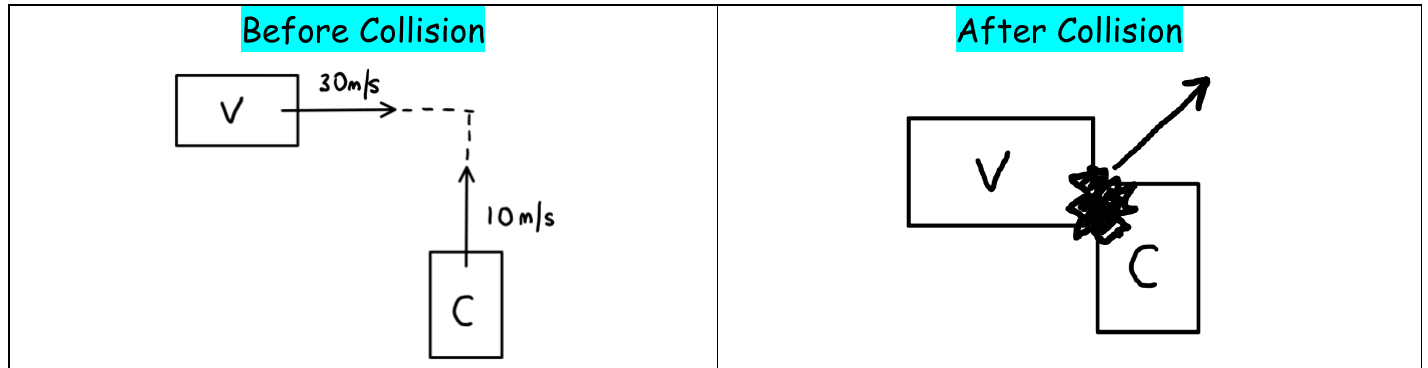
Consider a van and car colliding at right angles:
- Van: 800 kg moving at 30 m/s horizontally
- Car: 700 kg moving at 10 m/s vertically
- After collision, they become entangled (perfectly inelastic collision)
The solution involves setting up momentum conservation equations for both x and y directions, using the fact that after collision, both objects move together as one mass, then finding the resultant velocity using vector addition.
Example
Worked Example: Two-Dimensional Collision
Step 1: Calculate initial momentum in x-direction
Step 2: Calculate initial momentum in y-direction
Step 3: Apply conservation (total mass = 1,500 kg)
Step 4: Find resultant velocity
Conservation of momentum with connected systems
When objects are connected by strings or ropes (like in pulley systems), conservation of momentum principles still apply, but we must also consider the constraint that connected objects move together.
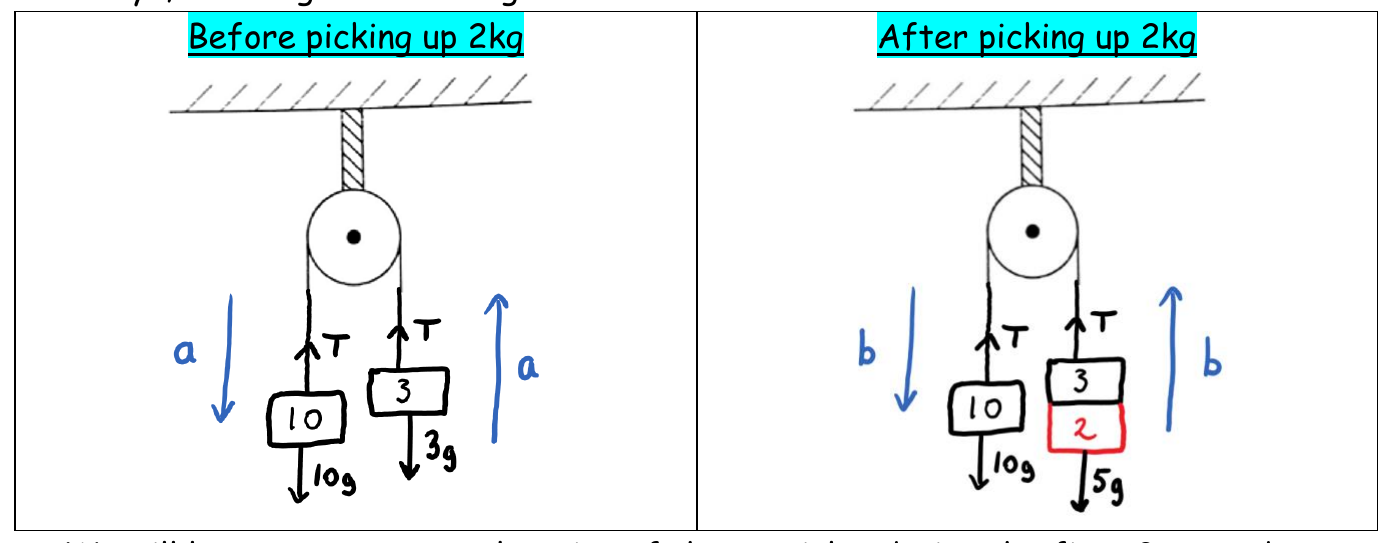
In pulley systems, the string creates a connection between masses. When one mass picks up additional mass, momentum is conserved at the instant of change. However, the system's behaviour changes as the total mass changes.
Note
Connected Systems Complexity: In connected systems, momentum is conserved at the instant when masses change, but immediately after, the system's motion is governed by the new force balance. This requires analysing both the moment of change (using momentum conservation) and the subsequent motion (using force analysis).
These problems typically involve:
- Analysing the system before and after mass changes
- Applying conservation of momentum at the moment of change
- Using force analysis (Newton's Second Law) to find accelerations
- Calculating distances travelled using kinematic equations
Exam tips
When tackling momentum problems in exams, follow these proven strategies:
- Always draw clear diagrams showing the situation before and after
- Define your coordinate system clearly at the start
- Remember that momentum is a vector quantity - direction matters
- In two-dimensional problems, treat x and y components separately
- Check your units throughout calculations
- For connected systems, identify when momentum conservation applies versus when force analysis is needed
Important
Common Mistake to Avoid: Don't confuse the moment when momentum is conserved (instantaneous change) with the ongoing motion afterward. In connected systems, momentum conservation applies at the instant of change, but forces determine the subsequent motion.
Remember!
Summary
Key Points to Remember:
- Momentum: and is measured in kg⋅m/s
- Conservation principle: Total momentum before = Total momentum after (when no external forces act)
- Impulse: and equals the change in momentum
- In two-dimensional collisions, apply conservation separately to x and y components
- Connected systems require careful analysis of when momentum is conserved versus when forces dominate
- Always consider the direction of momentum - it's a vector quantity