Energy and Conservation of Energy (Leaving Cert Applied Maths): Revision Notes
📚Revision Notes
Energy and Conservation of Energy
What is energy?
Energy is the fundamental concept that describes the ability to do work. In physics, this means energy represents the capacity of a system to cause changes or perform tasks. Energy is measured in Joules (J), and for larger quantities, we often use kilojoules (kJ), where 1 kJ = 1000 J.
Note
You might remember studying energy in Junior Certificate Science, but now we'll explore it with more mathematical detail and precision for Applied Mathematics.
Types of energy
There are many different forms of energy, but two of the most important types we need to understand are potential energy and kinetic energy.
Potential energy
Potential Energy is the energy that an object possesses due to its position or location. When an object is lifted to a certain height, it gains potential energy because it has the potential to do work if it falls back down.
The formula for calculating potential energy is:
Note
Variables in the potential energy formula:
- = mass of the object (in kg)
- = acceleration due to gravity (9.8 m/s²)
- = height above a reference point (in metres)
Kinetic energy
Kinetic Energy is the energy that a moving object possesses. The faster an object moves, the more kinetic energy it has. Similarly, heavier objects have more kinetic energy than lighter ones when moving at the same speed.
The formula for calculating kinetic energy is:
Note
Variables in the kinetic energy formula:
- = mass of the object (in kg)
- = velocity or speed of the object (in m/s)
The law of conservation of energy
One of the most fundamental principles in physics is the Law of Conservation of Energy. This law is absolutely critical to understanding how energy behaves in physical systems.
Important
Energy cannot be created or destroyed; it can only be changed from one form to another.
This means that the total amount of energy in a closed system remains constant. Energy simply transforms from one type to another.
Practical application - the roller coaster
A roller coaster provides an excellent example of energy conservation in action. When the carriage is at the top of a hill, it has lots of potential energy because of its height, but very low kinetic energy since it's moving slowly.
As the carriage moves down the hill, its kinetic energy rapidly increases as its speed increases. At the bottom of the hill, the potential energy is very low (since the height is minimal), but the kinetic energy reaches its maximum because the carriage is at its top speed.
Note
At any point along the roller coaster track, the relationship holds:
Work and energy relationship
There's an important connection between work and energy that we must understand:
Important
Work Done = Energy Gained
This principle allows us to calculate how much work has been done by measuring the change in energy of a system.
Worked example - rocket acceleration
Let's look at a practical example to see how this works:
Example
Worked Example: Rocket Acceleration
Problem: A body of mass 2 kg fires rockets which speed it up from 40 m/s to 60 m/s. Find the work done.
Solution: The work done is measured by the gain in energy. In this example, the energy involved is kinetic energy.
We calculate the kinetic energy before and after:
Energy Before =
Energy After =
The energy gained is:
Therefore, Work Done = 2000 J or 2 kJ
Pendulum motion and energy conservation
Pendulums provide another excellent example of energy conservation. The following detailed example shows how to apply conservation of energy principles to solve complex motion problems.
Example
Worked Example: Pendulum Motion
Problem: A pendulum is made of a mass at the end of a light string. The pendulum, which is 1 m long, makes an angle of 60° with the vertical when at its greatest height. Find its speed (in m/s) when at its lowest point, correct to 2 decimal places.
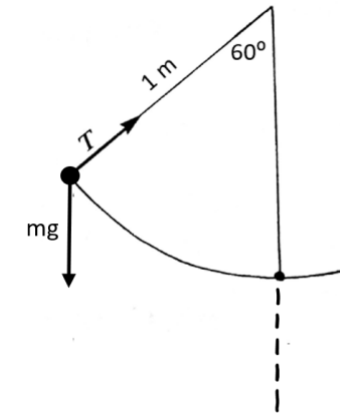
Step 1: Setting up the problem
First, we need to establish our reference positions. We define a "standard position" or "Position 0" that we measure all our distances from. In this case, we'll put Position 0 at the lowest point that the mass reaches.
We also define "Position 1" at the point where the particle is at its greatest height (60° from vertical).
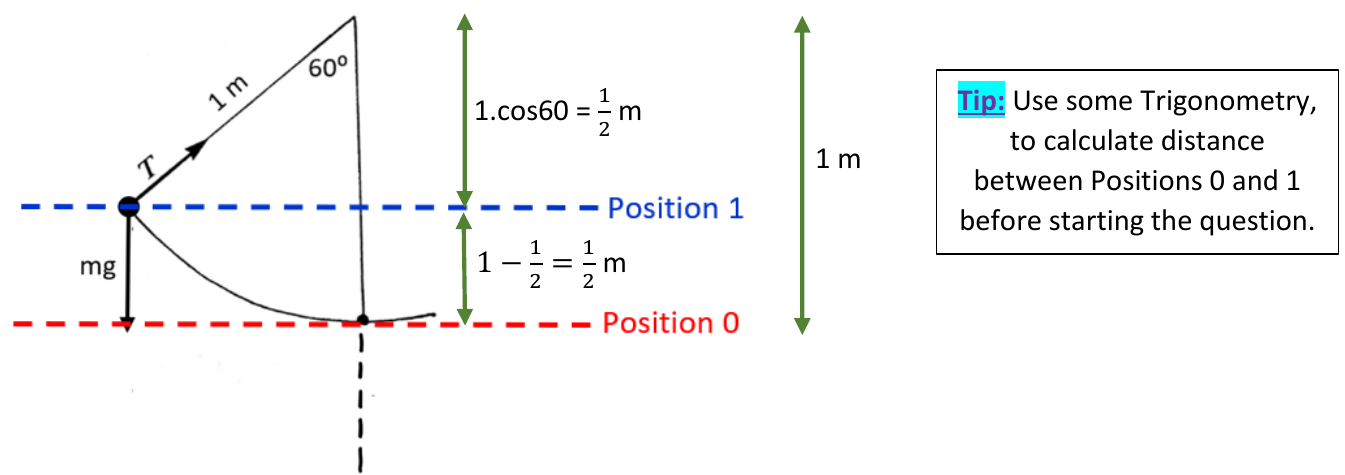
Step 2: Calculating the height difference
Using trigonometry, we can find the vertical distance between Position 0 and Position 1:
- The pendulum string length is 1 m
- At 60° from vertical: m from the pivot point vertically
- The height difference between positions is: m
Step 3: Applying conservation of energy
The tension in the string acts perpendicular to the direction of motion, so it does no work. The only force that affects the particle's speed is gravity, so we can use the Law of Conservation of Energy.
Between Position 0 and Position 1:
Substituting our values:
- At Position 0: ,
- At Position 1: ,
Therefore:
Simplifying:
Dividing both sides by and multiplying by 2:
Since :
Therefore: (correct to 2 decimal places)
Summary
Key Points to Remember:
- Energy is the ability to do work and is measured in Joules (J)
- Potential energy = (energy due to position/height)
- Kinetic energy = (energy due to motion)
- Energy cannot be created or destroyed, only transformed from one form to another
- Work done = Energy gained - this relationship helps us solve many practical problems