Salvador Dalí (Leaving Cert Art): Revision Notes
📚Revision Notes
Salvador Dalí
Introduction to Salvador Dalí
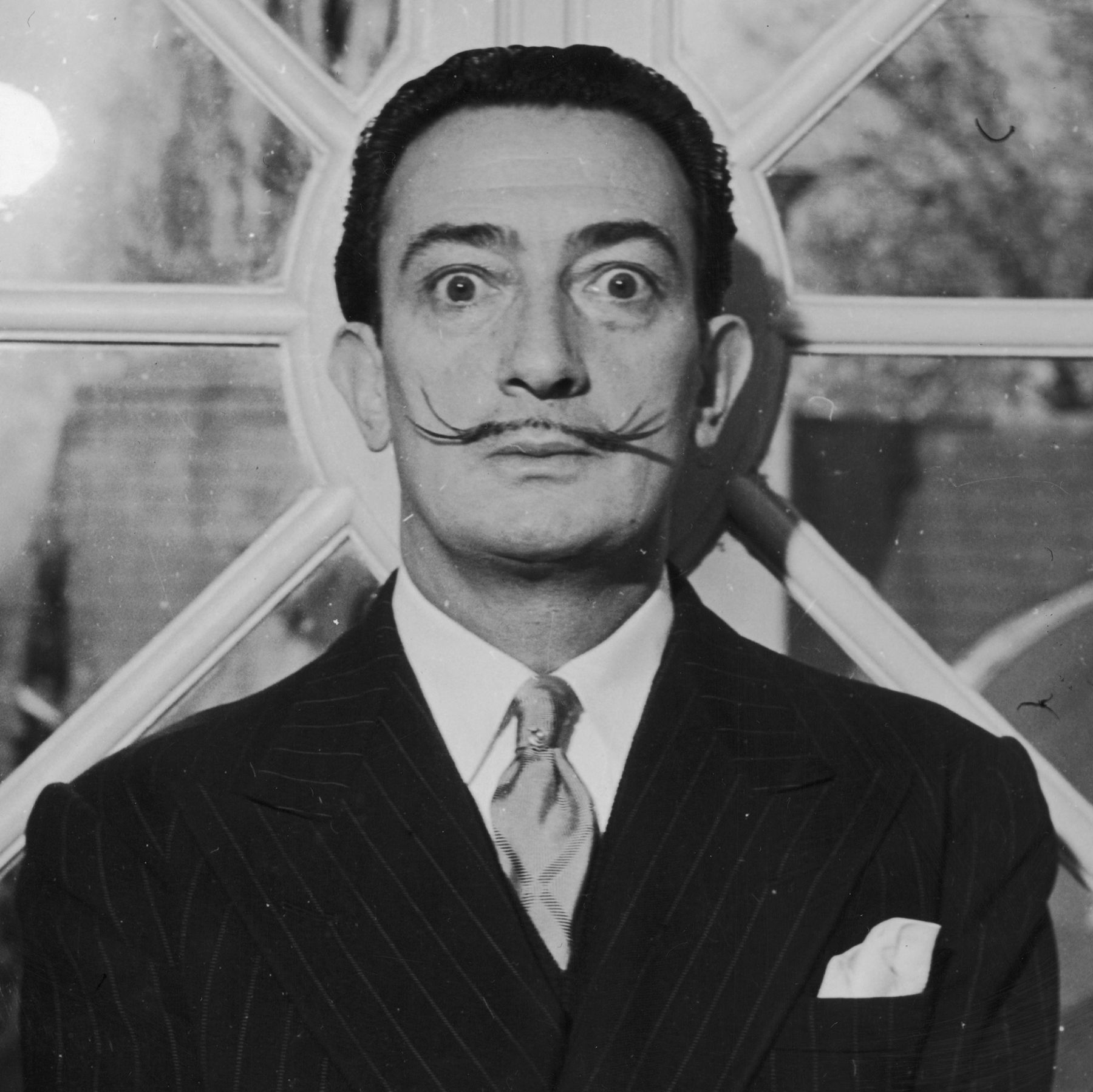
Salvador Dalí was one of the most famous and influential artists of the 20th century, best known for his surrealist paintings that explored the depths of the human subconscious mind. Born Salvador Domènec Felip Jacint Dalí i Domènech on 11th May 1904 in Figueres, Spain, he became renowned for creating dreamlike images that challenged our understanding of reality and time.
Note
Dalí's famous quote perfectly encapsulates his artistic philosophy: "Have no fear of perfection - you'll never reach it." This quote captured his approach to art and life, encouraging constant experimentation and creative risk-taking.
From an early age, he demonstrated exceptional artistic talent and intelligence, showing signs of the creative genius that would later revolutionise the art world. His unique combination of technical mastery and imaginative vision set him apart from his contemporaries and established him as one of the most recognisable figures in modern art.
Early life and artistic development
Dalí grew up in a middle-class family in Catalonia, Spain. His father worked as a notary and lawyer, while his mother, Felipa, provided emotional support for his artistic ambitions.
Important
A Defining Tragedy: His mother died when he was just sixteen years old, which deeply affected the young artist and influenced much of his later work. This loss became a recurring theme in his psychological exploration through art.
During his adolescence, Dalí's parents recognised his extraordinary talent and supported his artistic education. He attended the Real Academia de Bellas Artes de San Fernando in Madrid in 1922, though he was eventually expelled for his rebellious attitude and refusal to conform to traditional academic standards.
The artist's personality was as distinctive as his art - he was known for his flamboyant behaviour, distinctive upward-curved moustache, and theatrical public appearances. These characteristics helped establish his reputation as an eccentric genius who brought art into popular culture.
Surrealism and artistic techniques
Note
Understanding Surrealism: Surrealism was an artistic movement that aimed to express the contents of the subconscious mind through art, literature, and film. Surrealist artists sought to bypass rational thought and tap directly into their unconscious minds to create works that resembled dreams or hallucinations.
Dalí developed his own unique approach called the paranoid-critical method. This technique involved putting himself into a state of paranoid delusion to access his subconscious mind more effectively. He would then paint the bizarre, impossible images that emerged from this mental state with incredible technical precision.
The artist's work is characterised by:
- Precise, photographic detail combined with impossible, dreamlike scenarios
- Visual distortions that challenge our perception of reality
- Symbolic imagery drawn from psychology, religion, and personal experience
- Desert landscapes that create an otherworldly atmosphere
Key influences on Dalí's work
Sigmund Freud's psychoanalysis
Freud's theories about the unconscious mind and dream analysis profoundly influenced Dalí's artistic vision. The artist was fascinated by Freud's ideas about repressed memories and hidden desires, which became central themes in his surrealist paintings.
Gala Dalí
In 1929, Dalí met Elena Dmitrievna Diakonova, known as Gala, who would become his wife, muse, and business manager. Despite being married to another surrealist writer when they first met, Gala became completely devoted to Dalí's career.
Note
Gala's Crucial Role: She inspired many of his most famous works and helped manage the practical aspects of his artistic career, allowing him to focus entirely on creating art. Her influence extended beyond personal support to become an integral part of his creative process.
Major artworks
The Persistence of Memory (1931)

This masterpiece, also known as "The Melting Clocks", is perhaps Dalí's most recognisable work. Created in 1931, it was first exhibited at the Julien Levy Gallery in 1932 and has since become an icon of modern art and popular culture.
Example
Artwork Analysis: The Persistence of Memory
The painting depicts several soft, melting timepieces draped over various objects in a barren desert landscape. The melting clocks symbolise the relativity of time and space, suggesting that time becomes fluid and meaningless in the realm of dreams and memory.
Key symbolic elements:
- Melting clocks: The fluidity and subjectivity of time
- Ants: Often representing death and decay in Dalí's symbolism
- Desert landscape: The vast, empty spaces of the subconscious mind
The Face of War (1940)
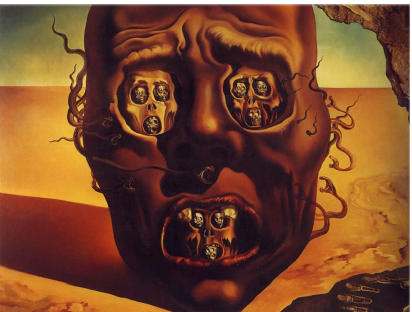
Painted during the Spanish Civil War, "The Face of War" represents Dalí's response to the violence and suffering he witnessed in his homeland. The artwork shows a large, bronze-coloured face with smaller skull-like faces filling the eye sockets and mouth, creating a disturbing visual metaphor for the endless cycle of death and destruction that war brings.
This painting demonstrates how Dalí could use his surrealist techniques to address serious political and social themes, moving beyond purely personal or psychological subjects to comment on broader human experiences.
Galatea of the Spheres (1952)
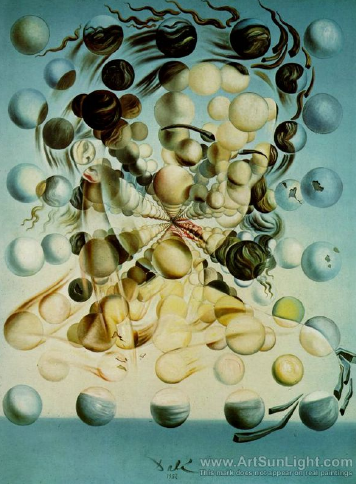
This portrait of Gala demonstrates Dalí's interest in atomic theory and nuclear physics following World War II. The painting shows his wife's face and form composed of floating spheres of various sizes, representing atoms and molecules.
Note
Scientific Influence: This work reflects Dalí's belief that everything in the universe is made up of tiny particles that never actually touch each other. The spherical composition also relates to his fascination with Renaissance art and mathematical proportions.
The Disintegration of the Persistence of Memory (1952-1954)
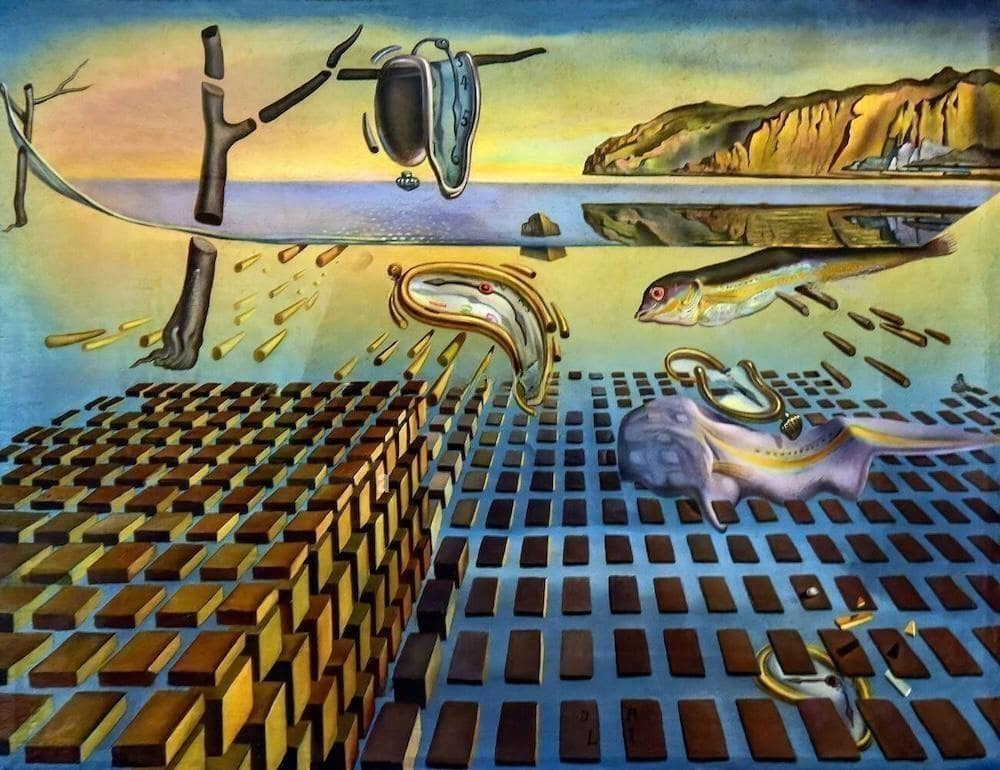
This later work revisits the theme of his famous melting clocks but places them in a new context influenced by atomic theory. The painting shows the original desert landscape being broken down into component parts, with the melting clocks now appearing to disintegrate into smaller elements.
The checkerboard floor pattern creates a sense of mathematical order beneath the surreal imagery, reflecting Dalí's growing interest in geometry and physics in his later career.
Tuna Fishing (1966-1967)
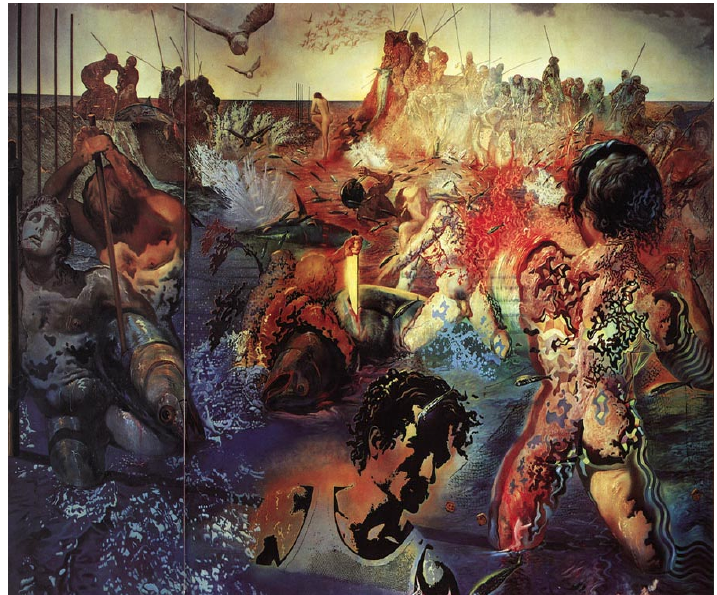
Considered by many to be one of Dalí's finest later works, "Tuna Fishing" combines classical mythology with psychedelic colours and forms. The complex composition includes warriors, mythological figures, and marine life in a chaotic, dreamlike scene that reflects both ancient themes and contemporary 1960s culture.
The painting's extreme use of colour and energy captures the vibrant, experimental spirit of the 1960s while maintaining Dalí's signature surrealist approach to composition and symbolism.
Artistic legacy and influence
Dalí's impact on art and popular culture extends far beyond the surrealist movement. His distinctive visual style and theatrical personality helped bring modern art to mainstream audiences, making him one of the first artists to achieve true celebrity status.
Note
Lasting Cultural Impact: Dalí's influence transcends traditional art boundaries, establishing him as a cultural icon whose work continues to resonate with contemporary audiences across multiple media and platforms.
The artist's influence can be seen in:
- Contemporary surrealist artists like Vladimir Kush, who creates similar dreamlike imagery
- Popular culture, where his melting clocks and other images have become widely recognised symbols
- Advertising and design, where his bold, attention-grabbing style continues to inspire creative work
- Film and photography, where his collaborative work with directors like Luis Buñuel pioneered new visual techniques
Understanding Dalí's symbolism
To fully appreciate Dalí's work, students should understand his personal symbolic vocabulary. Each symbol carried specific meaning that appeared consistently throughout his artistic career:
Note
Decoding Dalí's Visual Language
Understanding these symbols helps viewers interpret the deeper psychological and philosophical meanings in his paintings:
- Melting or soft objects: The fluidity of time and memory
- Ants: Death, decay, and anxiety
- Eggs: Birth, hope, and love
- Drawers: Hidden memories and repressed thoughts
- Crutches: Support for weak or failing structures
- Elephants with long legs: The weight of memory and time
- Burning giraffes: Masculine power and cosmic energy
Summary
Key Points to Remember:
- Salvador Dalí (1904-1989) was a Spanish surrealist painter famous for his dreamlike, technically precise artworks
- Surrealism aimed to express the subconscious mind through art, bypassing rational thought to access deeper psychological truths
- "The Persistence of Memory" (1931) with its melting clocks is his most famous work, symbolising the relativity of time in dreams and memory
- Gala Dalí was both his wife and primary muse, inspiring many of his greatest works and managing his career
- Dalí's influence extends beyond fine art into popular culture, making him one of the most recognisable artists in history