Gerard Dillon (Leaving Cert Art): Revision Notes
📚Revision Notes
Gerard Dillon
Introduction
Gerard Dillon (1916-1971) was an influential Irish painter known for his distinctive folk art style and intimate portrayals of Irish life. Born in Belfast, he developed from a working-class decorator into one of Ireland's most celebrated artists, creating works that captured the essence of rural Irish communities and domestic life.
Early life and career development
Dillon's artistic journey began from humble origins in Belfast. He left school at the young age of fourteen and spent seven years working as a painter and decorator, primarily in London. This practical background with paint and colour would later influence his artistic technique.
From childhood, Dillon showed interest in various creative fields including art, cinema, and theatre. Around 1936, when he was twenty years old, he made the decisive step to pursue art as his career. At eighteen, he had moved to London initially working as a decorator, but the outbreak of the Second World War brought him back to Belfast.
Note
The transition from tradesman to artist was not uncommon in the early 20th century, as many working-class individuals found artistic expression through their practical skills with materials and tools.
The following five years proved crucial for his artistic development. Working between Dublin and Belfast, Dillon evolved from a tradesman into a serious painter. During this period, his works became more sophisticated - they were not simply pictures of what he saw, but emotional responses and interactions expressed through paint.
Artistic style and themes
Dillon's artistic approach can be described as folk art or naive art - a style that appears simple and unsophisticated but is actually carefully crafted to convey deep emotional meaning. His work combined elements of post-impressionist and primitive styles with uniquely Irish subject matter.
Important
Understanding Folk Art vs Naive Art: While these terms are often used interchangeably, folk art typically refers to traditional community-based artistic expressions, while naive art describes work by self-taught artists. Dillon's work bridges both categories, being both rooted in Irish folk traditions and created by a largely self-taught artist.
Landscape painting
His Connemara landscapes became particularly famous, offering viewers insight into the characters who worked the land. These paintings captured the atmosphere of rural Ireland through his distinctive colour interpretations, often featuring earthy tones alongside vibrant accents.
Example
Artwork Analysis: Coastal Fishing Scene
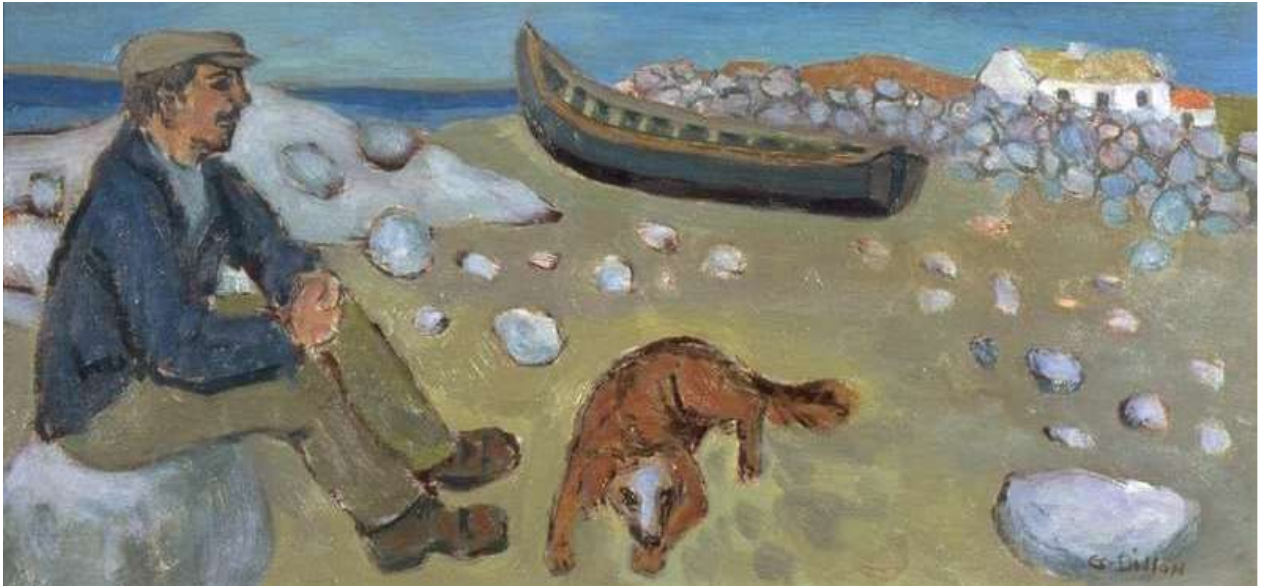
This coastal scene demonstrates Dillon's approach to landscape painting, showing a fisherman with his boat on a rocky shore. Key elements include:
- Composition: Simple, direct arrangement focusing on the relationship between man and sea
- Colour palette: Muted blues and greys of the seascape contrasted with warmer tones of the buildings
- Folk art characteristics: Simplified forms and flattened perspective that emphasise emotional content over realistic representation
Domestic interiors
Dillon excelled at painting intimate domestic scenes that revealed the warmth and humanity of everyday Irish life. These interior paintings often featured families, bedrooms, and household activities, rendered in his characteristic folk art style.
Example
Artwork Analysis: Bedroom Interior
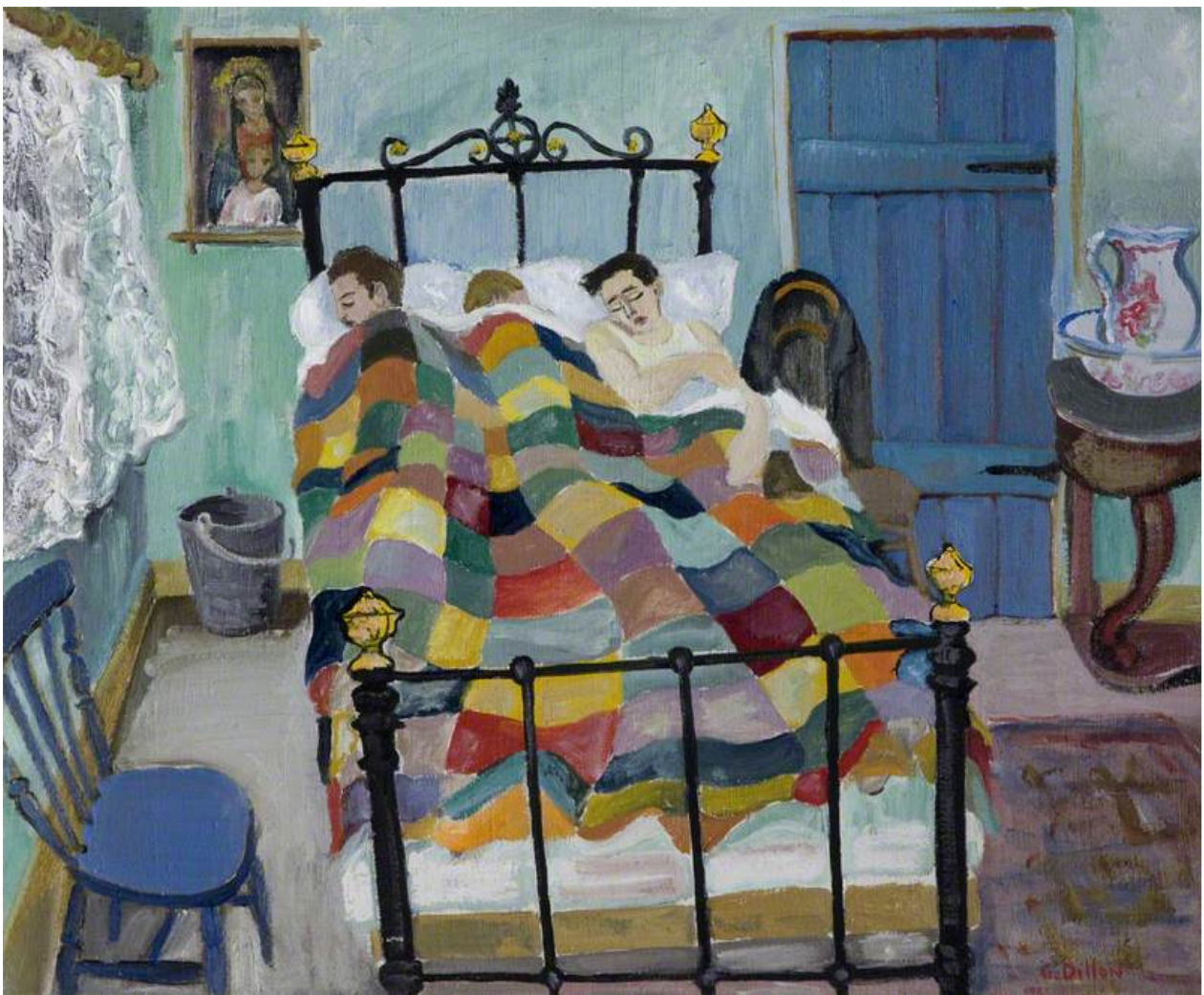
This bedroom scene showcases Dillon's talent for capturing domestic intimacy:
- Central focus: The vibrant patchwork quilt dominates the composition, representing comfort and home
- Religious elements: Sacred imagery reflects the deep Catholic faith of rural Irish communities
- Colour technique: Bold, non-naturalistic colours create emotional rather than realistic atmosphere
Example
Artwork Analysis: Contemplative Figure
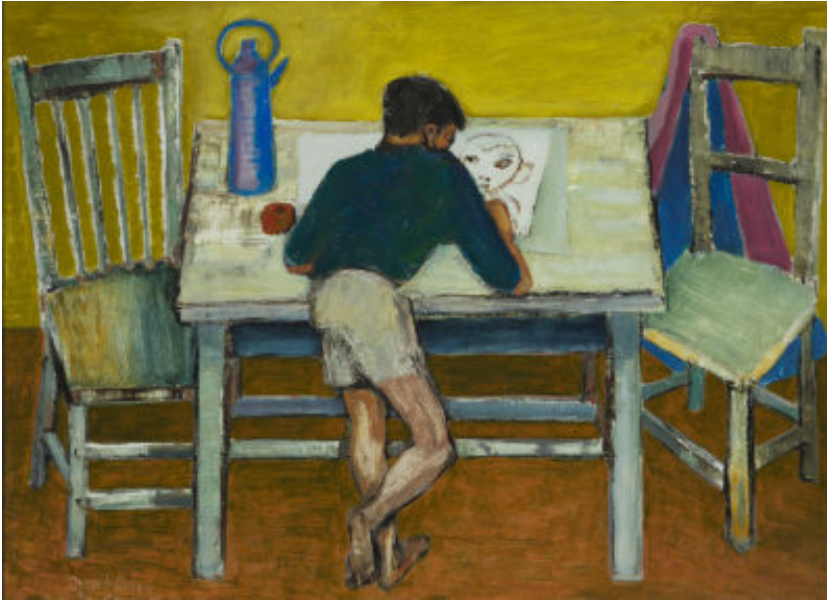
Another example of his domestic work shows a solitary figure resting:
- Emotional mood: Captures quiet, contemplative moments of daily life
- Colour symbolism: Bright yellow walls suggest warmth and security
- Simplified forms: Reduced detail focuses attention on the human element
Professional recognition and exhibitions
Dillon's first major breakthrough came in 1942 when his friend and fellow artist Mainie Jellett opened his first solo exhibition at The Country Shop in Dublin's St. Stephen's Green. The exhibition featured works including "Father, Forgive Them Their Sins," which reflected his concerns about the ongoing war.
Despite growing recognition, financial pressures forced him to return to London in 1944, where he worked on demolition gangs to support himself. However, by the late 1940s and through the 1950s, he was able to focus more fully on his art, particularly favouring the Roundstone area of Connemara.
The year 1958 marked a career highlight when Dillon received the extraordinary honour of representing Ireland at the Guggenheim International exhibition and Great Britain at the Pittsburg International Exhibition - a rare double recognition for any artist.
Key relationships and influences
In 1951, Dillon was introduced to Noreen Rice through her piano teacher. Rice had no formal artistic training but became a significant figure in his life, with both Dillon and George Campbell serving as her mentors for decades. Her work developed a similar surrealistic and primitive style to Dillon's.
Note
Artistic Collaboration and Mentorship The relationship between Dillon, Rice, and Campbell demonstrates how artistic communities formed around shared aesthetic values and mutual support, particularly important for artists working outside mainstream academic traditions.
Dillon and Rice, along with his sister Mollie, shared a property on Abbey Road from 1958. Together, Dillon and Rice would explore junk yards searching for materials like leather and string to incorporate into their artwork - an innovative approach that added texture and found-object elements to their paintings.
Political engagement during the Troubles
As political tensions escalated in Northern Ireland, Dillon took a principled stance regarding his art. In 1969, he withdrew his works from the Belfast section of the Irish Exhibition of Living Art in protest against what he called the "arrogance of the Unionist mob" during the early period of the Troubles.
Important
Art and Political Conscience Dillon's response to the Troubles demonstrates how artists often face difficult decisions about participating in cultural events during times of political conflict. His withdrawal from Belfast exhibitions was both a protest and a sacrifice, as it reduced his exposure and potential sales.
However, he remained committed to supporting his community. When Sheelagh Flanagan organised an exhibition to raise funds for victims of the Belfast riots in October 1969, Dillon donated his work. His painting was displayed alongside contributions from other notable artists including T.P. Flanagan, William Scott, and F.E. McWilliam.
Michael Longley supported Dillon's contribution, stating that "Belfast needed creativity, it needed people like Gerard Dillon" - highlighting the artist's importance to the cultural life of his troubled city.
Later years and artistic evolution
In 1967, Dillon suffered a stroke and spent six weeks in hospital. This health crisis marked a turning point in his artistic development. The awareness of his mortality transformed his work, sending it into what can be described as "another world" - a realm of dreams and paintings that seemed to anticipate his death.
Despite his health challenges, Dillon remained productive. In 1968, he returned to Dublin where he helped design sets and costumes for Seán O'Casey's play "Juno and the Paycock." He continued painting and began creating tapestries, working at his Singer sewing machine.
Note
The expansion into tapestry work in his final years showed Dillon's continued willingness to experiment with new media and techniques, even as his health declined.
During his final years, Dillon was invited to participate in a children's art workshop at the National Gallery of Ireland, demonstrating his commitment to nurturing the next generation of artists.
Death and legacy
Gerard Dillon died of a second stroke on 14 June 1971 at the age of fifty-five. As he had requested, his grave remains unmarked in Belfast's Milltown Cemetery.
His artistic legacy continues through the Danlann Gerard Dillon (The Gerard Dillon Gallery) located in Cultúrlann McAdam Ó Fiaich, which was named in his honour. This gallery ensures that his contribution to Irish art remains visible and celebrated.
Dillon's influence on Irish art extends beyond his individual works. He helped establish a distinctly Irish approach to folk art that captured the essence of rural and domestic life with honesty, warmth, and technical skill. His work provides a valuable record of mid-twentieth century Irish life, seen through the eyes of an artist who understood both its hardships and its beauty.
Summary
Key Points to Remember:
-
Gerard Dillon (1916-1971) was a Belfast-born Irish painter who developed from a working-class decorator into a celebrated folk artist
-
His artistic style combined folk art, naive art, and primitive elements to create emotionally powerful depictions of Irish life, particularly Connemara landscapes and domestic interiors
-
Key career highlights included representing both Ireland and Great Britain in major international exhibitions in 1958, demonstrating his broad recognition
-
Political engagement during the Troubles showed his principled stance - he withdrew from Belfast exhibitions in protest but donated work to support riot victims
-
His legacy continues through the Gerard Dillon Gallery and his influence on Irish art, particularly his authentic portrayal of rural and domestic Irish life through accessible, emotionally resonant folk art techniques