Rita Duffy (Leaving Cert Art): Revision Notes
📚Revision Notes
Rita Duffy
Introduction to Rita Duffy
Rita Duffy is a prominent Northern Irish artist born in 1959, widely recognised as one of the province's leading contemporary artists. She creates powerful works that challenge viewers to think critically about Irish society, politics, and identity. Duffy describes herself as a Republican, pacifist, and feminist, and these three perspectives deeply influence every aspect of her artistic practice.
Her paintings, installations, and projects often focus on socio-political issues, using art as a tool to examine and critique the world around her. Her work can be found in major collections including the Irish Museum of Modern Art and the Imperial War Museum in London, demonstrating her significance in both Irish and international art contexts.
Note
Rita Duffy's unique position as both an insider and critic of Irish society allows her to create works that are both deeply personal and universally relevant, making her one of the most important voices in contemporary Irish art.
Background and early influences
Rita Duffy was born in Belfast in 1959 to a Catholic family, growing up in the Protestant neighbourhood of Stranmillis during one of the most turbulent periods in Northern Irish history. Her childhood and teenage years were shaped by The Troubles of the 1970s, a conflict that would profoundly influence her artistic vision and subject matter.
This unique perspective of being a Catholic child in a Protestant area during intense sectarian conflict gave Duffy firsthand experience of the complexities, contradictions, and human cost of the Northern Irish situation. During her college years, she preferred creating socially engaged, figurative paintings rather than abstract work. She also spent time in New York City during holidays, where she drew street portraits, expanding her understanding of different cultures and social dynamics.
Important
Duffy's childhood experience of living as a Catholic minority in a Protestant neighbourhood during The Troubles provided her with a unique dual perspective that would become central to her artistic voice and political commentary.
Artistic style and approach
Duffy's artistic style combines several key elements that make her work instantly recognisable and deeply impactful. She uses irony, wit, and humour as powerful tools to examine Irish history and politics, believing that these approaches can often communicate difficult truths more effectively than serious, direct commentary.
Her work is significantly influenced by surrealism and magic realism, artistic movements that blend realistic imagery with fantastical or dreamlike elements. This influence allows her to create paintings that feel both familiar and unsettling, forcing viewers to see everyday situations from new and often uncomfortable perspectives.
Note
By combining humour with serious political commentary, Duffy follows in the tradition of satirical artists like Francisco Goya and George Grosz, who used wit and irony to critique the social and political conditions of their time.
Key works and themes
Political satire and social critique
Example
Artwork Analysis: Political Satire Through Visual Metaphor
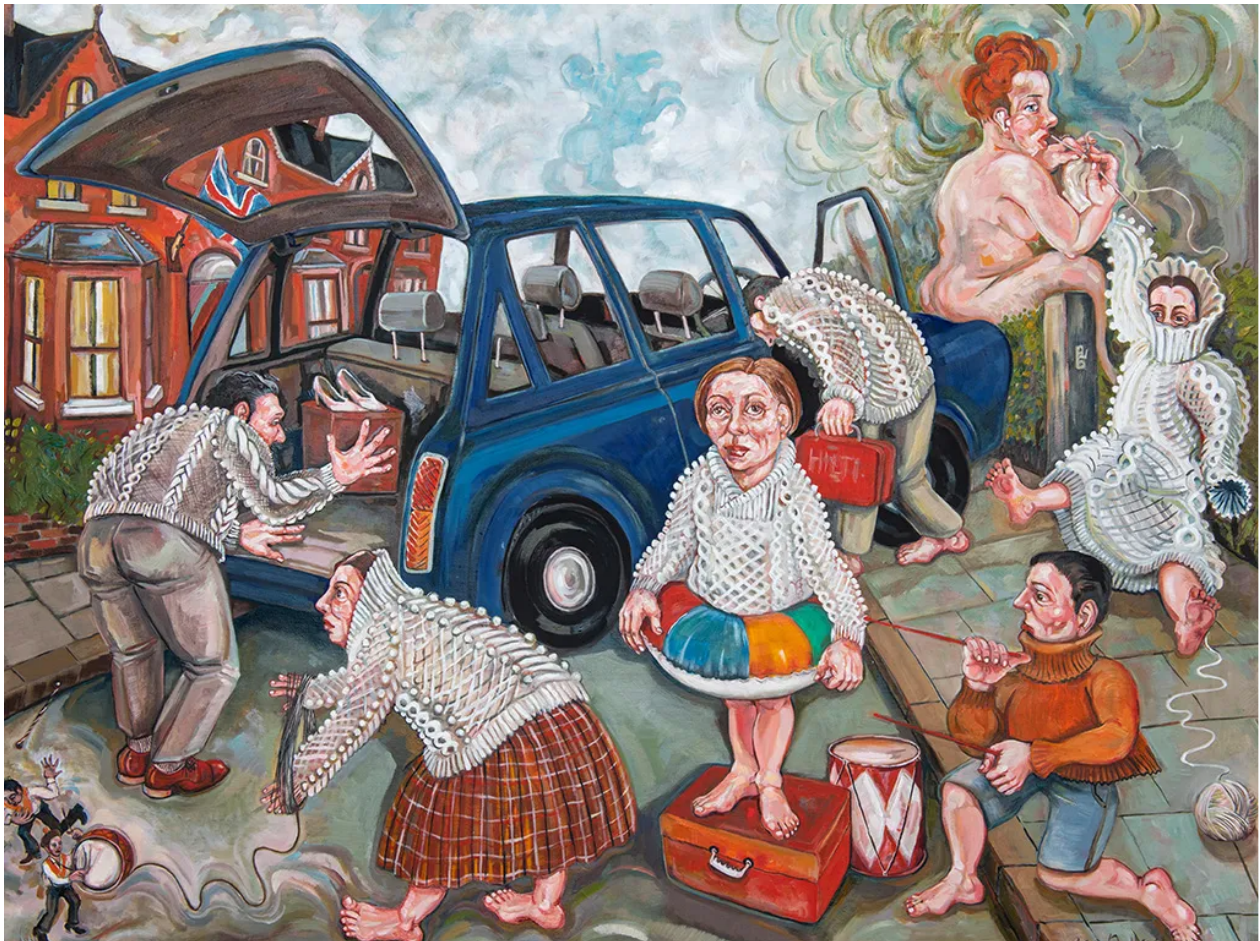
This satirical painting demonstrates Duffy's masterful use of political satire. The chaotic scene centres around a blue vehicle with figures wearing sheep-like costumes, creating a surreal atmosphere that immediately captures attention. The presence of the Union Jack flag in the background and the grotesque, caricature-like style typical of political cartoons shows how Duffy uses visual metaphor to comment on British politics and social issues.
The sheep costumes are particularly significant - they suggest themes of conformity, following without question, or being led blindly. This type of symbolism allows Duffy to make sharp political points while maintaining the dark humour that characterises much of her work.
Religious institution critique
Example
Artwork Analysis: Institutional Power and Corruption
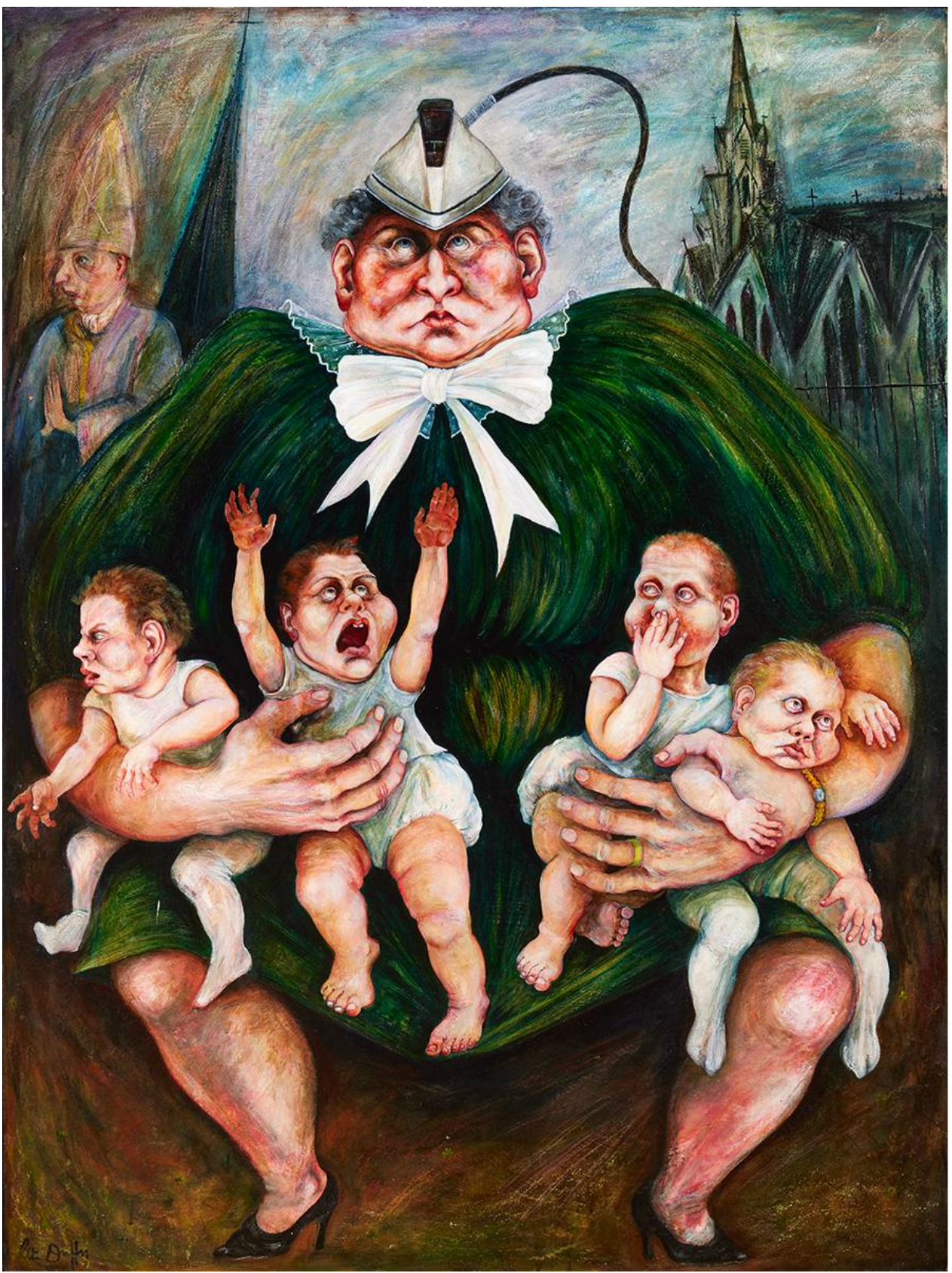
This powerful painting shows Duffy's willingness to tackle difficult and controversial subjects, particularly the role of religious institutions in Irish society. The work depicts a religious figure in green robes and bishop's mitre, painted in an expressionist style with exaggerated, grotesque features. The presence of distressed children in the composition, set against a Gothic cathedral background, suggests a critique of institutional corruption and abuse of power within religious organisations.
The expressionist style - with its dramatic brushwork and distorted features - helps communicate the emotional intensity and moral outrage that drives this work. Duffy's use of earthy tones and symbolic imagery creates a piece that functions as serious social commentary while maintaining her characteristic artistic sophistication.
Performance and spectacle
Example
Artwork Analysis: Performance and Public Spectacle
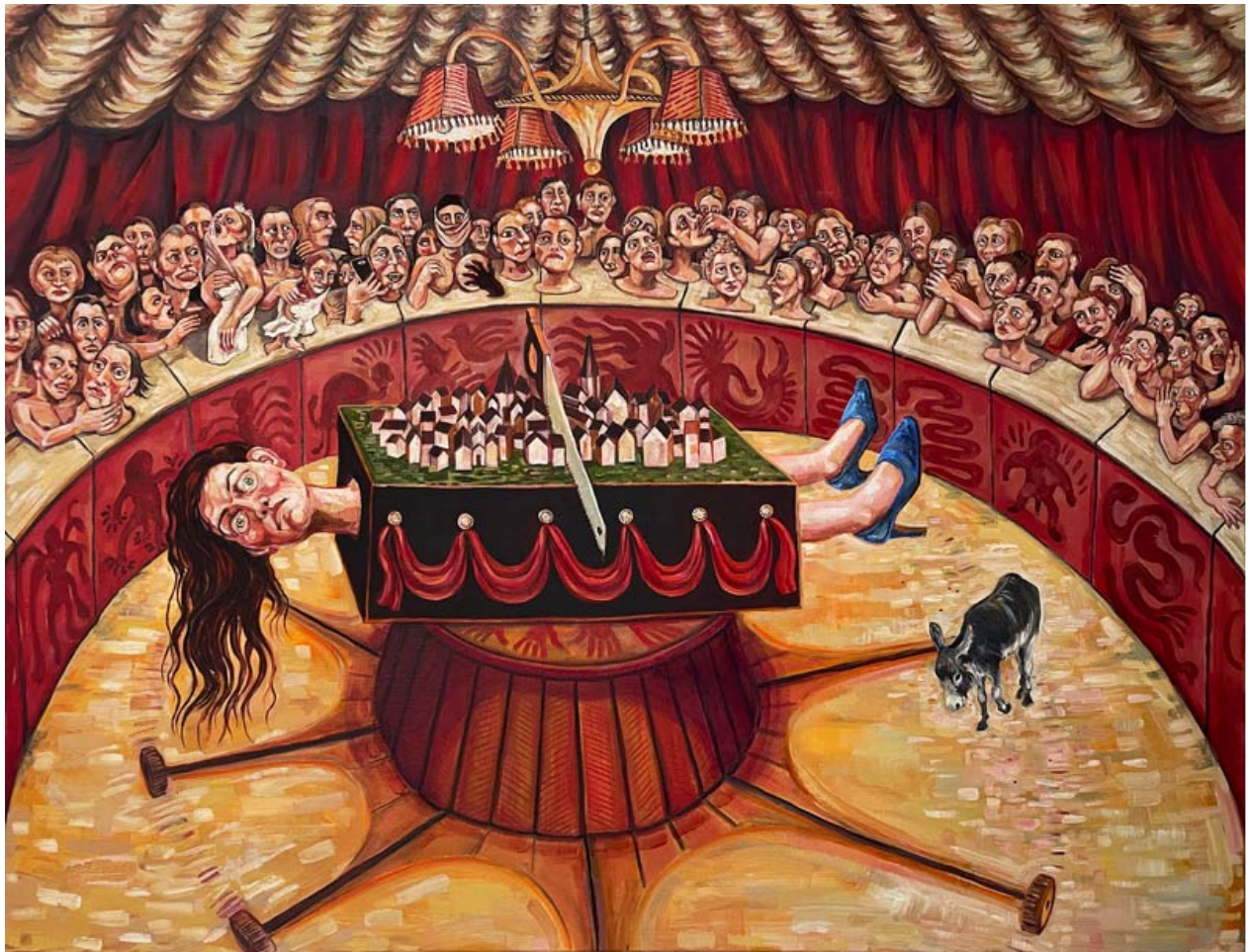
This theatrical scene shows another dimension of Duffy's work - her interest in performance, spectacle, and the relationship between audience and performer. The vintage circus setting depicts a classic magic trick (sawing a person in half) taking place in an ornate venue filled with engaged spectators.
The rich red and gold colour palette creates a sense of luxury and drama, while the folk art style gives the scene a slightly surreal, timeless quality. This work demonstrates how Duffy can explore themes of performance, illusion, and public spectacle - concepts that often relate to her broader interests in politics and social theatre.
Major projects and exhibitions
The iceberg proposal (2005)
In 2005, Duffy gained widespread attention for her ambitious proposal to tow an iceberg from Greenland to Belfast. This conceptual project was designed to represent the city's connections to the RMS Titanic disaster while highlighting what she saw as the "frosty impasse" of Northern Irish politics at the time. The project demonstrated her ability to create meaningful art that operates on multiple levels - historical, political, and symbolic.
Note
The iceberg proposal exemplifies Duffy's approach to conceptual art, where the idea itself becomes as important as any physical artwork, creating discussion and debate about both historical memory and contemporary politics.
The shirt factory project
During Derry's year as UK City of Culture, Duffy created the innovative "Shirt Factory Project", employing four people in a venture that functioned simultaneously as gallery space, museum, and shop. This project exemplified her interest in breaking down traditional boundaries between art, commerce, and social engagement.
The souvenir shop (2016)
On 24 April 2016, marking the centenary of the Easter Rising, Duffy opened an exhibition called "The Souvenir Shop" in a Georgian mansion on North Great George's Street, Dublin. This exhibition examined Irish identity through the lens of commercial culture and tourism, questioning how national identity gets packaged and sold.
Recognition and current practice
Duffy's significance as an artist has been widely recognised. She was described in 2005 as the province's "foremost artist", and her work is held in several major public collections, including the Irish Museum of Modern Art and the Imperial War Museum in London.
She continues to work from her studio in Ballyconnell, County Cavan, in the Irish Republic, just south of the border with Northern Ireland. This location is symbolically important - it allows her to maintain connections to both parts of Ireland while providing the perspective that comes from being slightly removed from the immediate political situation.
Summary
Key Points to Remember:
- Rita Duffy is a leading Northern Irish artist who uses satirical painting to examine politics and society
- Her work is shaped by three key identity markers: Republican, pacifist, and feminist perspectives
- She grew up as a Catholic in a Protestant neighbourhood during The Troubles, giving her unique insights into sectarian conflict
- Her artistic style combines irony, wit, and humour with influences from surrealism and magic realism
- She creates works that critique political institutions, religious power, and social conformity through powerful visual metaphors and grotesque imagery