Pre-Christian (c. 4,000 BCE – 500 CE) (Leaving Cert Art): Revision Notes
📚Revision Notes
The Iron Age: Celtic Art (c. 500 BC-400 AD)
Introduction and historical context
The Iron Age in Ireland marked a revolutionary period in art and culture. Around 700 BC, Celtic tribes began arriving in Ireland, bringing with them advanced iron technology and sophisticated artistic traditions. These Celtic peoples, known to the Greeks and Romans as skilled warriors, craftsmen, and metalworkers, would profoundly shape Irish art and culture for centuries to come.
The Celts were not a single unified group but rather a collection of tribes that shared similar languages, customs, and artistic styles. By the 3rd century BC, they had established themselves throughout much of Northern Europe, with Ireland becoming one of their most important strongholds. The arrival of iron technology revolutionised both warfare and daily life, allowing for stronger weapons, better tools, and more sophisticated craftsmanship.
Note
Celtic society valued skilled craftsmanship highly, with metalworkers holding positions of great respect and status. These artisans were often associated with magical powers, reflecting the deep spiritual significance attributed to their creations.
The La Tène style and Celtic artistic tradition
The distinctive Celtic art style that developed during this period is known as La Tène, named after an archaeological site on Lake Neuchâtel in Switzerland where important examples were first discovered. This style represented a remarkable fusion of influences from classical Greek and Roman art, Etruscan traditions, Scythian decorative techniques, and Oriental artistic elements, all blended with distinctly Celtic sensibilities.
Note
What is La Tène Style?
La Tène art combined influences from classical Greek and Roman art, the Etruscans, the Scythians and Oriental art with the Celtic style. This created a distinctive flowing, organic quality that avoided rigid geometric patterns in favour of more naturalistic forms that seemed to grow and move across the surface of objects.
La Tène art is characterised by its flowing, organic quality and sophisticated use of curved lines. The style avoided rigid geometric patterns in favour of more naturalistic forms that seemed to grow and move across the surface of objects. This created a sense of energy and vitality that distinguished Celtic art from the more static traditions of their Mediterranean neighbours.
Key characteristics of La Tène style
The La Tène style incorporated several distinctive design elements that can be seen in the chart below:
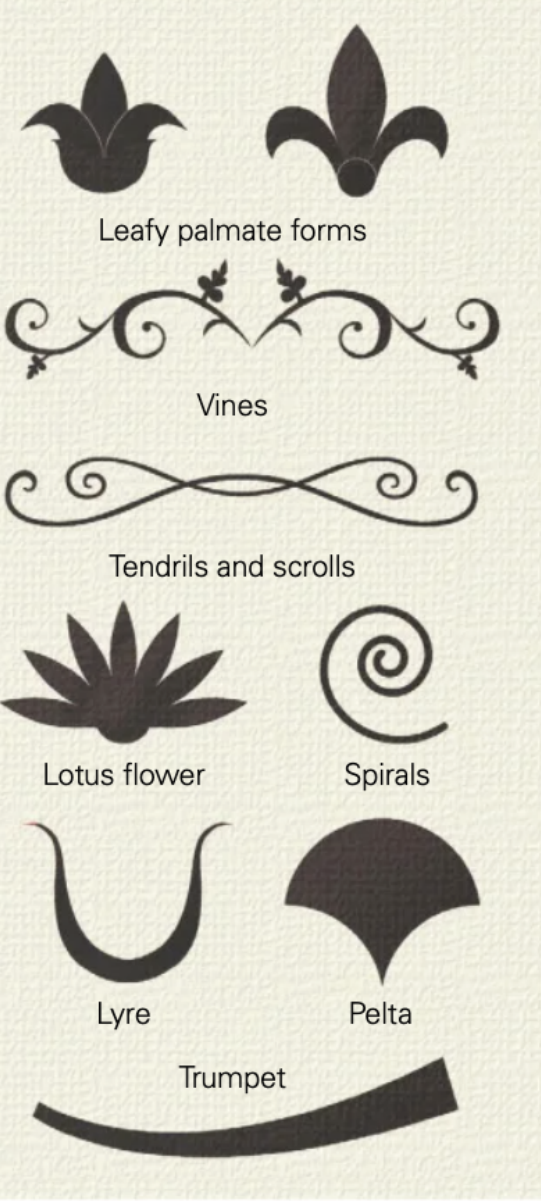
- Leafy palmate forms: Stylised plant motifs that resembled hands or leaves with finger-like projections
- Vine scrolls and tendrils: Flowing plant-based designs that curved gracefully across surfaces
- Trumpet shapes: Distinctive curved forms that resembled musical instruments
- Spirals and triskeles: Geometric patterns based on curved lines and three-armed spiral motifs
- Zoomorphic elements: Stylised animal forms, often highly abstract and integrated into decorative patterns
Materials and metalworking techniques
Celtic artisans mastered sophisticated techniques across multiple materials, demonstrating remarkable skill and innovation in their craftsmanship.
Bronze working and the lost wax technique
Bronze remained an important material throughout the Iron Age, particularly for decorative items such as horse trappings, tools, utensils, brooches, armbands, and rings. Celtic metalworkers employed the lost wax casting method, a sophisticated technique that allowed for the creation of complex, detailed objects.
Note
The Lost Wax Casting Process
The lost wax process involved several careful steps: craftsmen first created detailed wax models of their intended objects, then enclosed these wax forms in clay moulds. When the clay was fired, the wax melted away, leaving a hollow space that perfectly matched the original model. Molten bronze was then poured into this space, creating an exact replica of the wax original.
Iron technology and tools
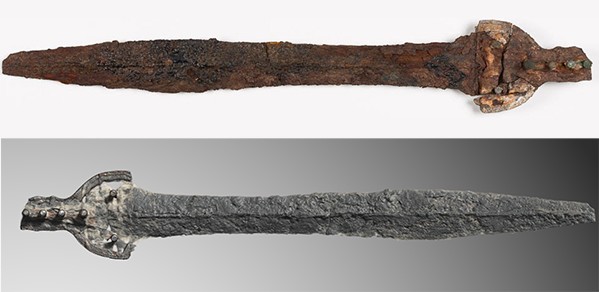
The introduction of iron technology transformed Irish society. Iron was more readily available than bronze and could be worked into stronger, more durable tools and weapons. Archaeological evidence shows that Celtic smiths quickly mastered iron working techniques, producing everything from simple domestic implements to elaborate decorated weapons.
Gold working and precious objects
Celtic artisans also worked extensively with gold, creating some of the most spectacular objects of the period. Gold was particularly valued for its beauty, durability, and symbolic associations with the divine and eternal.

Important
Chasing Technique
Chasing was a key technique used in goldworking. This process involved creating raised designs by hammering from the reverse side of the metal, pushing the decoration forwards into relief. The surrounding areas were then pressed back using specialised tools, creating contrast and depth in the finished piece.
Architectural achievements: ring forts and stone structures
Celtic society developed distinctive architectural forms that reflected both practical defensive needs and sophisticated engineering skills. The most characteristic of these were the ring forts, circular stone enclosures that served as both defensive structures and symbols of status.
Dún Aengus
One of the most impressive examples of Celtic Iron Age architecture is Dún Aengus on the Aran Islands. This enormous promontory fort demonstrates the sophisticated understanding of defensive architecture possessed by Celtic builders.
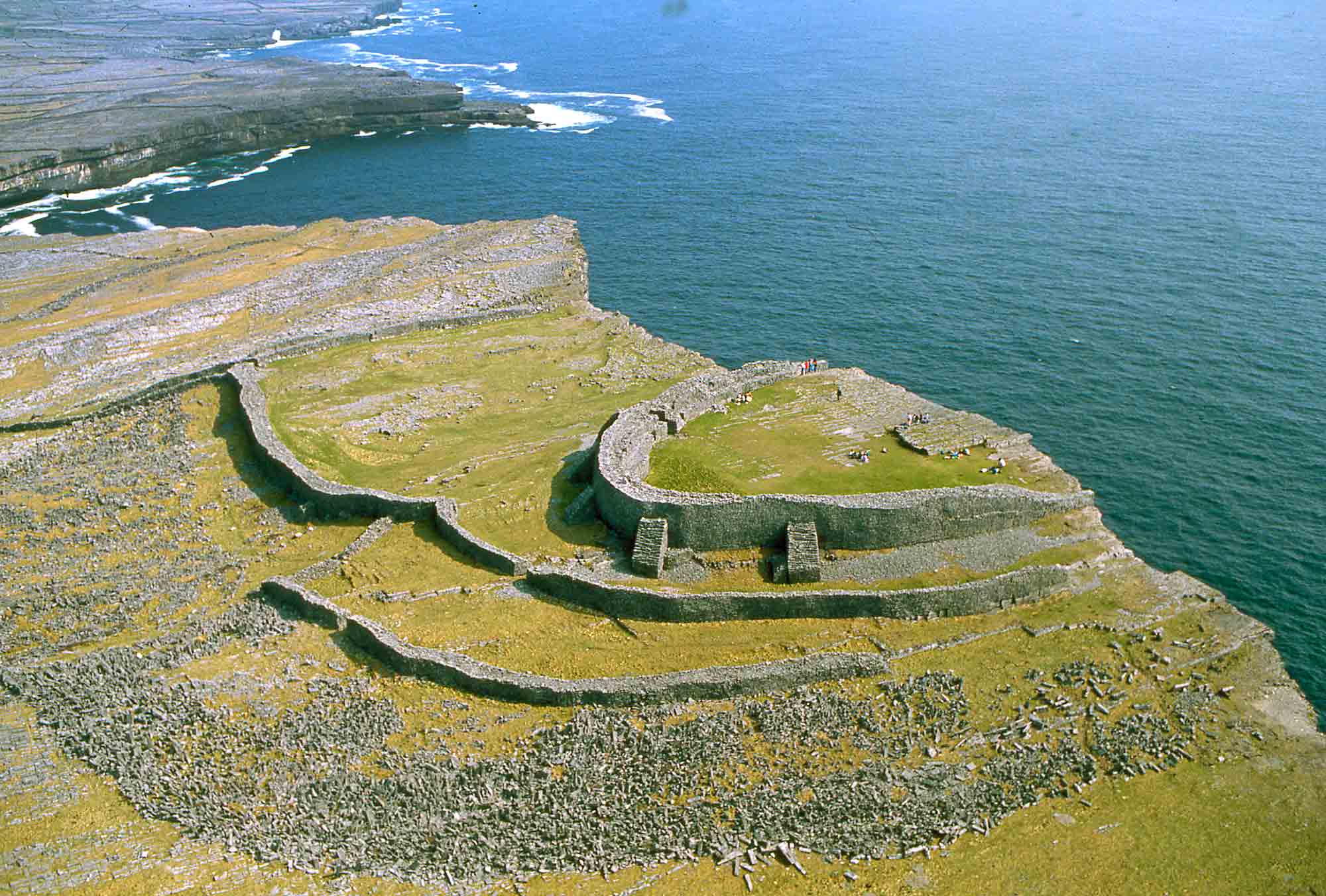
The fort features three walls curving around the clifftop, creating concentric defensive enclosures. The innermost wall stands 5 metres tall and up to 6 metres thick in places, enclosing an area approximately 50 metres by 100 metres. Inside these walls, flights of stairs lead up to defensive ramparts, while a second lower wall and an area of chevaux-de-frise (upright spikes set in the ground as a defence against cavalry attacks) provide additional protection.
Note
Archaeological work has revealed clear defensive features, and the site provides evidence of continuous occupation from the late Bronze Age through the Iron Age and into mediaeval times. The construction required enormous organisational skills and community effort, indicating the importance of such sites in Celtic society.
Stone carving and monumental art
Celtic artisans also excelled at stone carving, creating monuments that combined artistic sophistication with probable ritual or ceremonial functions.
The Turoe Stone
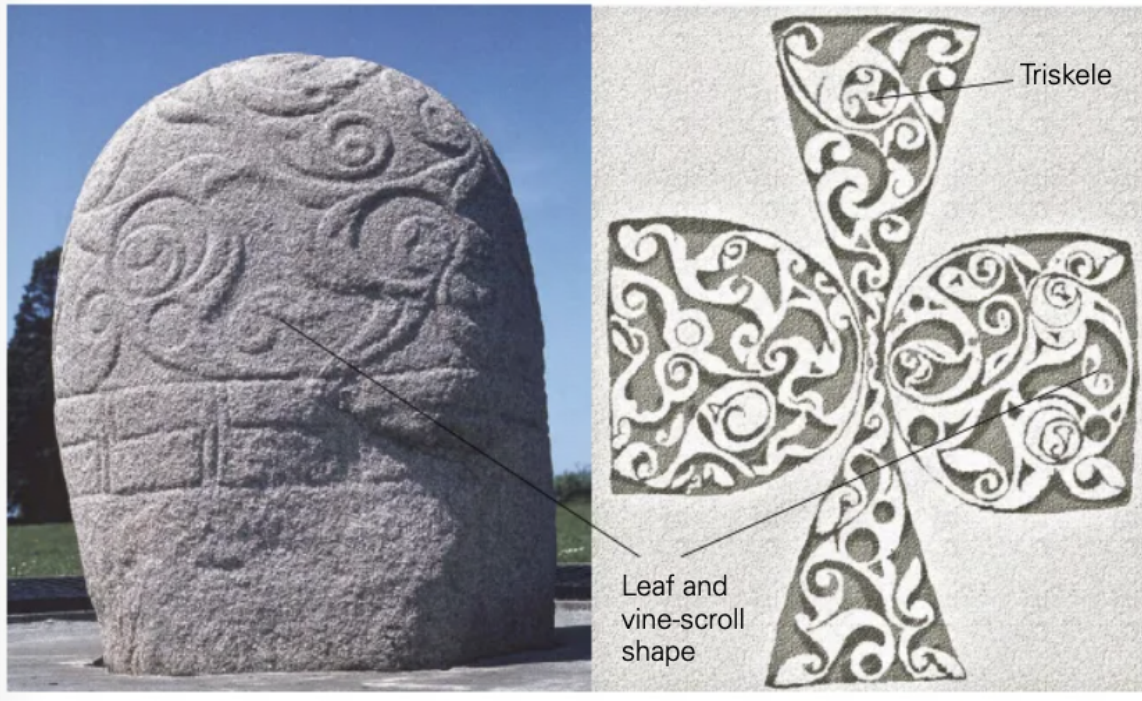
The Turoe Stone, dating to about 50 BC, represents one of the finest examples of Celtic stone carving in Ireland. This four-ton granite boulder, standing 1.68 metres tall, is carved with intricate La Tène style decorations that demonstrate the high level of skill achieved by Celtic stone carvers.

The stone's decoration consists of flowing abstract patterns that cover most of its surface. The design includes four segments, with two semi-circular areas and two triangular areas of pattern. Between these main design areas are two smaller triangular segments that connect over the top of the stone, creating a unified composition.
Example
Analysing the Turoe Stone Design
The patterns themselves feature characteristic La Tène elements:
- Flowing vine-like forms that create movement across the surface
- Trumpet ends that terminate design elements
- Spirals that draw the eye in circular motions
- A triskele appears near the triangular segments
- Sophisticated understanding of positive and negative space creates visual balance
Stone figures and symbolic carvings
Celtic stone carvers also created figurative works that suggest the importance of human representation in their artistic and religious traditions. These carvings often featured stylised human forms and faces that may have served ritual or ceremonial purposes.

Masterworks of metalworking
The Irish Iron Age produced several outstanding examples of metalwork that showcase the pinnacle of Celtic artistic achievement.
The Broighter Hoard
The Broighter Hoard, discovered in County Londonderry, represents one of the most important collections of Celtic goldwork ever found. This treasure includes a range of objects that demonstrate the sophistication of Celtic craftsmanship.
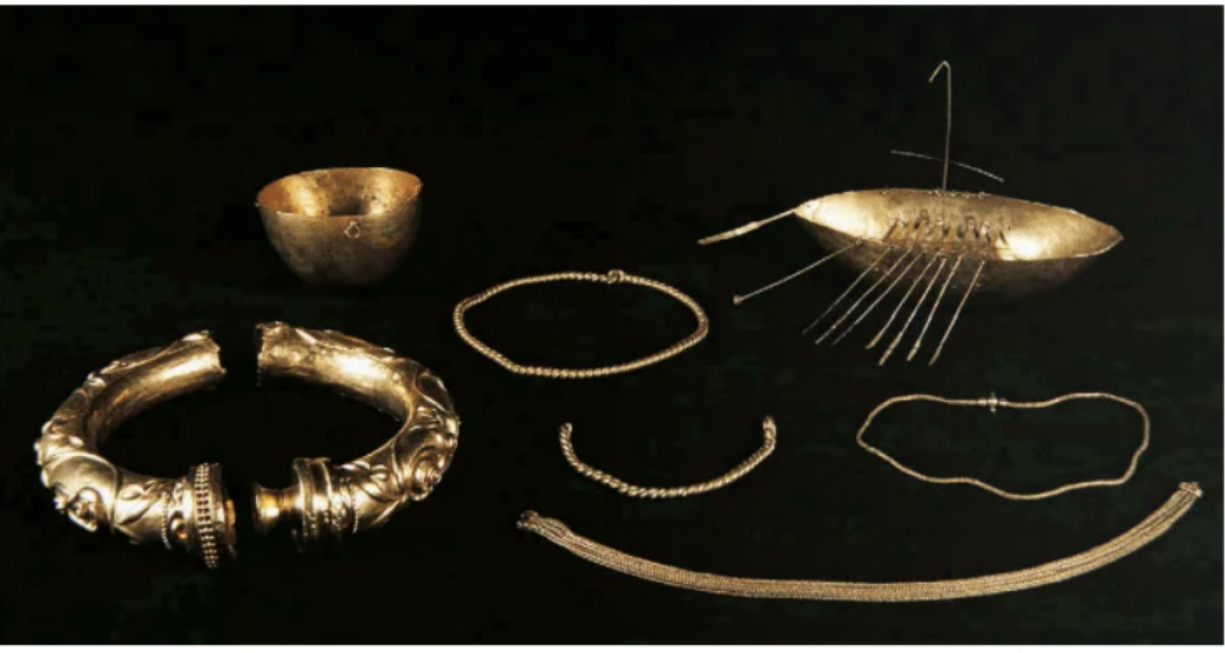
The Broighter Collar (c. 50 BC)
The Broighter Collar represents one of the most accomplished pieces of Celtic metalwork ever discovered. This extraordinary neck ornament was created using sheet gold and demonstrates mastery of several advanced techniques.
Example
Technical Achievement of the Broighter Collar
The collar's construction demonstrates remarkable skill:
Step 1: Basic Construction
- Two tubes of sheet gold joined together
- Knob mechanism allowing the collar to open and close
Step 2: Surface Decoration
- Intricate chased patterns featuring characteristic La Tène motifs
- Perfect symmetry with interconnecting S-curves
- Geometric patterns flowing around the collar's circumference
Step 3: Final Details
- Flat areas between raised patterns incised with compass arcs
- Patterned gold background areas incised for visual separation
- Buffer terminals crafted as decorative bosses
- Rows of beading along joints for structure and decoration
The collar consists of two tubes of sheet gold joined together with a knob mechanism that allowed it to be opened and closed. The surface is decorated with intricate chased patterns featuring characteristic La Tène motifs. The design shows perfect symmetry, with interconnecting S-curves creating geometric patterns that flow around the collar's circumference.
The Loughnashade Trumpet
The Loughnashade Trumpet, discovered in County Antrim and dating to the 1st century AD, represents another masterpiece of Celtic metalwork. This ceremonial instrument was created from sheet bronze using sophisticated forming and joining techniques.
The trumpet consists of two bronze tubes joined together with a knob mechanism. Its end plate features elaborate decoration including vine scrolls and elaborate pelta shapes (shield-like curved forms). The decoration follows characteristic La Tène principles, with flowing organic patterns that seem to grow across the surface.
Note
The trumpet's function was probably ceremonial rather than purely musical. Such instruments may have been used in religious ceremonies, for communication during warfare, or as symbols of authority and status.
The Petrie Crown
The Petrie Crown, dating to the 1st century AD, demonstrates the continuation of Celtic artistic traditions and their evolution towards more complex symbolic systems. This unique object consists of an openwork band with a cone and two discs attached to it.
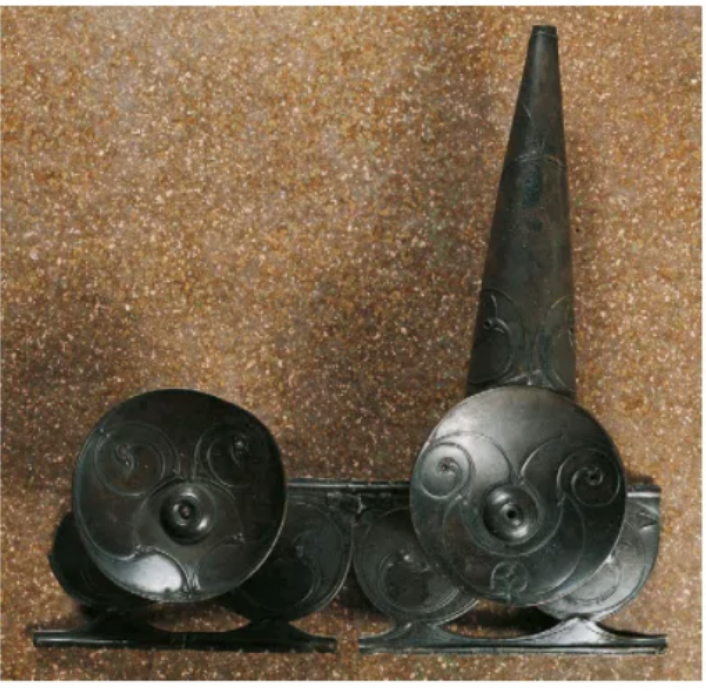
The crown's decoration features spirals ending in bird heads, showing the continued importance of zoomorphic elements in Celtic art. All parts are decorated with characteristic spiral patterns, but the design shows influences from the developing Ultimate La Tène style, with more geometric organisation than earlier examples.
Important
The crown's function remains mysterious - it may have been an actual crown, but could equally have been sewn onto fabric or leather, or fixed to wood or metal. This uncertainty reflects the complex ritual and ceremonial life of Celtic society, where objects often served multiple symbolic purposes.
Evolution of style: from early to ultimate La Tène
Celtic art in Ireland underwent significant development during the Iron Age, evolving from the early flowing forms to more structured and geometric designs.
Early La Tène characteristics
Early La Tène art in Ireland, known as Insular La Tène, maintained strong connections to continental European styles while developing distinctively Irish characteristics. This style featured:
- Flowing, organic forms based on plant motifs
- Emphasis on curved lines and asymmetrical compositions
- Integration of classical influences with Celtic sensibilities
- Complex interwoven patterns that seemed to grow naturally
Ultimate La Tène development
By the late Iron Age, around the turn of the first millennium, Celtic art had evolved into what scholars term Ultimate La Tène style. This represented a significant shift towards:
- More delicate and refined execution
- Increased symmetrical organisation
- Greater emphasis on geometric patterns
- Plant-based designs giving way to more abstract forms
- More sophisticated use of positive and negative space
Note
This evolution reflects the maturation of Celtic artistic traditions and possibly the influence of changing social and political conditions as Ireland moved towards the early Christian period.
Design elements and symbolic meaning
Celtic art incorporated a rich vocabulary of symbolic elements, each carrying cultural and possibly religious significance.
Plant-based motifs
Celtic artists drew extensively from the natural world, creating stylised representations of:
- Vine scrolls: Flowing patterns that suggested growth and vitality
- Leafy palmate forms: Hand-like leaf shapes that may have symbolised protection or blessing
- Lotus flowers: Borrowed from classical traditions, these may have represented rebirth or purity
- Tendrils and scrolls: Delicate curving forms that added movement and grace to compositions
Geometric patterns
Geometric elements provided structure and symbolic meaning:
- Spirals: Perhaps the most characteristic Celtic motif, spirals may have represented the cycle of life, death, and rebirth
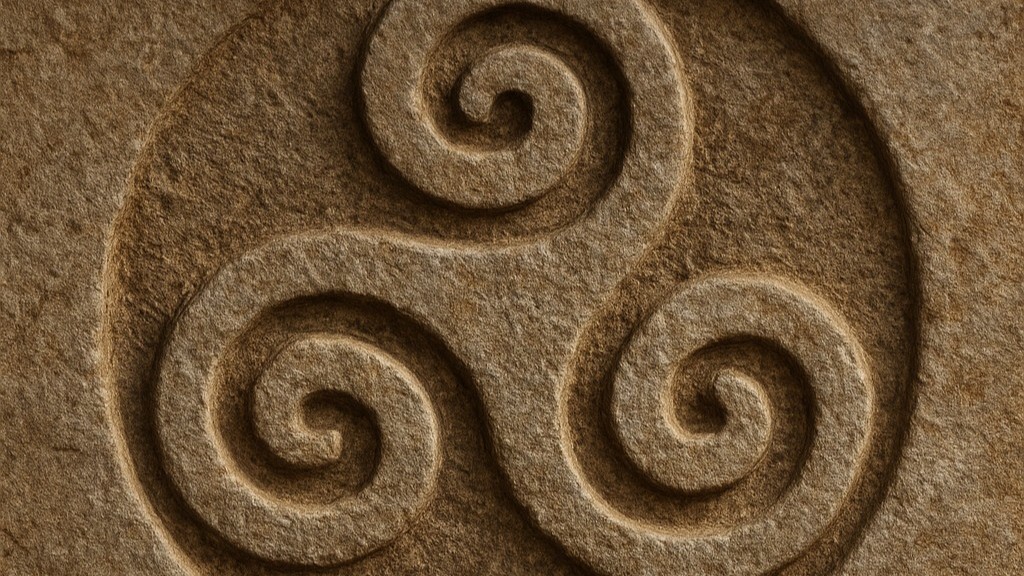
- Triskeles: Three-armed spiral patterns that could symbolise various trinities important in Celtic belief
- Lyre shapes: Musical instrument forms that may have referenced the importance of music and poetry in Celtic culture
- Pelta forms: Shield-like shapes that could represent protection or warrior status
Important
Understanding the Triskele
A triskele is a motif of three curved lines that spring from the same point and turn in the same direction. This symbol appears frequently in Celtic art and may have represented important trinity concepts in Celtic belief systems.
Zoomorphic elements
Animal forms, though often highly stylised, remained important in Celtic art:
- Bird heads: Often appeared as terminal decorations, possibly representing messengers between worlds
- Stylised creatures: Abstract animal forms that maintained recognisable characteristics while serving decorative functions
- Transformation motifs: Designs where plant forms gradually became animal forms, suggesting the fluid boundaries between different aspects of nature
Legacy and transition
The Celtic artistic tradition established during the Iron Age provided crucial foundations for subsequent developments in Irish art. As Christianity arrived in the 5th century AD, many Celtic artistic traditions were adapted and incorporated into Christian contexts.
The sophisticated metalworking techniques, understanding of decorative composition, and symbolic vocabulary developed during the Iron Age would later influence the creation of masterpieces like the Ardagh Chalice and the Book of Kells. The ring fort architectural traditions continued into the early mediaeval period, while the stone carving techniques established during the Iron Age would eventually be applied to high crosses and other Christian monuments.
Note
Celtic design principles - the emphasis on flowing organic forms, sophisticated use of interwoven patterns, and symbolic integration of natural and geometric elements - became fundamental characteristics of Irish artistic identity that continue to influence Irish art to the present day.
Summary
Key Points to Remember:
- La Tène style combined Celtic traditions with classical influences, creating flowing organic art characterised by spirals, plant forms, and sophisticated metalwork
- Advanced techniques like lost wax casting and chasing allowed Celtic artisans to create extraordinarily sophisticated objects in bronze, iron, and gold
- Key monuments like the Turoe Stone, Dún Aengus, and the Broighter Collar demonstrate the high level of artistic achievement reached during this period
- Symbolic vocabulary included spirals, triskeles, plant motifs, and stylised animal forms that carried deep cultural and possibly religious meaning
- Artistic evolution moved from early flowing forms to Ultimate La Tène's more geometric and symmetrical designs, providing foundations for later Irish Christian art