The Stone Age (c. 4000-2000 BC) (Leaving Cert Art): Revision Notes
📚Revision Notes
The Stone Age (c. 4000-2000 BC)
Introduction to the Stone Age period
The Stone Age in Ireland, also known as the Neolithic period, lasted from approximately 3700 to 2000 BC. This era marked a revolutionary time when the first farmers arrived in Ireland, bringing with them new technologies, artistic traditions, and monumental building techniques that would lay the foundation for all future developments in Irish culture.
Important
These early settlers were remarkable innovators who had to create everything from scratch. Every tool, design technique, and construction method had to be developed without any existing examples to follow. Their achievements were truly groundbreaking, as they established the first permanent communities and created some of Europe's most impressive ancient monuments.
Tools and technology
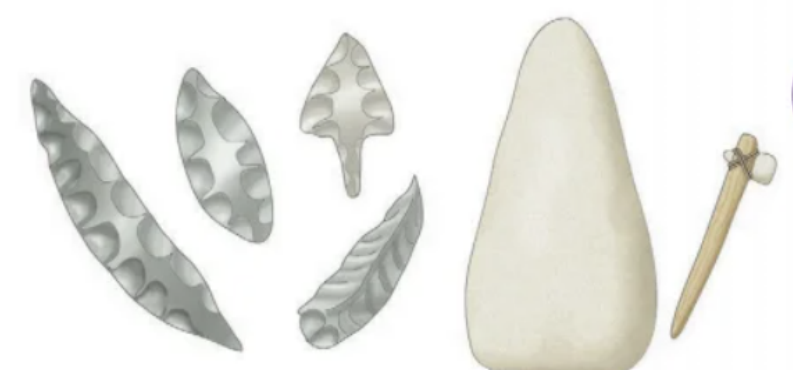
Stone Age people developed an impressive range of tools and weapons using the materials available to them. They became skilled craftspeople, working with stone, wood, bone, and later, clay to create functional and decorative objects.
Note
The sophistication of Stone Age tool-making demonstrates that these early people possessed advanced technical knowledge and problem-solving abilities. Each tool represented countless hours of experimentation and refinement of techniques.
Stone working techniques
Chip carving was a fundamental technique where lines and patterns were created by cutting into stone surfaces with sharp flint or obsidian edges. This method could also involve picking or pecking with a stone chisel or point driven by a hammer stone. The technique was used to create decorative relief patterns on important stones.
Smoothing involved finishing stone surfaces by hammering or rubbing with rough textured stones. The entrance stones at Newgrange show evidence of this careful finishing work, where lines were smoothed and deepened through patient craftsmanship.
Stone dressing was practised at sites like Knowth and Newgrange, where most stones were carefully shaped and finished. Rough areas were smoothed, and a thin layer of stone was often removed with sharp flint tools to create uniform surfaces for decoration.
Pottery and domestic life
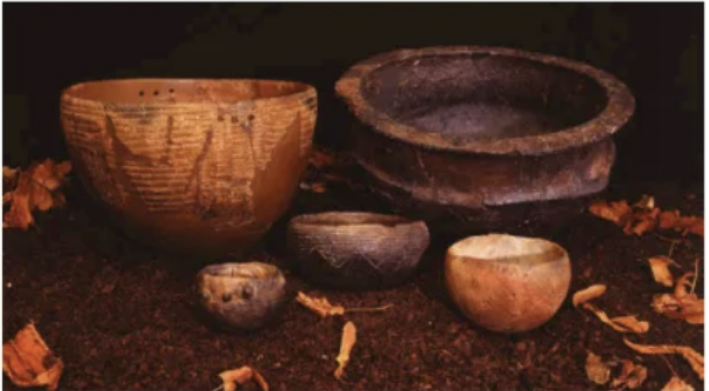
Clay was shaped by hand and built into various forms of simple pottery, which were then heated in open fires to create durable ceramics. These vessels served practical purposes for storing food, water, and other materials.
Houses
Domestic buildings during this period were typically round structures built with stone, wood, and mud, featuring thatched roofs. These homes represented a major shift towards permanent settlement, as people moved away from the nomadic lifestyle of earlier periods.
Note
The construction of these houses required considerable skill and planning. Large stones for structural elements would have been moved using dragging and levering techniques, possibly with logs serving as rollers to ease transportation. The engineering knowledge required for these buildings was substantial, especially considering that beasts of burden and wheeled transport were not yet available.
Art elements and design principles
Stone Age designs demonstrate sophisticated artistic understanding, combining both practical and symbolic elements. The art can be organised into distinct categories based on the types of lines and shapes used.
Design categories
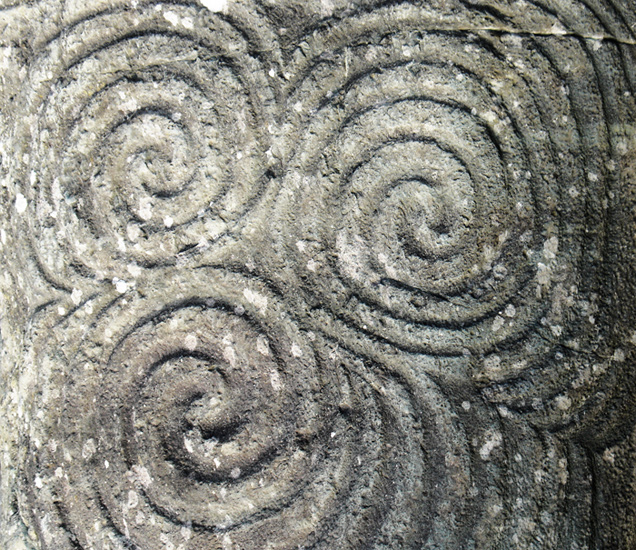
Curved line designs include concentric circles, spirals, arcs, and serpentine (snake-like) patterns. These flowing forms dominate Stone Age art and may have held special symbolic meaning.
Straight line designs feature chevrons (V-shaped patterns), lozenges (diamond shapes), radials (lines radiating from a central point), parallel lines, and various offset patterns.
Example
Design Pattern Analysis:
Curved Patterns:
- Concentric circles → possibly representing cycles or spiritual journeys
- Spirals → may symbolise growth, time, or cosmic movement
- Serpentine lines → could represent water, rivers, or life energy
Straight Patterns:
- Chevrons → might indicate direction or movement
- Lozenges → could represent agricultural fields or territorial boundaries
- Radial lines → possibly sun symbols or energy radiating from a centre
All these designs were created using freehand drawing techniques. While the shapes appear abstract, they likely held significant meaning for the people who created them, possibly relating to spiritual beliefs, seasonal cycles, or community identity.
Burial structures and monuments
The Stone Age period is famous for its impressive burial monuments, which represent some of the earliest large-scale architecture in Ireland. These structures served both practical and ceremonial purposes, demonstrating the sophisticated engineering skills and spiritual beliefs of their builders.
Dolmens
Dolmens are the simplest form of megalithic (large stone) structures. The term comes from the Greek words meaning "large" and "stone." These monuments were identified as tombs because archaeologists discovered human remains from both burials and cremations within them.

Important
Dolmens typically consist of three to seven large stone legs supporting one or two enormous capstones. The entrance usually faces south or south-east, and there are approximately 170 portal dolmens throughout Ireland. These structures represent remarkable engineering achievements, as the capstones often weigh several tonnes and required sophisticated lifting and positioning techniques.
Court cairns
Court cairns were designed as places where ceremonies and rituals might have taken place. These structures feature a covered chamber inside a mound or cairn of stones, accessed through upright stone slabs and lintels that create "doorways" between different spaces.
The most distinctive feature is the open court area in front of the burial chamber, which provided space for ceremonial gatherings. These monuments demonstrate early understanding of creating formal entrance sequences and ceremonial spaces within architectural designs.
Passage mounds (graves)
Passage mounds represent the most sophisticated burial monuments of the Stone Age period. These structures consist of long stone passages leading to internal burial chambers, all covered by massive earthen mounds.
There is a notable concentration of these monuments in County Meath, particularly around Brú na Bóinne (the Boyne Valley), which contains some of the most famous examples in Ireland.

Major sites
Newgrange (c. 3200 BC)
Newgrange is perhaps Ireland's most famous prehistoric monument, built around 3200 BC and extensively reconstructed between 1967 and 1975. This massive structure demonstrates extraordinary engineering and astronomical knowledge.
The monument is famous for its "roof box" - a specially designed opening above the entrance that allows sunlight to penetrate the passage and illuminate the burial chamber. This phenomenon occurs during the winter solstice (around 21 December), marking the shortest day of the year and symbolically celebrating the beginning of the new solar cycle.

Example
Construction Achievement at Newgrange:
Scale and Size:
- Mound height: 11 metres tall
- Diameter: 79-85 metres across
- Stone weight: up to 5 tonnes per individual stone
Engineering Challenge:
- Required transporting massive stones across considerable distances
- Needed precise positioning for astronomical alignment
- Demanded exceptional community organisation and cooperation
- Achieved using only Stone Age tools and human labour
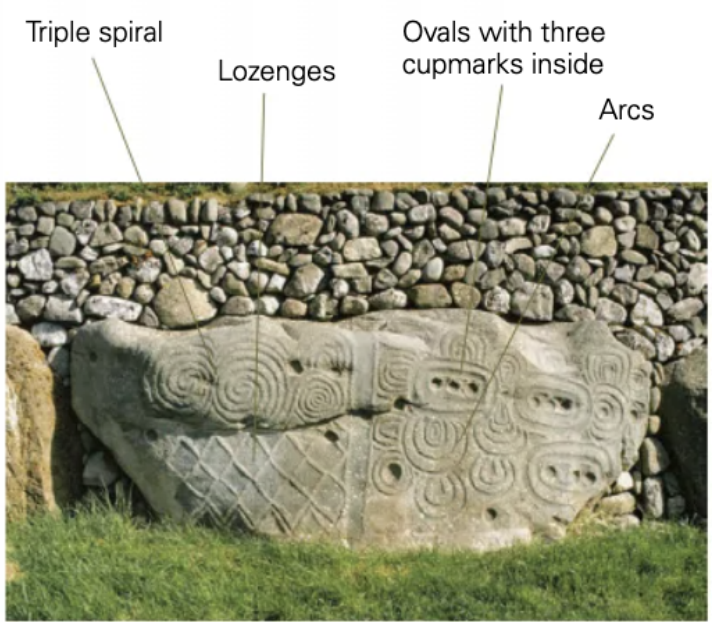
Decorated elements: The entrance stone at Newgrange displays some of Ireland's finest prehistoric art, featuring intricate spiral patterns carved using the chip-carving technique. The design emphasises the importance of the entrance with carefully planned decorative schemes.
Knowth (c. 4000 BC)
Knowth is both the oldest and largest of the Boyne Valley passage mounds, covering an impressive 1.5 acres. This site contains two separate passages - one facing east and one facing west - making it unique among Irish passage tombs.
The western passage extends 34 metres and belongs to the undifferentiated passage tomb type, with no clearly separate chamber at its end. Archaeological excavations revealed a basin stone with cremated remains and grave goods, including stone balls, pendants, coloured beads, shell necklaces, and various stone tools.
The eastern passage is more elaborate, featuring a chamber with a cruciform (cross-shaped) floor plan and a corbelled roof reaching 4 metres in height. A beautifully decorated basin stone was discovered in the northern side of this chamber.
Note
Kerbstones surround the base of the mound - these are large stones ranging from 3 to 4 metres long and over 1 metre high. Many display intricate decorative patterns that help define the visual impact of the monument.
Dowth (c. 3200 BC)
Although not yet fully excavated, Dowth features two passages facing west. One passage has a circular chamber, while the other has a cruciform chamber containing a basin stone. The site contains many decorated stones and awaits complete archaeological investigation to reveal its full significance.
Construction techniques
Corbelling
Important
Corbelling represents one of the most important architectural innovations of the Stone Age period. This technique creates roofed chambers by gradually building courses of stone that project slightly inward from the course below, eventually meeting to form a complete roof structure.
Corbelled chambers are among the oldest roofed structures still standing in Western Europe.
At Newgrange, grooves were cut into the top surface of roof stones to help channel any water that might seep through, demonstrating sophisticated understanding of weatherproofing and structural maintenance.
Layout and orientation
The construction of passage mounds began with careful planning of the layout and orientation. The positioning relative to the sun and moon was essential, as these monuments were designed to align with specific astronomical events.
Note
The line marking the kerb boundary had to be established early in the construction process, as this would determine the final size and shape of the completed monument. The careful arrangement of decorated kerbstones around the perimeter created visual unity and emphasised the sacred nature of these spaces.
Decorative elements and symbolism
Stone Age artists developed a rich vocabulary of symbolic motifs that appear consistently across different monument types. These designs were created using the chip-carving technique, where patterns were carefully cut into stone surfaces.
Common motifs
Spiral patterns appear in various forms including single spirals, double spirals, triple spirals, and complex interlocking spiral designs. These may have represented concepts like the cycle of seasons, spiritual journeys, or the movement of celestial bodies.
Geometric patterns include lozenges (diamond shapes), concentric circles, zigzag lines, and radiating designs that might represent the sun. These patterns often combine to create complex decorative schemes.
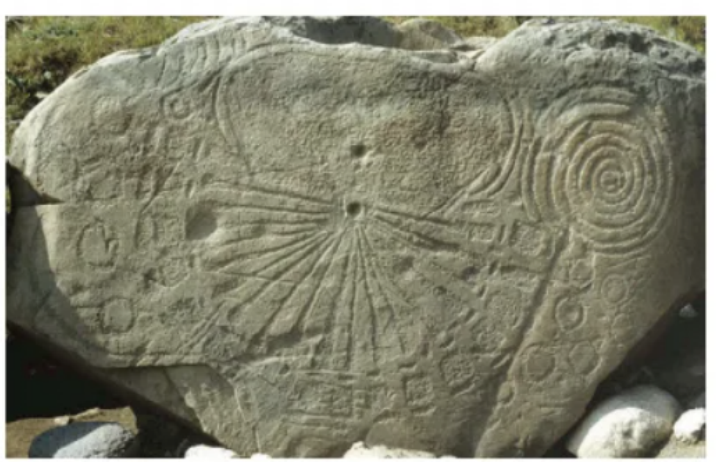
Cupmarks - small circular indentations carved into stone surfaces - frequently appear in groups of three and may have held special ritual significance.
Astronomical connections
Growing evidence suggests that Stone Age monuments were carefully aligned with astronomical events, demonstrating sophisticated understanding of seasonal cycles and celestial movements.
Seasonal alignments
The passages at Knowth align with the rising and setting sun at the equinoxes (around 21 March and 23 September), when day and night are equal in length. These times marked important seasonal transitions for farming communities.
At Newgrange, the famous light box phenomenon occurs during the winter solstice, allowing sunlight to enter the chamber on the shortest day of the year. This event may have symbolised the "death" of the old year and the "birth" of the new solar cycle.
Lunar observations
Some researchers suggest that certain kerbstones at Knowth might record lunar events and patterns. A complete lunar cycle takes approximately 18 years, requiring long-term observation and record-keeping to understand fully.
Important
Stone Age people clearly possessed detailed knowledge of astronomical cycles, which they incorporated into both the design and construction of their most important monuments. This demonstrates a level of scientific understanding that was remarkably advanced for the time period.
Remember!
Summary
Key Points to Remember:
-
The Stone Age (Neolithic period) in Ireland lasted from approximately 3700-2000 BC, marking the arrival of the first farmers and the beginning of permanent settlement.
-
Three major monument types dominated this period: dolmens (simple stone tombs), court cairns (ceremonial burial places), and passage mounds (sophisticated tombs with astronomical alignments).
-
Corbelling was a revolutionary building technique that created the oldest roofed stone structures still standing in Western Europe by gradually projecting stone courses inward until they met.
-
The Boyne Valley sites (Newgrange, Knowth, and Dowth) represent the pinnacle of Stone Age achievement, combining advanced engineering, sophisticated art, and precise astronomical knowledge in monuments that still function today.
-
Stone Age art featured distinctive spiral and geometric motifs created through chip-carving techniques, possibly holding deep symbolic meaning related to seasonal cycles, spiritual beliefs, and community identity.