Post-Impressionism (Leaving Cert Art): Revision Notes
📚Revision Notes
Post-Impressionism
What is Post-Impressionism?
Post-Impressionism was a revolutionary French art movement that flourished from 1886 to 1905. Unlike other art movements with unified styles, Post-Impressionism served as an umbrella term for various artistic approaches that emerged in response to what artists saw as limitations in Impressionism.
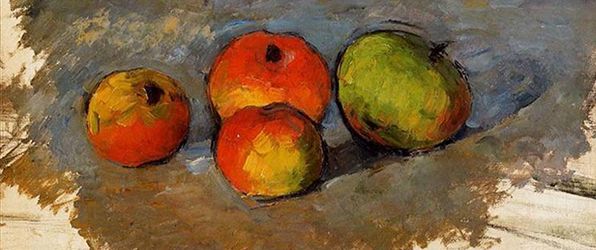
The movement developed when artists became dissatisfied with Impressionism's focus on capturing fleeting moments and naturalistic light effects. Instead, Post-Impressionist artists sought to bring back structure, meaning, and emotional expression to their work whilst building upon Impressionism's innovations with colour and brushwork.
Note
Post-Impressionism is unique among art movements because it doesn't represent a single unified style, but rather encompasses multiple diverse approaches that all shared a common desire to move beyond the perceived limitations of Impressionism.
Historical context and origins
The term Post-Impressionism was first coined by British art critic Roger Fry in 1906 and later used for his influential 1910 exhibition "Manet and the Post-Impressionists" at the Grafton Galleries in London. This exhibition, featuring works by Paul Cézanne, Paul Gauguin, and Vincent van Gogh, introduced British audiences to these groundbreaking artists.
The 1889 Volpini Exhibition in Paris was crucial in establishing the movement's identity. Held at the Café des Arts during the Paris Universal Exhibition, it showcased works by the "Impressionist and Synthetist Group," including Paul Gauguin and Émile Bernard, who were developing new approaches to painting.
Important
The term "Post-Impressionism" was actually created after the movement had already occurred, as a way to categorise and understand the diverse artistic responses to Impressionism that emerged in the late 19th century.
Key characteristics of Post-Impressionism
Post-Impressionist artists shared several important approaches that distinguished them from their Impressionist predecessors:
Structural emphasis
Rather than focusing solely on light effects, Post-Impressionists prioritised the underlying structure and form of their subjects. They sought to create art that was "solid and durable, like the art of the museums."
Symbolic content
Unlike Impressionism's emphasis on direct observation, Post-Impressionists often incorporated symbolic meaning and emotional expression into their work.
Expressive use of colour
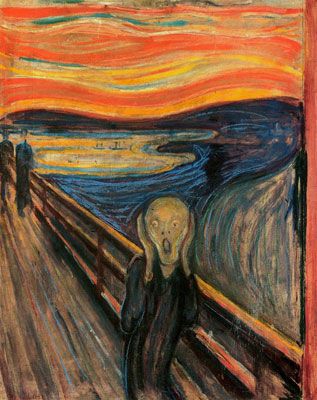
Artists used colour not just to represent reality but to convey emotions and ideas. Colours could be heightened, modified, or completely unnatural to serve the artist's expressive purpose.
Varied techniques
The movement encompassed multiple approaches, from the systematic dot technique of Neo-Impressionism to the flat colour areas of Synthetism and the expressive brushwork of artists like Van Gogh.
Major Post-Impressionist artists
Paul Cézanne (1839-1906)
Often called the "father of Post-Impressionism," Cézanne developed a systematic approach to painting that emphasised geometric structure beneath surface appearances.
Vincent van Gogh (1853-1890)
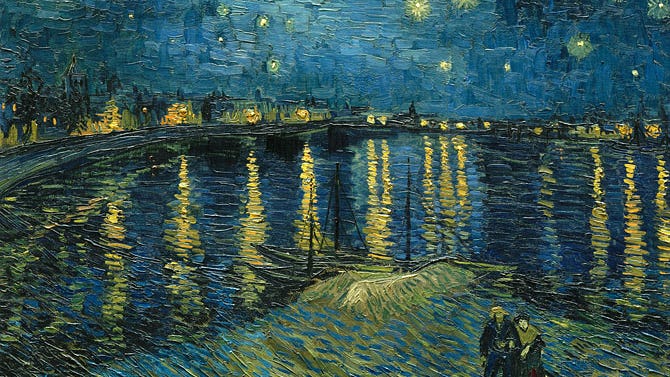
Van Gogh used vibrant colours and dynamic brushstrokes to express his emotional and psychological state.
Paul Gauguin (1848-1903)
Gauguin developed Synthetism, using flat areas of bold colour and simplified forms to create symbolic rather than realistic representations.
Georges Seurat (1859-1891)
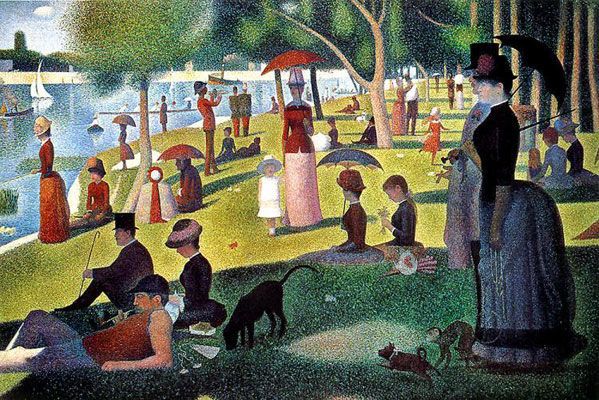
Seurat founded Neo-Impressionism, developing the systematic pointillist technique that applied colour theory scientifically.
Henri Rousseau (1844-1910)
Known for his naive or primitive style, Rousseau created dreamlike jungle scenes and fantastical compositions.
Example
Artist Identification Tip: When analysing Post-Impressionist works, look for these distinctive features:
- Cézanne: Geometric forms and structural composition
- Van Gogh: Swirling, expressive brushstrokes
- Gauguin: Flat colour areas with strong outlines
- Seurat: Small dots of pure colour (pointillism)
- Rousseau: Detailed, dreamlike scenes with naive perspective
Sub-movements within Post-Impressionism
Neo-Impressionism (Pointillism)
Neo-Impressionism, developed by Georges Seurat and Paul Signac, applied colour theory scientifically. Artists placed small dots of pure colour next to each other, allowing the viewer's eye to optically blend them. This technique was also called Divisionism or Pointillism.
Key characteristics:
- Systematic application of colour theory
- Small dots or strokes of pure colour
- Scientific approach to light and colour mixing
- Often depicted rural or urban scenes with mathematical precision
Note
The term "Pointillism" was actually coined by critics as a somewhat mocking description of the technique. The artists themselves preferred "Divisionism" as it better described their scientific approach to dividing colours.
Synthetism
Developed by Paul Gauguin and Émile Bernard, Synthetism emphasised the synthesis of three elements: the outward appearance of natural forms, the artist's feelings about the subject, and aesthetic considerations of line, colour, and form.
Key features:
- Flat areas of bold colour
- Strong outlines (Cloisonnism)
- Simplified, symbolic forms
- Rejection of naturalistic representation
Symbolism
Symbolist Post-Impressionists focused on expressing ideas and emotions through symbolic imagery rather than depicting reality directly. They often explored themes of dreams, mythology, and the spiritual world.
Important
Don't confuse Post-Impressionist Symbolism with the broader Symbolist movement in literature and art. While related, Post-Impressionist Symbolism specifically refers to the symbolic approaches used by painters moving beyond Impressionism.
Artistic techniques and innovations
Colour as expression
Post-Impressionists liberated colour from its purely descriptive function. Artists could use any colour that served their expressive purpose, leading to bold, unrealistic colour schemes that conveyed emotion or symbolic meaning.
Structural composition
Unlike Impressionists who often painted spontaneously outdoors, many Post-Impressionists carefully planned their compositions, emphasising the underlying geometric structure of their subjects.
Brushwork as personal expression
Each artist developed distinctive brushwork techniques that became part of their personal style. Van Gogh's swirling strokes, Cézanne's methodical colour patches, and Seurat's systematic dots all served different expressive purposes.
Example
Technique Comparison: Compare how different Post-Impressionist artists approached the same subject:
- Impressionist approach: Quick brushstrokes to capture light effects
- Cézanne's approach: Systematic colour patches to build geometric form
- Van Gogh's approach: Expressive, emotional brushwork
- Seurat's approach: Scientific colour dots for optical mixing
Legacy and influence
Post-Impressionism proved crucial in the development of modern art. The movement's emphasis on personal expression, structural innovation, and symbolic content laid the groundwork for twentieth-century art movements including:
- Fauvism: The bold use of unrealistic colour directly influenced the Fauves
- Expressionism: The emphasis on emotional expression over realistic representation
- Cubism: Cézanne's geometric approach to form influenced Picasso and Braque
- Abstract art: The move away from naturalistic representation opened doors to abstraction
Important
Post-Impressionism represents a crucial bridge between 19th-century naturalistic art and the revolutionary abstract movements of the 20th century. Understanding this movement is essential for comprehending the development of modern art.
Exam tips
- Remember the key dates: 1886-1905
- Focus on how Post-Impressionism differs from Impressionism
- Be able to identify characteristics of major sub-movements (Neo-Impressionism, Synthetism, Symbolism)
- Know the key artists and their distinctive styles
- Understand the movement's influence on later developments in art
Summary
Key Points to Remember:
-
Post-Impressionism (1886-1905) was a reaction against Impressionism's focus on naturalistic light and colour effects
-
Major artists included Cézanne, Van Gogh, Gauguin, Seurat, and Rousseau, each developing unique approaches within the movement
-
Key characteristics included emphasis on structure, symbolic content, expressive use of colour, and diverse technical approaches
-
Important sub-movements were Neo-Impressionism (pointillism), Synthetism (flat colour areas), and Symbolism (emotional/spiritual themes)
-
The movement's innovations in colour, form, and expression directly influenced Fauvism, Expressionism, and other modern art movements