The Breathing System (Leaving Cert Biology): Revision Notes
📚Revision Notes
The Breathing System
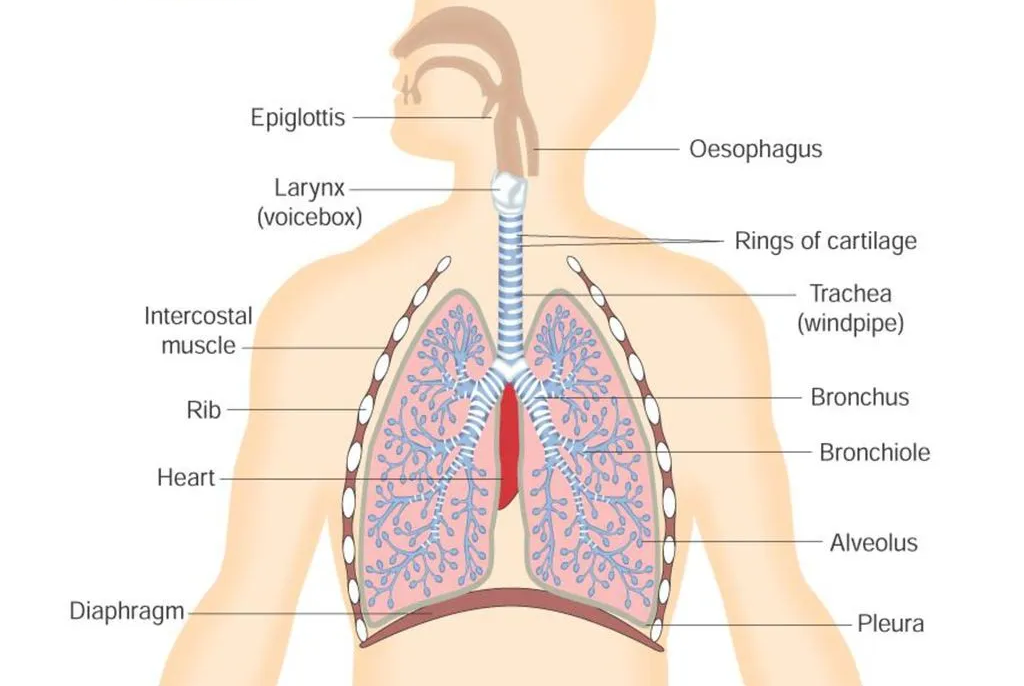
Nose
- Air enters the body through the nasal cavity when we breathe in.
- The nasal cavity is moist, which warms and moistens the air. Warm, moist air can diffuse more easily from the lungs into the blood.
- Tiny hairs (cilia) in the nasal cavity philtre the air as it passes through.
- The sinuses are close to the nasal cavity. When we have a cold or flu, the sinuses can swell and cause a 'blocked nose'.
- Air taken in through the mouth is not warmed, moistened, or filtered. During exercise, we often breathe through the mouth to take in a larger volume of air.
Pharynx (Throat)
- The pharynx connects the nose and mouth to the larynx.
- The epiglottis is located in the pharynx, at the top of the trachea.
- The epiglottis closes over the trachea when we swallow to prevent food or liquid from entering the airway.
Larynx
- The larynx, or voice box, contains the vocal cords.
- The larynx produces sound.
Trachea
- The trachea (windpipe) carries air into the lungs.
- It branches into bronchi and bronchioles, which are made of muscle and elastic fibres, supported by rings of cartilage.
- Cartilage prevents the airways from collapsing as air flows through.
- The walls of the lower bronchioles are made of muscle and elastic fibres only.
- All of the air pipes are lined with mucous secreting cells and tiny hairs called cilia.
- The airways are lined with mucous-secreting cells and tiny hairs called cilia.
- Mucous traps dust, bacteria, and viruses.
- Cilia beat in an upward current, moving mucous to the oesophagus, where it is swallowed into the stomach. Clearing the throat helps force mucous upwards.
Note
Exam Focus:
- Rings of cartilage prevent the trachea from collapsing.
- Cilia beat and create an upward current to move mucous up and into the oesophagus.
Lungs
- Gaseous exchange occurs in the lungs, primarily in the alveoli.
- The lungs are enclosed by two pleural membranes which are filled with a fluid to reduce friction during breathing.
- The lungs are protected by the rib cage.
Note
Note: The heart is about the size of a fist. It is positioned slightly to the left of the midline in the chest, and the left lung is slightly smaller than the right lung to accommodate the space taken up by the heart.