The Control and Mechanism of Breathing (Leaving Cert Biology): Revision Notes
📚Revision Notes
The Control and Mechanism of Breathing
The Control of Breathing
Breathing is controlled by the medulla oblongata in the brain, which responds to CO₂ levels in the blood.
- CO₂ Detection: When CO₂ levels in the blood rise, the CO₂ dissolves in plasma and forms carbonic acid. Blood pH lowers slightly.
- Chemoreceptor response: Chemoreceptors in the body detect this pH change.
- Signal to brain: These chemoreceptors send signals to the medulla oblongata.
- Increase breathing rate: The medulla oblongata responds by signalling the diaphragm and intercostal muscles to contract more frequently, increasing the breathing rate.
- Excrete CO₂: Faster breathing expels more CO₂, which helps return blood pH to normal levels. This process ensures that the body maintains a stable internal environment.
Note
Homeostasis: the maintenance of a constant internal environment.
The Mechanism of Breathing
Inhalation (Breathing In)
- Respiration in our body cells produces the waste gas, carbon dioxide. This gas is carried in the blood.
- The medulla oblongata in the brain monitors blood acidity caused by CO₂ levels.
- If CO₂ levels are high, the medulla sends electrical signals to the diaphragm and intercostal muscles.
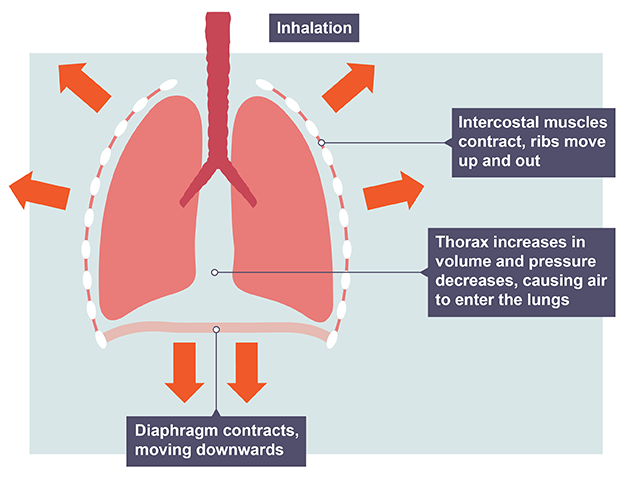
- The diaphragm and intercostal muscles contract. (Inhalation is an active process requiring energy.)
- The ribs move up and out, the diaphragm moves down.
- This enlarges the thorax (chest cavity), so the volume of the lungs increases.
- The increased volume of the lungs causes thoracic pressure to decrease, making it lower than atmospheric pressure.
- Due to the difference in air pressure, air flows into the lungs and the lungs inflate.
Exhalation (Breathing Out)
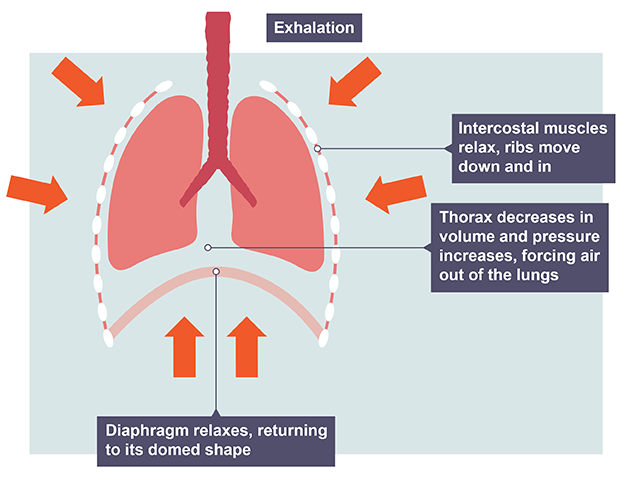
- No message is sent from the medulla oblongata so the diaphragm and intercostal muscles both relax.
- The rib cage moves down and in, diaphragm moves up.
- This reduces the thorax, so the volume of the lungs decreases.
- The thoracic pressure increases so it is higher than atmospheric pressure.
- This results in air being forced out of the lungs.
- Exhalation is usually a passive process because it does not require energy (muscles are only relaxing, not contracting).
- During strenuous exercise, exhalation can become an active process, as additional effort is used to expel CO₂ more rapidly.
Effect of Exercise on Breathing Rate
- Exercise requires energy, which is produced through respiration.
- During exercise, the rate of respiration increases, resulting in the production of more CO₂.
- The increased CO₂ levels in the blood trigger the medulla oblongata, which increases the rate of breathing.
- This ensures that more CO₂ is exhaled, helping to maintain normal blood pH by reducing CO₂ levels.