The Urinary System (LC 2027) (Leaving Cert Biology): Revision Notes
📚Revision Notes
The Role of ADH
What is osmoregulation?
Osmoregulation is the body's way of controlling water and salt concentrations to maintain a healthy balance. This process is essential for homeostasis - keeping your internal environment stable despite changes in your surroundings or activities.
Note
Homeostasis is one of the most fundamental concepts in biology. Without proper water and salt balance, your cells cannot function properly, and essential processes like enzyme activity and membrane transport would be disrupted.
The main way your body controls osmoregulation is by regulating how much urine you produce. This is controlled by a hormone called anti-diuretic hormone (ADH), also known as vasopressin.
Understanding ADH
ADH (Anti-diuretic hormone) is a key hormone that controls water balance in your body. Here's what you need to know about ADH:
- Storage location: ADH is stored in the pituitary gland in your brain
- Release mechanism: It's released from the pituitary gland into your bloodstream when needed
- Target organs: ADH affects the distal convoluted tubules and collecting ducts in your kidneys
- Main function: It causes more water to be reabsorbed from these kidney tubules back into your blood
- Overall effect: ADH controls osmoregulation by adjusting how much water your body retains or loses
Important
Remember: ADH is anti-diuretic, which means it works against diuresis (excessive urine production). When ADH is present, it reduces urine production by increasing water reabsorption.
When blood plasma becomes too concentrated
Your blood plasma becomes too concentrated when you:
- Drink too little water
- Lose too much water through sweating or faeces
- Consume too much salt
When this happens, your body responds through a carefully coordinated process:
Example
Step-by-Step Process: Responding to Concentrated Blood Plasma
- Detection: Osmoreceptors in the hypothalamus detect increased blood concentration
- Signal: The pituitary gland releases ADH into the bloodstream
- Transport: ADH travels to your kidneys via the bloodstream
- Action: In the kidneys, ADH makes the walls of the distal tubules and collecting ducts more permeable to water
- Result: More water gets reabsorbed from the nephron back into your blood
- Outcome: This leads to a reduction in urine volume and increased concentration of urine
- Restoration: The salt concentration in your blood plasma decreases back to normal
When blood plasma concentration is normal or too dilute
Your blood plasma becomes too dilute when you:
- Consume large amounts of water
- Eat a low-salt diet
In this situation, your body follows the opposite pathway:
- ADH is not released from the pituitary gland
- The distal tubules and collecting ducts remain relatively impermeable to water
- Very little water is reabsorbed from these parts of the nephron
- The concentration of your blood plasma remains relatively unchanged
- You produce a large volume of dilute urine
How ADH controls osmoregulation through negative feedback
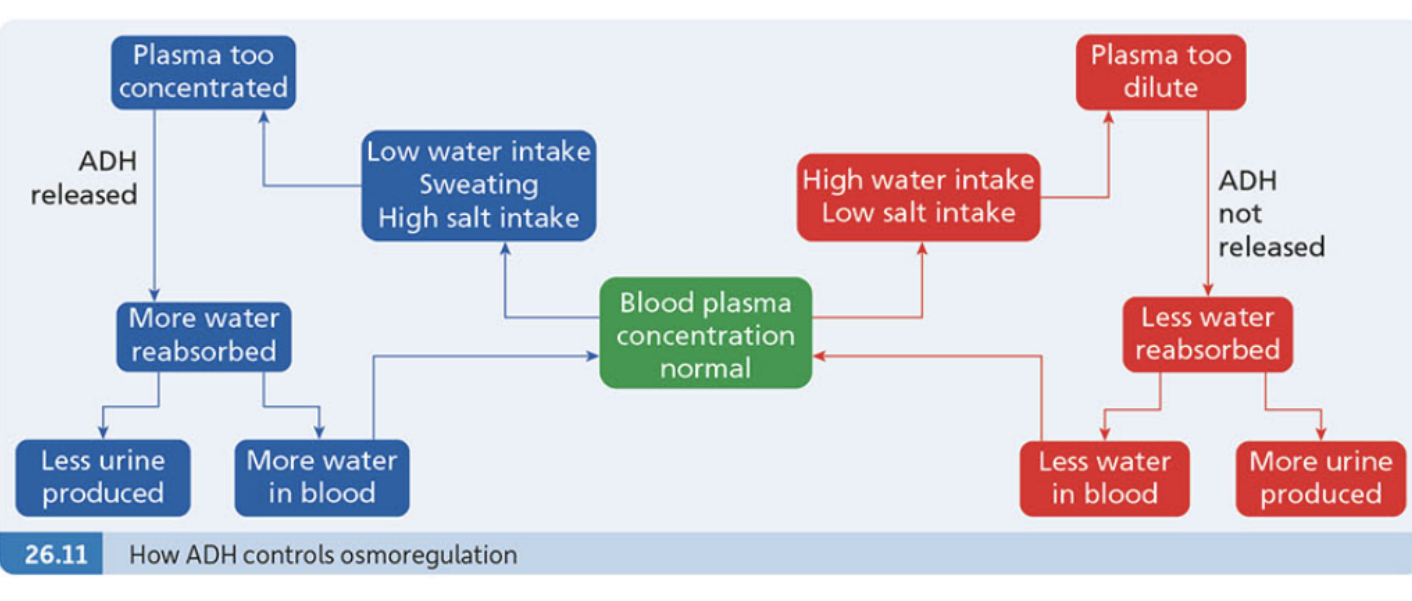
This diagram shows how ADH works as a negative feedback mechanism to maintain water balance. The process works like a thermostat - when levels get too high or too low, the body automatically adjusts to bring them back to normal.
Note
Negative feedback is crucial for homeostasis. It ensures that when your body detects a change from the normal state, it triggers responses that counteract that change and restore balance. This prevents dangerous extremes in water concentration.
Effects of different conditions on ADH and urine production
Different lifestyle factors affect your body's water balance:
- Salty diet or exercise: Leads to dehydration, triggering ADH release and producing concentrated urine
- High water intake: Results in no ADH release and dilute urine production
- High protein diet: Increases urea concentration but doesn't significantly affect water handling
Important
Common Mistake to Avoid: Don't confuse the concentration of urine with the concentration of blood plasma. When blood plasma becomes concentrated (too much salt, too little water), the body produces concentrated urine to conserve water. These work in opposite directions!
Key exam tips
Summary
Essential Points for Exams:
- Remember that ADH is anti-diuretic, meaning it works against diuresis (excessive urine production)
- When ADH levels are high, urine volume is low and concentrated
- When ADH levels are low or absent, urine volume is high and dilute
- The process works through negative feedback to maintain homeostasis
- Focus on the relationship between blood concentration, ADH release, and kidney response
Remember!
Summary
Key Points to Remember:
- ADH is stored in the pituitary gland and released when blood becomes too concentrated
- ADH increases water reabsorption in the distal tubules and collecting ducts of the kidney
- More ADH = less urine produced (more water retained in the body)
- Less/no ADH = more urine produced (less water retained in the body)
- The system works through negative feedback to maintain proper water balance and homeostasis