Nephrons (Leaving Cert Biology): Revision Notes
📚Revision Notes
Nephrons
Location of nephrons
Each kidney contains over one million tiny functional units called nephrons. These microscopic structures are approximately 3 centimetres long and are found throughout both the outer cortex and inner medulla regions of the kidney. Nephrons serve as the kidney's primary filtration and processing units, working continuously to produce urine and maintain the body's fluid balance.
Note
The sheer number of nephrons in each kidney - over one million - demonstrates the kidney's incredible capacity for filtration. If all the nephrons in both kidneys were laid end to end, they would stretch for approximately 60 kilometres!
Structure of a nephron
A nephron consists of several interconnected parts, each with a specific role in filtering blood and forming urine:
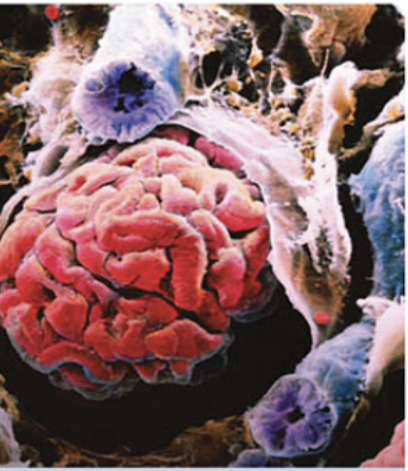
Bowman's capsule - A cup-shaped structure that surrounds a cluster of tiny blood vessels called the glomerulus. This forms the beginning of the nephron where initial filtration occurs.
Proximal convoluted tubule - A twisted tube that connects to Bowman's capsule. This region performs most of the reabsorption work, recovering valuable substances from the filtered liquid.
Loop of Henle - A hairpin-shaped portion consisting of:
- Descending limb - Allows water to pass through its walls
- Ascending limb - Permits salt movement but prevents water from crossing
Distal convoluted tubule - Another twisted section that fine-tunes the composition of the forming urine through selective reabsorption.
Collecting duct - The final pathway where multiple nephrons converge, allowing final adjustments to water and salt balance before urine formation is complete.
Note
Each part of the nephron is specially designed for its function. The twisted, convoluted tubules increase surface area for maximum reabsorption efficiency, while the loop of Henle creates the concentration gradient essential for water conservation.
Blood supply to the nephron
The nephron receives its blood supply through a sophisticated network of vessels. Blood enters each kidney via the renal artery, which branches repeatedly to form smaller arterioles. Each nephron is supplied by an afferent arteriole that brings blood into the glomerulus.
Within Bowman's capsule, the afferent arteriole splits into a tight cluster of capillaries called the glomerulus. This arrangement creates the perfect conditions for filtration to occur. Blood then leaves the glomerulus through the efferent arteriole, which forms additional capillaries that surround the rest of the nephron tubules before eventually joining to form renal veins.
Important
The unique arrangement where blood flows from one set of capillaries (glomerulus) directly into another set (peritubular capillaries) through the efferent arteriole is called a portal circulation. This design is crucial for maintaining the pressure differences needed for both filtration and reabsorption.
Formation of urine in nephrons
Urine production involves two main processes working together: filtration and reabsorption.
Filtration
Filtration takes place in the glomerulus within Bowman's capsule. Several factors make this process highly efficient:
- High blood pressure in the glomerular capillaries forces liquid and small molecules out of the blood
- Large surface area of the glomerular capillaries provides extensive filtering space
- Thin, porous capillary walls allow small molecules like water, glucose, amino acids, vitamins, salts, and waste products to pass through
- Selective barrier prevents large molecules such as blood cells, platelets, antibodies, and proteins from being filtered out
The liquid that emerges from this filtration process is called glomerular filtrate. Remarkably, about 180 litres of this filtrate are produced every 24 hours - that's roughly five times the total fluid content of the human body!
Example
Calculation Example: Daily Filtration Rate
If each kidney produces 90 litres of filtrate per day:
- Both kidneys combined = 90 × 2 = 180 litres per day
- Average human body contains ~35-40 litres of fluid
- Therefore: 180 ÷ 37.5 = 4.8 times the body's total fluid volume filtered daily!
Reabsorption
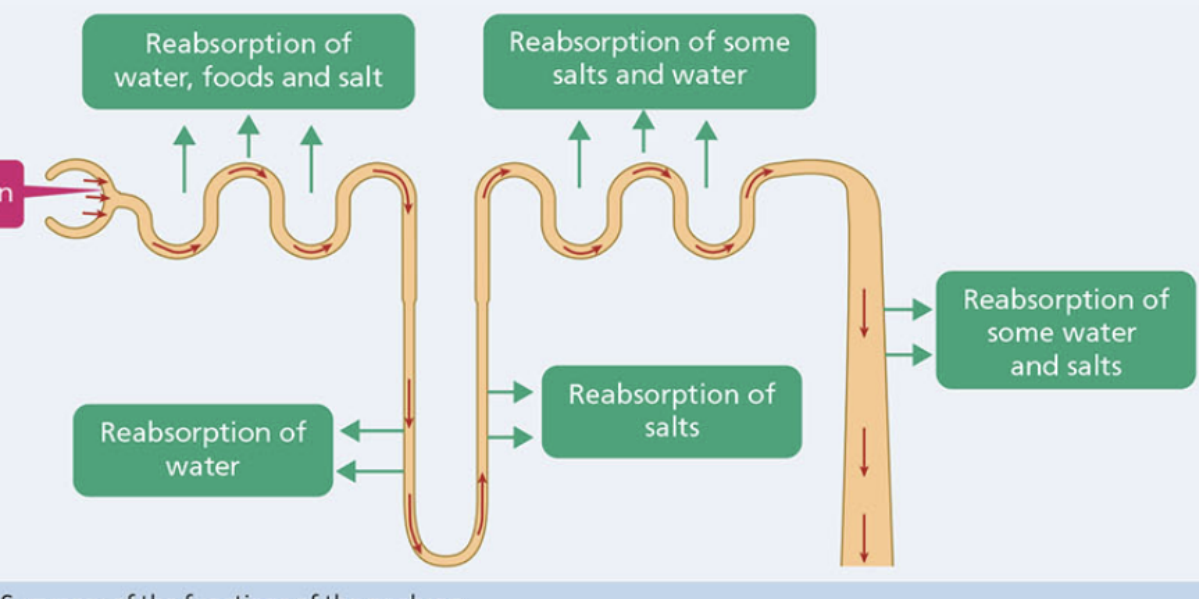
Since the body cannot afford to lose 180 litres of fluid daily, an efficient reabsorption system recovers approximately 99% of the glomerular filtrate. This process occurs throughout different regions of the nephron:
In the proximal convoluted tubule:
- Most water is reabsorbed through osmosis
- Useful substances like glucose, amino acids, and vitamins are completely recovered through active transport and diffusion
- Most salts are reabsorbed through active transport or diffusion
- The tubule is specially adapted with a thin wall, extended length, numerous internal folds called microvilli, and abundant mitochondria to provide energy for active transport
In the descending limb of the loop of Henle:
- Cells allow water to pass through
- Small amounts of water are reabsorbed by osmosis
In the ascending limb of the loop of Henle:
- Cells prevent water from crossing
- Cells are permeable to salts, which move out initially by diffusion but are actively pumped out at the top of the ascending limb
- This salt removal concentrates the surrounding fluid, helping the kidney conserve water
In the distal convoluted tubule:
- Precise control of water, salt, and blood pH occurs
- Some water and salts are reabsorbed through a combination of osmosis and active transport
In the collecting duct:
- Final adjustments to water and salt balance take place
- Cells are permeable to water, and some reabsorption occurs due to the high salt concentration in the surrounding medulla
- Some salts are also reabsorbed
Important
The kidney's ability to reabsorb 99% of the filtered volume is crucial for survival. Without this efficient reabsorption, the body would lose all its fluid within hours. Any damage to the reabsorption mechanisms can quickly lead to dehydration and electrolyte imbalances.
Summary of reabsorption processes
The following table summarises what happens in each region of the nephron:
| Region | Substances reabsorbed | Amount of water reabsorbed |
|---|---|---|
| Proximal convoluted tubule | Most salts, glucose, amino acids, and vitamins | Most |
| Loop of Henle (descending limb) | None | A little |
| Loop of Henle (ascending limb) | Some salts | None |
| Distal convoluted tubule | Some salts | Some |
| Collecting duct | Some salts | Some |
Note
Notice how the proximal convoluted tubule does the "heavy lifting" of reabsorption, while the other regions fine-tune the final composition. The loop of Henle's unique properties - water permeable descending limb and salt permeable ascending limb - create the concentration gradient that makes water conservation possible.
Glomerular filtrate vs. urine
The transformation from glomerular filtrate to urine involves significant changes in composition:
Glomerular filtrate characteristics:
- Contains much more water (making it more dilute than urine)
- Contains many useful molecules such as glucose and amino acids that are normally absent from urine
Final urine characteristics:
- More concentrated due to water reabsorption
- Contains primarily waste products and excess substances the body needs to eliminate
- Useful substances like glucose and amino acids have been removed and returned to the blood
This comparison highlights the kidney's remarkable efficiency in conserving valuable substances while eliminating waste products.
Example
Worked Example: Filtrate to Urine Transformation
Starting volume: 180 litres of glomerular filtrate per day
- Proximal tubule reabsorbs: ~65% = 117 litres
- Loop of Henle reabsorbs: ~15% = 27 litres
- Distal tubule and collecting duct reabsorb: ~18.5% = 33 litres
- Final urine volume: ~1.5 litres per day
This represents a 99.2% reabsorption rate!
Remember!
Summary
Key Points to Remember:
- Each kidney contains over one million nephrons - these microscopic functional units work continuously to philtre blood and produce urine
- Nephrons have five main parts - Bowman's capsule, proximal convoluted tubule, loop of Henle, distal convoluted tubule, and collecting duct, each with specific functions
- Filtration occurs in the glomerulus - high pressure forces small molecules out of blood while keeping large molecules like proteins and blood cells in circulation
- Reabsorption recovers 99% of filtrate - the kidney produces 180 litres of filtrate daily but only excretes 1.5 litres as urine, showing incredible efficiency
- Different regions reabsorb different substances - the proximal convoluted tubule does most of the work, while other regions fine-tune water and salt balance