Mendel's First and Second Laws (Leaving Cert Biology): Revision Notes
📚Revision Notes
Mendel's First and Second Laws
Gregor Mendel's groundbreaking work with pea plants established two fundamental principles that explain how traits are passed from parents to offspring. These laws form the foundation of our understanding of genetic inheritance and help us predict patterns of inheritance in all sexually reproducing organisms.
Mendel's first law: the law of segregation
Mendel's first law, also known as the law of segregation, describes how genetic information is distributed during reproduction. This fundamental principle governs how traits are passed from one generation to the next through the precise distribution of genetic material.
Important
Mendel's Law of Segregation states that:
- Traits are determined by pairs of alleles (different versions of the same gene)
- These alleles separate from each other during gamete formation
- Each gamete receives only one allele from each pair
Understanding segregation in terms of alleles
When examining how characteristics are inherited, segregation works at the allele level. The process ensures that genetic information is properly distributed between generations through a systematic separation mechanism.
Example
Worked Example: Plant Height Inheritance
Consider studying plant height where:
- The height characteristic is controlled by two alleles working together
- One allele might code for tall stems (T) while the other codes for short stems (t)
- During gamete formation, these paired alleles separate
- Each reproductive cell carries either the T allele OR the t allele, never both
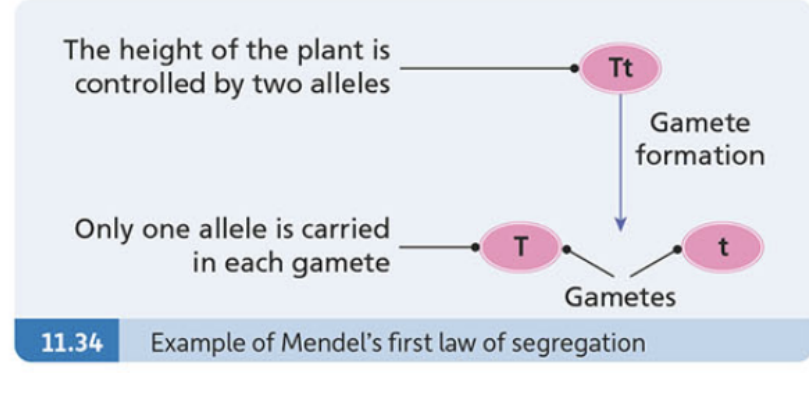
This separation process ensures that genetic information is properly distributed and that offspring receive one allele from each parent for every trait.
Understanding segregation in terms of chromosomes
The physical basis for Mendel's first law lies in chromosome behaviour during meiosis. Understanding this chromosomal foundation helps explain why segregation occurs at the cellular level.
Note
Chromosomal Basis of Segregation:
- Alleles are located on homologous chromosomes (matching chromosome pairs)
- During gamete formation, homologous chromosomes separate
- Each gamete receives only one chromosome from each homologous pair
- Therefore, each gamete contains only one allele for each gene
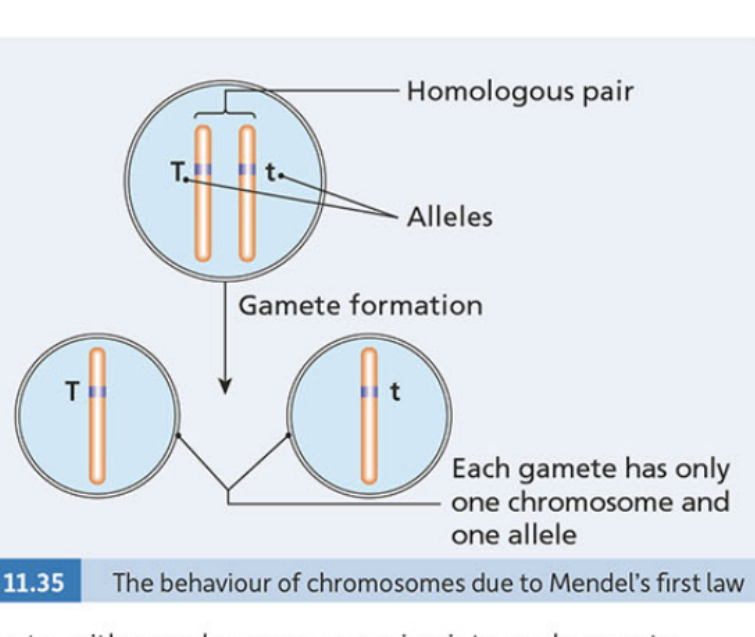
This chromosome separation explains why Mendel's law of segregation occurs - it's a direct consequence of how cells divide during reproduction.
Mendel's second law: the law of independent assortment
Mendel's second law, the law of independent assortment, explains how different genes behave when inherited together. This law reveals how genetic diversity is created through the random combination of different traits.
Important
Mendel's Law of Independent Assortment states that:
- When gametes are formed, alleles for different genes sort independently of each other
- The inheritance of one trait does not influence the inheritance of another trait
- This independent sorting creates new combinations of alleles in offspring
Understanding independent assortment in terms of alleles
When an organism carries genes for multiple traits, independent assortment ensures genetic diversity through random combinations. This process creates multiple possible outcomes from a single cross.
Example
Worked Example: Independent Assortment
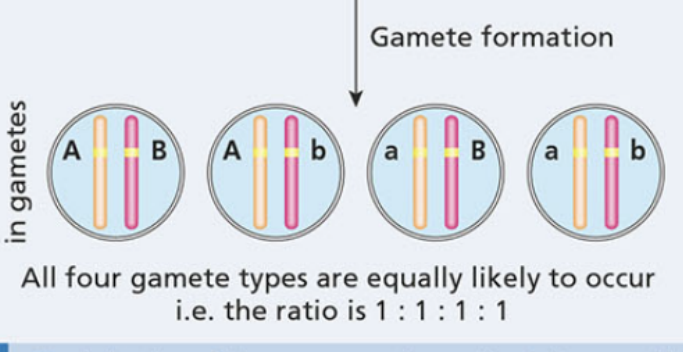
Consider an organism with genotype AaBb:
- The A and a alleles can combine with either B or b alleles during gamete formation
- This creates four different types of gametes: AB, Ab, aB, and ab
- Each combination has an equal probability of occurring
- The final ratio of gamete types is 1:1:1:1
Understanding independent assortment in terms of chromosomes
The chromosome basis for independent assortment involves multiple chromosome pairs working simultaneously. This chromosomal behaviour creates the physical mechanism for genetic recombination.
Note
Chromosomal Basis of Independent Assortment:
- Different genes are located on different homologous chromosome pairs
- During meiosis, these chromosome pairs align and separate independently
- The way one pair of chromosomes separates doesn't influence how other pairs separate
- This random assortment creates various combinations of maternal and paternal chromosomes in gametes
Dihybrid crosses and genetic ratios
When studying two characteristics simultaneously (a dihybrid cross), Mendel's laws predict specific patterns that demonstrate the mathematical precision of genetic inheritance.
Note
Key Principles of Dihybrid Crosses:
- The inheritance of one trait remains independent of the second trait
- In crosses between two heterozygous parents (AaBb × AaBb), we expect specific phenotypic ratios
- These mathematical ratios provide strong evidence for both segregation and independent assortment
The precision of these ratios helps geneticists predict inheritance patterns and solve complex genetic problems with remarkable accuracy.
Applications in modern genetics
Understanding Mendel's laws enables scientists and breeders to apply these principles in numerous practical situations. These fundamental concepts remain as relevant today as they were when first discovered.
Note
Modern Applications of Mendel's Laws:
- Predict the outcomes of genetic crosses with accuracy
- Explain the genetic basis of inheritance patterns
- Calculate the probability of specific traits appearing in offspring
- Understand how genetic diversity arises in populations
- Analyse inheritance patterns in plant and animal breeding programmes
These fundamental principles remain central to modern genetics, even though we now understand the molecular mechanisms that drive these processes.
Summary
Key Points to Remember:
- Segregation principle: Allele pairs separate during gamete formation, ensuring each gamete receives only one allele from each pair
- Independent assortment: Different genes sort independently during reproduction, creating genetic diversity through new allele combinations
- 1:1:1:1 ratio: The expected proportion of different gamete types when two genes assort independently
- Chromosome basis: Both laws result from the behaviour of chromosomes during meiosis
- Predictive power: Mendel's laws allow calculation of probability for specific genetic outcomes in breeding experiments