The Male Reproductive System (Leaving Cert Biology): Revision Notes
📚Revision Notes
The Male Reproductive System
The male reproductive system is a complex collection of organs and structures designed to produce, store, and deliver sperm cells for reproduction. Understanding this system is essential for grasping how human reproduction works and how hormones control these important processes.
Overview of the male reproductive system
The male reproductive system consists of both internal and external structures that work together to produce sperm and deliver them during reproduction. The main functions include sperm production, hormone production (particularly testosterone), and the physical delivery of sperm to the female reproductive system.

Note
The male reproductive system is unique in that it combines both internal and external structures, each with specialised functions that must work in coordination for successful reproduction.
The system includes several key components:
- External structures: penis, scrotum, and testes
- Internal structures: sperm ducts, epididymis, seminal vesicles, prostate gland, and urethra
- Supporting structures: bladder (though primarily part of urinary system, it connects to the reproductive system via the urethra)
Testes and scrotum
Location and structure
The testes (singular: testis) are the male gonads - organs that produce sex cells (sperm) in animals. These oval-shaped structures develop inside the body cavity during foetal development but descend into the scrotum (a pouch of skin) a few weeks before birth.
Temperature regulation
Important
Critical Temperature Requirement
The scrotum serves a crucial function in maintaining the correct temperature for sperm production. The temperature inside the scrotum is maintained at 35°C, which is 2 degrees lower than normal body temperature (37°C). This cooler temperature is essential because meiosis (the process that produces sperm) cannot occur properly at normal body temperature. Without this temperature regulation, males would be infertile.
Sperm production
Each testis contains a coiled mass of tiny tubes called seminiferous tubules (approximately 50 cm long in total). These tubules are lined with special sperm-producing cells. It is within these cells that meiosis occurs to produce haploid sperm cells containing 23 chromosomes each.
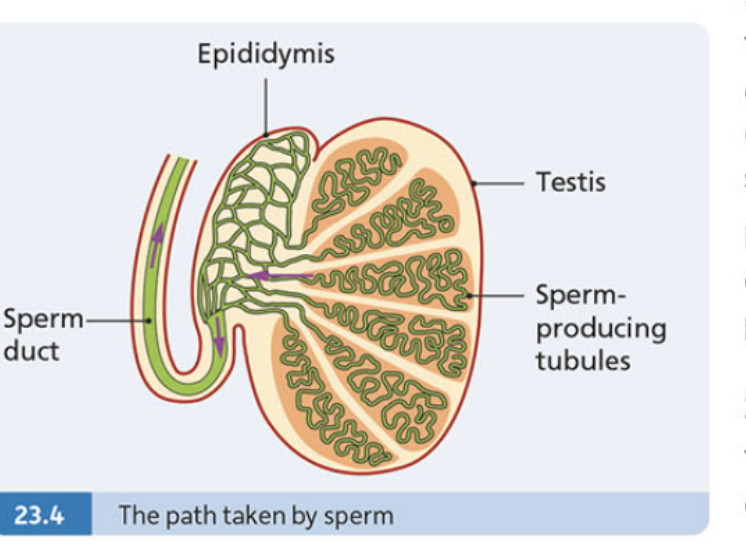
The testes also produce the hormone testosterone, which plays vital roles in male development and reproduction.
Sperm structure and function
Anatomy of sperm
Sperm cells are highly specialised reproductive cells designed for one primary function: to fertilise an egg. Each sperm cell is haploid, meaning it contains only 23 chromosomes (half the normal number found in body cells).
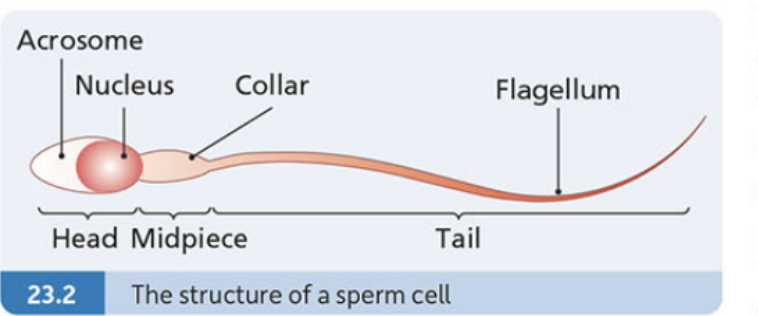
A sperm cell consists of three main regions:
Head region:
- Acrosome: a cap-like structure containing enzymes that help the sperm digest through the membrane of the egg during fertilisation
- Nucleus: contains the 23 chromosomes carrying genetic material from the father
Midpiece:
- Collar: connects the head to the tail
- Contains many mitochondria which provide energy for the sperm to swim
Tail:
- Flagellum: a long, whip-like structure that allows the sperm to swim towards the egg
Journey of sperm
Note
Sperm cells are first produced in the testes during a process that begins at puberty (between 9 and 13 years of age in males) and continues throughout a male's lifetime. The newly formed sperm then follow a specific pathway through the male reproductive system.
Epididymis and sperm transport
Epididymis function
The epididymis is a tightly coiled tube located outside each testis. When sperm are first produced, they cannot swim effectively. The epididymis serves as a storage and maturation site where sperm develop the ability to swim and become fully functional. Sperm can be stored in the epididymis for up to 6 weeks.
Note
Sperm Resorption Process
If sperm are not released during this time, they are broken down and their components are reabsorbed back into the bloodstream through a process called resorption. This ensures that unused sperm don't accumulate in the system.
Sperm duct (vas deferens)
From the epididymis, mature sperm travel through the sperm duct (also called the vas deferens). These ducts carry sperm towards the urethra in preparation for ejaculation.
Supporting structures
Urethra
The urethra is a tube located in the centre of the penis that serves a dual function:
- Carrying urine out of the body during urination
- Allowing sperm to exit the body during ejaculation (at different times)
Seminal vesicles and prostate gland
The seminal vesicles and prostate gland are accessory glands that produce a liquid called seminal fluid. When seminal fluid is mixed with sperm cells, the resulting mixture is called semen.
Seminal fluid provides:
- A medium for sperm to swim in
- Nutrients to nourish the sperm (including fructose sugar for energy)
- Protection for sperm as they travel through the female reproductive system
Penis, glans and foreskin
The penis is the external reproductive organ designed to introduce sperm into the female reproductive system. Key features include:
- Glans: the swollen tip of the penis
- Foreskin (or prepuce): a fold of skin that covers the glans
During sexual arousal, increased blood flow causes the penis to become erect, allowing it to be inserted into the female reproductive system for sperm delivery.
Hormonal control of the male reproductive system
Key hormones
The male reproductive system is controlled by two main hormones produced by the pituitary gland:
FSH (Follicle-stimulating hormone):
- Stimulates the diploid sperm-producing cells in the testes to divide by meiosis
- Essential for sperm production throughout adult life
LH (Luteinising hormone):
- Stimulates the testes to produce testosterone
- Testosterone production increases dramatically at puberty
Example
Worked Example: Hormone Interaction
Step 1: Pituitary gland releases FSH and LH
- FSH → targets sperm-producing cells in testes
- LH → targets testosterone-producing cells in testes
Step 2: Testes respond to hormone signals
- FSH stimulation → meiosis occurs → sperm production
- LH stimulation → testosterone production increases
Step 3: Testosterone effects
- Maintains sperm production
- Develops secondary sexual characteristics
- Controls reproductive organ growth
Testosterone functions
Testosterone is the primary male sex hormone with several important roles:
- Causes the development of primary male sex characteristics (growth of reproductive organs)
- Triggers the development of secondary sexual characteristics at puberty
- Maintains sperm production throughout adult life
- Controls the descent of testes into the scrotum during development
The production of testosterone increases enormously at puberty, causing enlargement of the penis, testes, and other reproductive structures.
Secondary sexual characteristics
Secondary sexual characteristics are physical features that distinguish males from females, apart from the reproductive organs themselves. These develop under the influence of testosterone during puberty and include:
- Growth of pubic, underarm, facial, and body hair
- Enlargement of the larynx, causing the voice to break and deepen
- Increased muscular and bone development
- Widening of the shoulders
- Growth spurts (body weight may double)
- Increased secretion of sebum (oil) in the skin
These changes typically begin during puberty and help establish the physical differences between adult males and females.
Summary
Key Points to Remember:
-
The scrotum maintains testes at 35°C (2°C below body temperature) - this is essential for proper sperm production through meiosis
-
Sperm have three main parts: head (contains nucleus and acrosome), midpiece (provides energy), and tail (flagellum for swimming)
-
Two key hormones control the system: FSH stimulates sperm production, while LH stimulates testosterone production
-
Testosterone triggers secondary sexual characteristics during puberty and maintains the male reproductive system throughout life
-
The male reproductive system produces millions of haploid sperm cells continuously from puberty onwards, with sperm maturing and being stored in the epididymis