Innate and Acquired Immunity (Leaving Cert Biology): Revision Notes
📚Revision Notes
Innate and Acquired Immunity
Introduction to immunity
Immunity is your body's amazing ability to resist infection and fight off diseases caused by harmful microorganisms called pathogens. Think of it as your body's personal security system that works around the clock to keep you healthy.
Your immune system has two main parts that work together:
- Innate immunity - the defences you're born with
- Acquired immunity - the specific protection you develop over time
Innate immunity
Innate immunity is like having a built-in security system that you're born with. It doesn't need any previous training or experience - it automatically attacks any pathogen that tries to enter your body. This type of immunity is non-specific, meaning it responds the same way to all threats.
Innate immunity has two main parts that work as your body's first responders:
First line of innate immunity
The first line acts like a fortress wall, trying to prevent pathogens from entering your body in the first place. It includes several important barriers:
Skin Your skin provides a tough, physical barrier that prevents most pathogens from entering your body. It's like wearing natural armour all the time.
Clotting When your skin gets broken, blood clotting quickly seals the wound to prevent pathogens from entering through the opening.
Example
Example: How Lysozyme Works
Lysozyme is a special enzyme found in your sweat, tears, and saliva. It attacks and dissolves the cell walls of many bacteria, acting like a natural disinfectant. When you cry or sweat during physical activity, you're actually deploying this protective chemical across your body's surfaces.
Sebaceous glands These glands in your skin produce an oily substance called sebum, which contains chemicals that kill bacteria and help prevent your skin from cracking open.
Mucus Many of your body systems are lined with sticky mucous membranes. Pathogens get trapped in this mucus and can't enter your body easily.
Cilia Your respiratory system is lined with tiny hair-like structures called cilia. These beat continuously to create a current that moves mucus (and any trapped pathogens) back up your respiratory system so you can cough or swallow them away.
Note
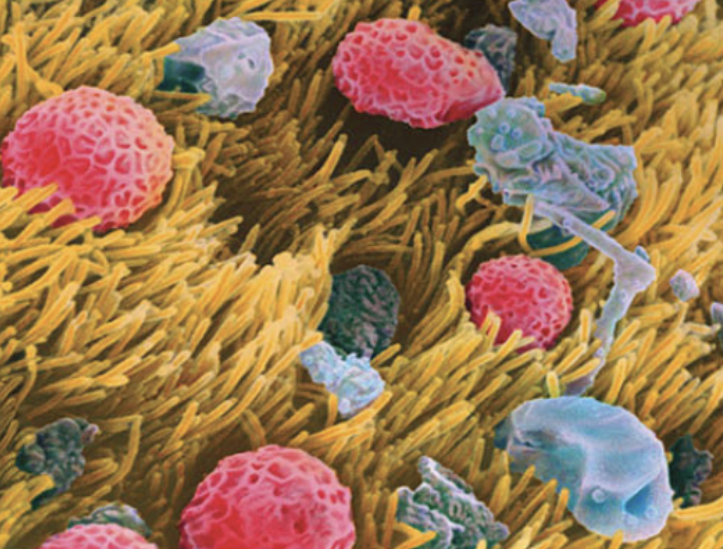
This microscopic image shows cilia in your trachea that have trapped pollen grains (pink), demonstrating how this defence system works.
Acid The hydrochloric acid in your stomach kills many pathogens that you might swallow with food or drink.
Beneficial bacteria Good bacteria in your body (like those in your digestive system) produce lactic acid, which prevents harmful pathogens from growing and taking over.
Second line of innate immunity
When pathogens manage to get past your first line of defence, your body activates its second line. This involves the destruction of pathogens by white blood cells and other defence mechanisms.
Phagocytic white blood cells When pathogens enter your body, they have special molecules on their surface that your white blood cells can recognise as foreign. These white blood cells then surround, engulf, and destroy the invading bacteria or viruses. This process is called phagocytosis.
Note
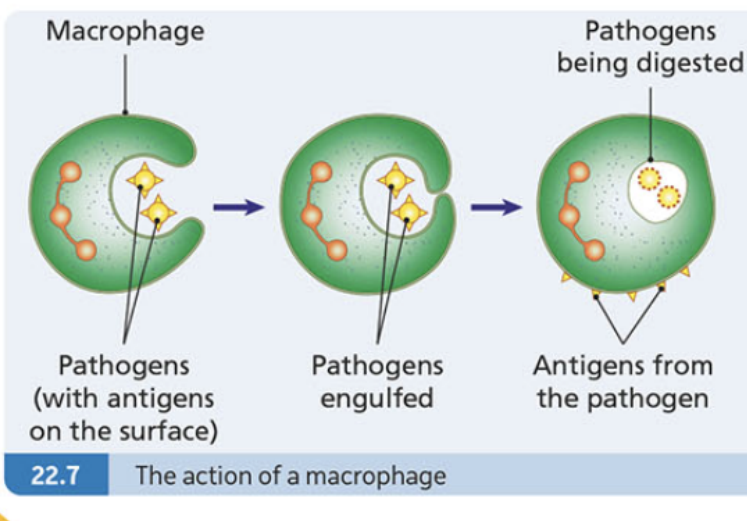
This diagram shows how a macrophage (a type of white blood cell) progressively engulfs and digests pathogens in three stages.
Some of these white blood cells, called macrophages, are particularly important:
- Some move around your body like patrol guards, acting as scavengers
- Others stay fixed in specific places like your spleen, tonsils, and other organs
- They philtre out and destroy any pathogens they encounter
- They can also be attracted to infected areas by chemical signals
Important
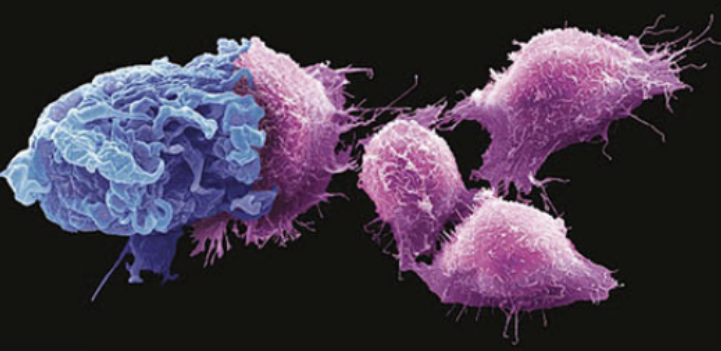
This microscopic image shows a macrophage (blue) in the process of engulfing cancer cells (pink), demonstrating how your immune system fights harmful cells.
Chemicals that destroy pathogens Your body produces several types of chemicals to fight infection:
- Complement - a set of about 30 proteins in your blood that get activated during infection to destroy viruses and other pathogens
- Interferons - proteins produced by virus-infected cells that help prevent viral multiplication and limit the spread of infections like colds and flu
Inflammation When cells are infected, a type of white blood cell releases chemicals (like histamines) that cause blood vessels to open wider and become more porous. This creates the swelling, redness, heat, and pain you experience during inflammation. While uncomfortable, inflammation helps fight infection by attracting more white blood cells to the area.
Acquired immunity
Acquired immunity is like having a highly trained, specialised security force that learns from experience. Unlike innate immunity, this system:
- Develops during your lifetime
- Is specific to particular pathogens
- Provides long-term memory and protection
- Gets stronger with exposure
Acquired immunity works through two main mechanisms:
Antibody production
Antigens are foreign molecules (usually found on the surface of pathogens) that your immune system recognises as threats. Think of them as criminal identification tags.
Antibodies are special proteins produced by white blood cells called lymphocytes. Each antibody is designed to recognise and bind to one specific antigen, like a key fitting into a specific lock.
Important
The Lock and Key Mechanism
The relationship between antigens and antibodies is highly specific - each antibody can only bind to its matching antigen. When this happens, the antibody marks the pathogen for destruction by other immune cells, or may trigger the complement system to destroy the pathogen.
Macrophages play a crucial role in this process. After they digest pathogens, they display pieces of the pathogen (antigens) on their surface. This "presents" the antigen to other immune cells, helping to stimulate antibody production.
White blood cells destroying infected body cells
Some white blood cells (lymphocytes) specialise in attacking your own body cells that have become infected with viruses or have turned cancerous. They can recognise when cells display foreign antigens on their surface and destroy these compromised cells to prevent the spread of infection.
Duration of acquired immunity
One of the most remarkable features of acquired immunity is its memory. After your body fights off an infection, some of the antibody-producing lymphocytes remain in your body as memory cells.
Example
Example: How Immune Memory Works
If the same pathogen enters your body again later, these memory cells can rapidly produce large amounts of the specific antibody needed - much more quickly and in greater quantities than during the first infection. This is why you usually don't suffer from the same infection twice, and if you do, the symptoms are typically much milder.
Active and passive acquired immunity
Acquired immunity can be gained in two different ways:
Active immunity
Active immunity occurs when your body produces its own antibodies in response to foreign antigens. This provides long-term protection because your lymphocytes create memory cells.
Natural active immunity This happens when you get infected by a pathogen in the normal way. Your body fights the infection and develops immunity naturally. For example, getting chickenpox usually provides lifelong immunity.
Artificial active immunity (vaccination) This occurs when a pathogen is medically introduced into your body through vaccination.
Example
Example: How Vaccination Works
Vaccination involves giving you a vaccine - a preparation containing a pathogen (or its toxin) that has been killed or weakened so it can't cause disease. This stimulates your immune system to produce antibodies without making you seriously ill.
A vaccine may contain:
- Pathogens that have been killed or treated so they cannot reproduce
- Only the outer wall or coat of the pathogen (containing the antigens needed to produce immunity)
- Small sections of RNA that cause your cells to manufacture parts of pathogen proteins, triggering antibody production
When you receive a vaccine, you may experience mild symptoms like soreness, low fever, or headache, but you gain long-term immunity without suffering the full effects of the disease.
Note
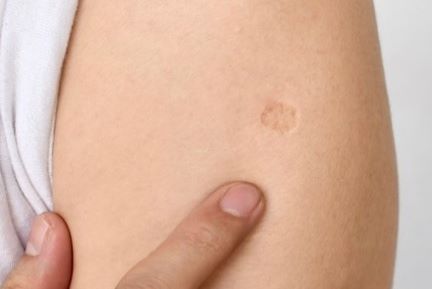
This image shows a TB vaccination scar, demonstrating the lasting physical evidence of immunisation.
Passive immunity
Passive immunity occurs when you receive antibodies that were produced by another organism. This provides only short-term protection because you don't develop your own memory cells.
Natural passive immunity This happens when a child receives antibodies from their mother in two ways:
- Across the placenta while in the womb
- Through breast milk (especially colostrum) during the first few days of breastfeeding
Important
These maternal antibodies provide the child with some immunity to common diseases for the first few months of life, until the child's own immune system develops.
Immunisation
Immunisation is the process of making a person resistant to an infectious disease, usually through vaccination. It's one of the most effective ways to prevent serious diseases.
Modern vaccination programmes protect children against diseases like diphtheria, meningitis, hepatitis, whooping cough, polio, tetanus, measles, mumps, and rubella. Recent developments include vaccines for influenza (flu) and cervical cancer, and most recently, Covid-19.
Note
The key to successful immunisation is that it typically produces antibodies without causing the full symptoms of the disease, while providing long-term immunity through memory cell formation.
Summary
Key Points to Remember:
-
Innate immunity is your inborn, non-specific defence system with two lines: physical/chemical barriers (first line) and white blood cell responses (second line)
-
Acquired immunity is specific, long-lasting protection that develops through exposure to particular pathogens via antibodies and memory cells
-
Active immunity involves producing your own antibodies (naturally through infection or artificially through vaccination) and provides long-term protection
-
Passive immunity involves receiving antibodies from another source (like mother to child) and provides only short-term protection
-
Vaccination stimulates your immune system safely by using killed or weakened pathogens to create immunity without serious disease