Bone (Leaving Cert Biology): Revision Notes
📚Revision Notes
Bone
- Bone is dense connective tissue that forms the major part of the skeleton.
- Long bones, like the femur, are enclosed by a membrane called the periosteum. This membrane contains blood vessels and nerves.
- The long shaft of the bone is called the diaphysis.
- The head of the bone is called the epiphysis.
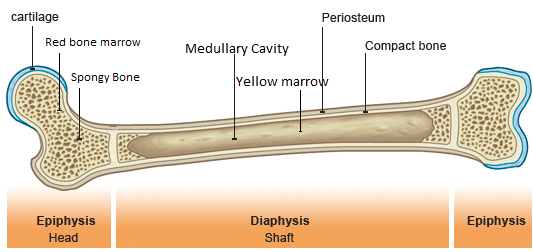
We will study:
- Compact bone
- Spongy bone
- Medullary cavity
- Cartilage
- Bone growth
- Bone renewal
Note
Can you name the four main types of animal tissue?
- Epithelial
- Connective
- Muscular
- Nervous
Compact Bone
- Compact bone is composed of bone cells called osteoblasts, enclosed in a matrix.
- The matrix is composed of;
- 70% inorganic salts (calcium, carbonate and phosphates).
- 30% organic material (protein-collagen).
- The inorganic material gives strength to the bone.
- The organic material gives the bone its flexibility.
- Compact bone also contains blood vessels and nerve fibres.
Spongy Bone
- Found mainly in the epiphysis of long bones.
- It looks like a sponge under a microscope.
- Its function is to provide strength and rigidity without adding excessive weight.
Medullary Cavity (Bone Marrow)
- The medullary cavity is filled with bone marrow, a soft material.
- Red bone marrow: active in making blood cells.
- Yellow bone marrow: inactive and contains numerous fat-storage cells. It can convert to active red marrow if needed.
Cartilage
- Cartilage is a flexible material made of protein fibres embedded in a rubbery matrix.
- Cartilage protects the ends of long bones and acts as a shock absorber.
- It lacks blood vessels and nerves.
Bone Growth
- Before week 8 of embryonic development, there is no bone, only cartilage.
- From week 8 onward, cartilage is replaced by bone in a process called ossification.
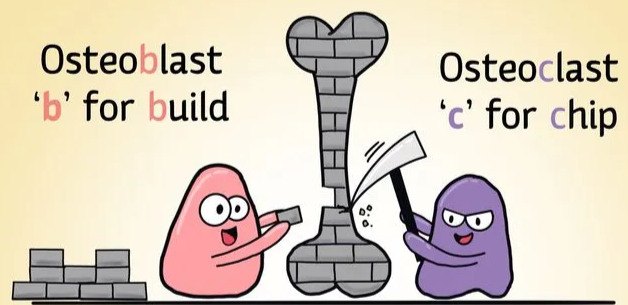
- Osteoblasts: Bone-forming cells that replace cartilage with bone.
- Osteoclasts: Cells that digest and remove old bone.
- Growth Plate: A section of cartilage between the medullary cavity and spongy bone that allows the bone to lengthen.
- In the growth plate, osteoblasts form new bone to increase the bone length.
- Growth plates stop functioning at approximately age 16 in females and 18 in males.
Bone Renewal
- Bone is constantly being renewed throughout life. There are two types of bone cells involved in this process:
3. Catabolic cells (osteoclasts):
- These bone-digesting cells remove calcium from the inside of the medullary cavity. They deposit this calcium in blood vessels.
- This prevents bones from becoming too heavy.
- Anabolic cells (osteoblasts):
- These bone-forming cells create new bone.
- The activity of these cells is influenced by physical activity, hormones, and diet.
Bone renewal is influence by:
- Physical activity
- Stimulates osteoblasts, resulting in stronger bones.
- Hormones
- Human Growth Hormone (HGH) and sex hormones (testosterone, oestrogen, progesterone) increase bone size and strength.
- Growth spurts during puberty are due to higher hormone levels.
- After menopause, lower oestrogen levels may reduce bone strength, increasing the risk of conditions like osteoporosis.
- Diet
- Calcium is crucial in the diet because bones are continually being broken down and rebuilt.