Ligaments, Tendons, Joints and Muscles (Leaving Cert Biology): Revision Notes
📚Revision Notes
Ligaments, Tendons, Joints and Muscles
Ligaments
- Ligaments connect bone to bone and are made of strong, elastic fibres.
- They prevent the excessive movement of bones at a joint.
- Ligaments are more flexible when warm, so warming up before exercise helps prevent damage.
Note
Ligaments prevent the excessive movement of bones at a joint.
Tendons
- Tendons connect muscle to bone and are strong, flexible, inelastic fibres.
- They are composed of collagen and contain some blood vessels.
Note
Collagen is a fibrous protein.
Joints
- A joint is where two or more bones meet.
- Joints are classified by the amount of movement they allow:
- Immovable (Fixed or Fused) Joints
- Found in the skull and pelvic girdle.
- The junction between fused bones is called a suture**.**
- These joints provide strength, support, and protection.
- Slightly Movable Joints
- Found between vertebrae in the upper spinal column.
- These joints are separated by pads of cartilage, which allow limited movement while providing cushioning and support.
- Freely Moveable (Synovial)
- The ends of the bones are covered with cartilage and separated by a cavity.
- Bones are held in place by ligaments, which prevent excessive movement of bones at joints.
- Synovial fluid is found between the bones. This fluid lubricates the joint and reduces friction.
- Examples of synovial joints:
- Ball and socket joints (e.g., shoulder and hip).
- Hinged joints (e.g., elbow and knee).
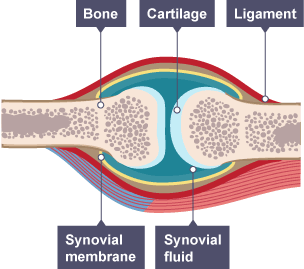
Synovial Joint
Musculoskeletal Disorder: Arthritis
Cause
- Caused by swelling of the joints.
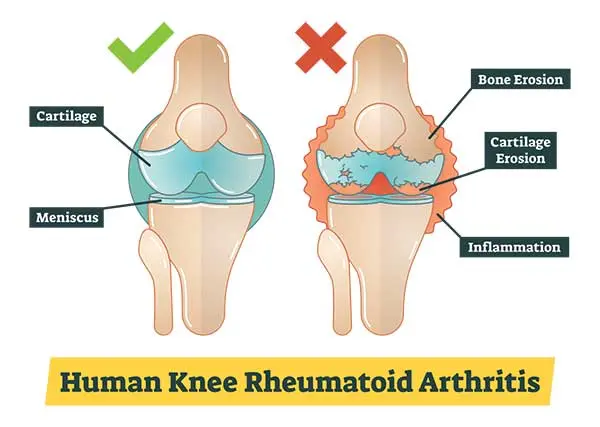
- Osteoarthritis is caused by wear and tear to cartilage in the joint. It usually affects one or a few joints.
- Rheumatoid arthritis is caused by the body's immune system attacking its own joints. It affects most joints in the body.
Prevention
- Osteoarthritis can be prevented by reducing wear and tear on joints.
- Use proper footwear and engage in non-impact exercise if a joint is sore or inflamed.
Treatment
- Arthritis is normally incurable.
- Treatment options:
- Rest.
- Weight loss.
- Special exercises to maintain agility.
- Anti-inflammatory medication.
- Surgery in severe cases to repair damage.
Muscles
- Muscles are adapted to contract.
- Muscles are made from protein.
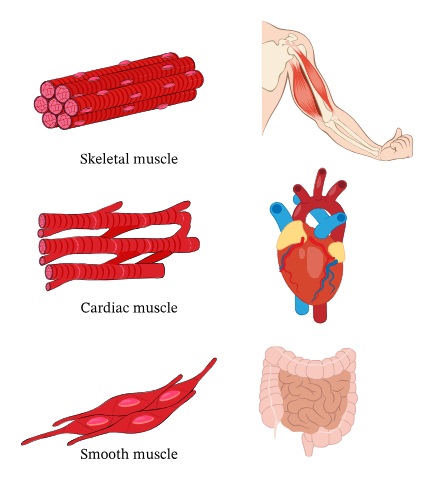
- There are 3 types of muscle:
- Involuntary (smooth): found in intestines, blood vessels and bladder.
- Cardiac: found in the heart and does not tyre.
- Voluntary (skeletal or striped): responsible for body movements and works in antagonistic pairs.
Antagonistic Pairs
- Antagonistic muscles are pairs of muscles that work opposite to each other e.g. biceps and triceps of the arm.
- The biceps contract while the triceps relax, which raises the forearm.
- The triceps contract while the biceps relax, which lowers the forearm.
