Neurons and Synapses (Leaving Cert Biology): Revision Notes
📚Revision Notes
Neurons and Synapses
What are neurons?
A neuron is a specialised nerve cell that forms the basic unit of the nervous system. These remarkable cells are designed to carry electrical signals (called nerve impulses) from one part of the body to another. Neurons enable communication throughout your body, allowing you to sense your environment, process information, and respond appropriately.
Note
Neurons vary greatly in size - some in your brain are microscopic, while others connecting your spine to your feet can be over a metre long! Despite this variation, all neurons share the same basic structure and function.
Structure of neurons
Understanding neuron structure is essential for understanding how they work. Each neuron has several key components that work together to transmit electrical impulses efficiently throughout the body.
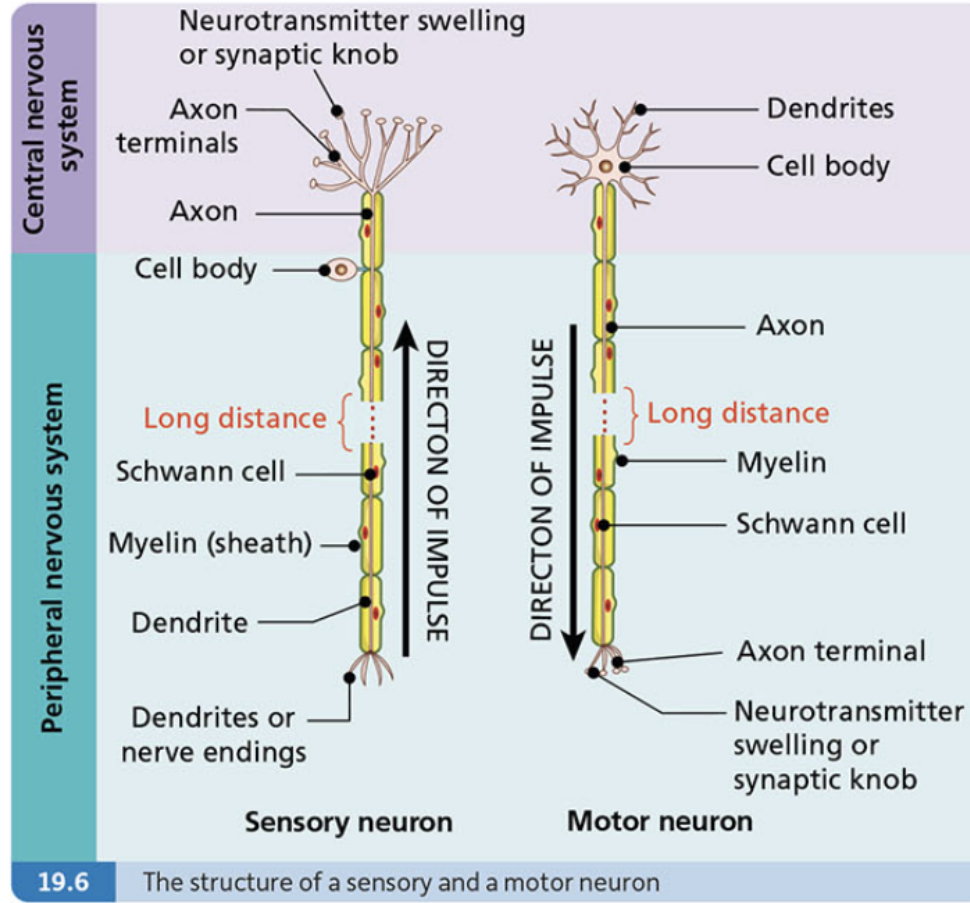
Key parts of a neuron:
- Cell body: Contains the nucleus and most organelles, including mitochondria that provide energy for nerve impulses
- Dendrites: Branched fibres that receive electrical impulses from other neurons and carry them towards the cell body
- Axon: A long projection that carries electrical impulses away from the cell body. Axons start with the letter 'A' and carry impulses 'Away' from the cell body
- Myelin sheath: A fatty layer that insulates electrical impulses, making transmission faster and more efficient
- Schwann cells: Specialised cells that produce the myelin sheath
- Axon terminals: Branches at the end of the axon that form connections with other neurons
- Neurotransmitter swellings (or synaptic knobs): Tiny swellings at axon terminals that store chemical messengers
Important
Remember the mnemonic: Axons carry impulses Away from the cell body, while Dendrites carry impulses toDays the cell body (towards).
Types of neurons
There are three main types of neurons, each with a specific job in the nervous system. Understanding their roles is crucial for comprehending how information flows through your body.
Sensory neurons
- Carry electrical impulses from sense organs to the central nervous system
- Their cell bodies are located outside the CNS in structures called dorsal root ganglia
- Examples: neurons that detect touch, pain, light, sound, or smell
Motor neurons
- Carry electrical impulses from the central nervous system to effectors (muscles or glands)
- Their cell bodies are located within the CNS
- These neurons cause muscles to contract or glands to secrete
Interneurons
- Short neurons found between motor and sensory neurons in the CNS
- They process information and make connections
- Not covered by myelin sheaths
- Essential for complex thinking and decision-making
Note
The pathway of information flow follows a logical sequence: Sensory neurons detect stimuli → Interneurons process the information → Motor neurons produce responses.
How electrical impulses work
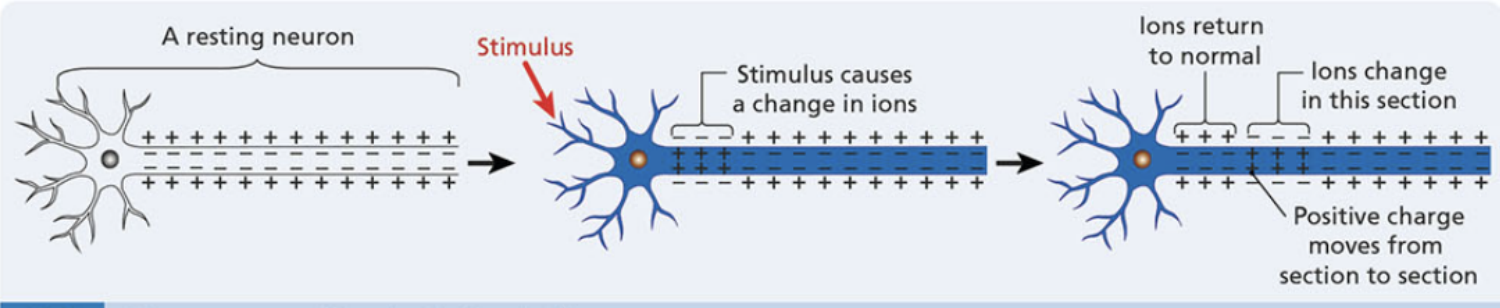
Neurons transmit information using electrical impulses, also called action potentials. This process involves the movement of charged particles (ions) across the neuron's membrane, creating a wave of electrical activity.
Example
How an Electrical Impulse Travels:
Step 1: Resting state - The neuron maintains a steady electrical charge across its membrane
Step 2: Stimulation - A stimulus causes the membrane to change its permeability to ions, allowing sodium ions to rush in
Step 3: Propagation - The electrical change triggers the next section of the neuron to change, creating a wave of electrical activity that travels along the axon at speeds up to 120 metres per second
This electrical signal travels much faster in neurons with myelin sheaths, as the impulse can 'jump' between gaps in the myelin rather than travelling continuously along the membrane.
Synapses and neurotransmission
A synapse is where two neurons come into close contact to pass on information. The tiny space between neurons at a synapse is called the synaptic cleft (or gap). Understanding synapses is crucial because they determine how information is processed and transmitted throughout the nervous system.

Structure of a synapse:
- Pre-synaptic neuron: The neuron sending the signal
- Post-synaptic neuron: The neuron receiving the signal
- Synaptic cleft: The microscopic gap between the two neurons (about 0.00002 mm wide)
How synapses work:
Example
Synaptic Transmission Process:
Step 1: Electrical impulse arrives - An electrical impulse reaches the axon terminal of the pre-synaptic neuron
Step 2: Neurotransmitter release - The impulse stimulates vesicles to release chemical messengers called neurotransmitters into the synaptic cleft
Step 3: Diffusion across the gap - Neurotransmitters diffuse across the synaptic cleft
Step 4: Binding to receptors - Neurotransmitters bind to specific receptors on the post-synaptic neuron
Step 5: New impulse generated - This binding generates a new electrical impulse in the post-synaptic neuron
Step 6: Cleanup - Neurotransmitters are either broken down by enzymes or reabsorbed by the pre-synaptic neuron for reuse
Important neurotransmitters
Different neurotransmitters have specific roles in brain function and behaviour. Understanding these chemical messengers helps explain many aspects of human behaviour, emotions, and bodily functions.
Acetylcholine (ACh)
- The first neurotransmitter discovered
- Crucial for muscle function, memory, and learning
- Found at neuromuscular junctions where neurons meet muscles
Dopamine
- Acts as a 'reward' chemical, giving feelings of pleasure and motivation
- Important for memory, mood, sleep, learning, and concentration
- Involved in addiction - pleasurable activities increase dopamine production
- Low dopamine levels are linked to depression and Parkinson's disease
Endorphins
- Natural 'feel-good' chemicals released during exercise, laughter, and stress
- Act as natural painkillers by blocking pain signals
- Reduce stress, anxiety, and depression
- Trigger the release of dopamine
Note
These neurotransmitters work together to regulate mood, motivation, and physical responses. Imbalances can lead to various mental health and neurological conditions, which is why understanding them is important for medical treatments.
Functions of synapses
Synapses do much more than simply pass on messages. They act as sophisticated control centres that regulate neural communication throughout the body.
- Control impulse direction: Neurotransmitters are only found on one side of the synapse, ensuring impulses travel in one direction only
- Prevent overstimulation: When constantly stimulated, neurotransmitter production decreases, preventing effectors from being overworked
- Allow modification: Impulses can be blocked or enhanced by drugs or other chemicals, which is important for pain control and treating psychiatric disorders
Important
The one-way nature of synaptic transmission is crucial for proper nervous system function. Without this directional control, nerve impulses would bounce back and forth chaotically, making coordinated responses impossible.
Reflex actions
A reflex action is an automatic, involuntary response to a stimulus that helps protect the body from harm. These responses are incredibly fast because the impulse doesn't need to travel all the way to the brain for processing.
Example
The Reflex Arc Pathway:
Step 1: Stimulus detected - Receptors (e.g., in the finger) detect a harmful stimulus like a hot flame
Step 2: Sensory neuron activated - The stimulus triggers an impulse in a sensory neuron
Step 3: Spinal cord processing - The impulse travels to the spinal cord where it connects with interneurons
Step 4: Motor response - Interneurons immediately activate motor neurons
Step 5: Effector response - Motor neurons cause muscles to contract, pulling the hand away from danger
Step 6: Brain awareness - Simultaneously, impulses travel to the brain, making you conscious of what happened
Common reflex examples:
- Pulling your hand away from something hot
- Blinking when something approaches your eyes
- The knee-jerk reflex when tapped below the kneecap
- Breathing and heart rate control
Note
Reflex actions occur in as little as 0.15 seconds, much faster than conscious responses which take about 0.5 seconds. This speed difference can be life-saving in dangerous situations.
Factors affecting neurotransmitters
Understanding what influences neurotransmitter production helps explain why lifestyle choices have such profound effects on mental health and wellbeing.
Exercise
Regular physical activity increases both dopamine and endorphin levels, leading to improved mood, motivation, and reduced stress. This explains why people often feel energised and happy after exercise.
Diet
- Protein-rich foods: Provide amino acids needed to make neurotransmitters like dopamine
- Sugary and processed foods: Can reduce dopamine effectiveness
- Healthy fats: Support overall brain function and neurotransmitter production
Lifestyle choices
Certain substances can dramatically affect neurotransmitter function:
- Recreational drugs can artificially increase dopamine and endorphin levels, but this reduces natural production and can lead to addiction
- Some medications work by blocking pain receptors or affecting neurotransmitter reuptake
Important
While external substances can temporarily boost neurotransmitter levels, they often disrupt the body's natural production mechanisms. This is why natural methods like exercise and proper nutrition are generally healthier long-term strategies.
Summary
Key Points to Remember:
-
Neurons are specialised cells that carry electrical impulses around the body using three main types: sensory (to CNS), motor (from CNS), and interneurons (within CNS)
-
Synapses are communication points between neurons where electrical signals are converted to chemical signals (neurotransmitters) and back to electrical signals
-
Key neurotransmitters include acetylcholine (muscle function/memory), dopamine (reward/motivation), and endorphins (natural painkillers/mood)
-
Reflex actions are automatic protective responses that bypass the brain for speed, travelling through the spinal cord via sensory neurons → interneurons → motor neurons
-
Lifestyle factors significantly impact neurotransmitter levels - exercise and good nutrition boost natural production while drugs can disrupt normal function