Hearing - The Ear (Leaving Cert Biology): Revision Notes
📚Revision Notes
Hearing - The Ear
- The ear has two main functions:
- Hearing
- Balance
- It consists of three sections: 3. Outer ear 4. Middle ear 5. Inner ear
- The outer and middle ear are filled with air.
- The inner ear is filled with a fluid called lymph.
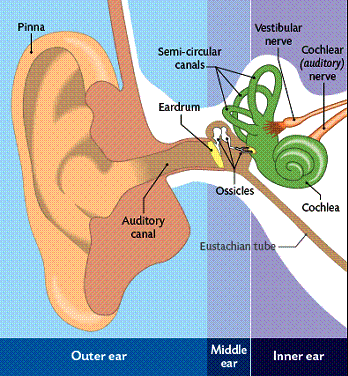
1. The Outer Ear
| Part | Function |
|---|---|
| Pinna | Made of cartilage. Collects vibrations in the air and channels them into the auditory canal. |
| Auditory canal | Carries vibrations to the eardrum. |
| Eardrum | A tightly stretched membrane that vibrates when stimulated by sound vibrations. |
2. The Middle Ear
| Part | Function |
|---|---|
| Ossicles | Three tiny bones (hammer, anvil, stirrup) that increase vibrations and pass them to the oval window. |
| Eustachian tube | Connects the middle ear to the pharynx (throat). Equalises pressure on either side of the eardrum. |
3. The Inner Ear
- The inner ear is filled with lymph fluid.
| Part | Function |
|---|---|
| Cochlea | • A spiral tube resembling a snail's shell. • Responsible for hearing. • Vibrations pass into the lymph in the cochlea through the oval window. As vibrations travel along the cochlea, they stimulate pressure receptors in the organ of Corti. sending impulses to the cerebrum via the auditory nerve. |
| Semi-Circular Canals | • Three canals positioned at right angles. • Part of the vestibular apparatus. • Responsible for balance. • Receptors in the semi-circular canals detect motion in all planes and send impulses to the cerebellum through the vestibular nerve. |
Note
Exam Focus:
- The stirrup is the smallest bone in the body.
- The femur is the largest bone in the body.
Hearing Disorder: Glue Ear
Cause
- Caused by fluid build-up in the middle ear, often due to a viral infection.
- Common in young children.
Symptoms
- Loss of hearing.
- Glue ear prevents the three bones of the middle ear moving correctly.
Correction
- Mild cases:
- Nose drops can unblock the Eustachian tube.
- Severe cases:
- Small tubes called grommets are inserted into the eardrum.
- They allow air into the middle ear, forcing fluid down the Eustachian tube.
- Over time, the grommets fall out of the eardrum by themselves.