Parts of the Nervous System (Leaving Cert Biology): Revision Notes
📚Revision Notes
Parts of the Nervous System
The nervous system is one of the most important body systems, responsible for controlling and coordinating all bodily functions. To understand how it works, we need to learn about its two main divisions and how they work together to keep us functioning properly.
Overview of nervous system organisation
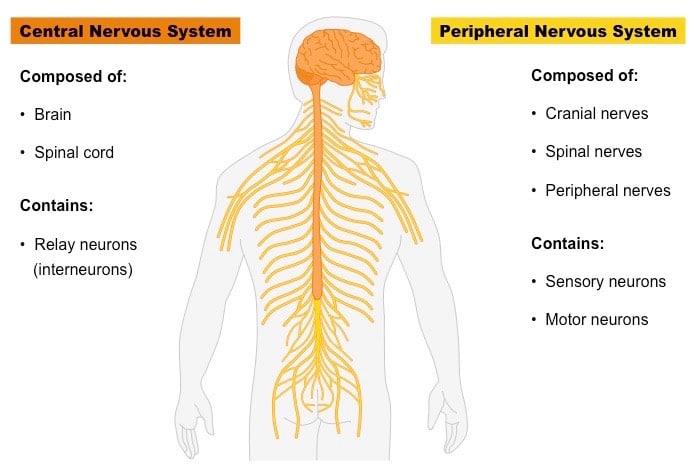
The nervous system has two main parts that work together as a team. These are the central nervous system (CNS) and the peripheral nervous system (PNS). Think of the CNS as the command centre, whilst the PNS acts like a communication network that connects this command centre to every part of your body.
Note
This teamwork analogy is helpful to remember: imagine the CNS as mission control and the PNS as all the communication satellites and ground stations that keep everything connected!
Central nervous system
The central nervous system serves as the main control hub for your entire body. It is made up of two key structures: the brain and the spinal cord.
Components of the CNS
The brain acts as the master control centre, making decisions and processing all the information it receives. It's where thinking, memory, and conscious decisions happen.
The spinal cord works like a major highway for information. It contains specialised nerve cells called neurons that carry messages back and forth between the brain and the rest of your body.
Functions of the CNS
The central nervous system has several important jobs:
- Receives information from all over the body through sensory signals
- Processes this information by analysing what it means and what should be done
- Makes decisions about how the body should respond
- Sends out commands to different parts of the body to carry out the appropriate response
This process happens incredibly quickly, often without you even being aware of it.
Example
Real-life Example: The Hot Touch Response
When you touch something hot, here's what happens in milliseconds:
- Sensory receptors in your skin detect the heat
- This information travels via the PNS to your spinal cord and brain
- Your CNS processes: "This is dangerous!"
- Your CNS immediately sends a signal back through the PNS
- Your muscles receive the command and pull your hand away
This entire process happens faster than you can consciously think about it!
Peripheral nervous system
The peripheral nervous system is like an extensive communication network that reaches every corner of your body. It connects the central nervous system to all your organs, muscles, and sensory receptors.
Components of the PNS
The PNS is made up of:
- Nerve fibres - these are like cables that carry electrical signals throughout your body
- Cell bodies - these are grouped together in clusters called ganglia
- Bundles of nerves - nerve fibres are organised into bundles that can be found in your arms, legs, and throughout your body
Important
Critical Concept: The PNS contains all nervous tissue that lies outside the brain and spinal cord. If it's not in the CNS, it's part of the PNS!
Functions of the PNS
The peripheral nervous system has one main job: carrying messages. It works in both directions:
- Sensory information travels from your body parts (like your eyes, ears, skin) towards the CNS
- Motor commands travel from the CNS out to your muscles and organs
Think of the PNS as a two-way postal service, constantly delivering messages between your brain and spinal cord and every other part of your body.
Location and structure
The cell bodies that make up the PNS are located in special groups called ganglia. These ganglia are found outside the central nervous system, often close to the spinal cord or in locations near the organs they serve, such as near the heart, lungs, and digestive organs.
Note
Ganglia vs. Brain/Spinal Cord: While the brain and spinal cord contain nerve cell bodies too, ganglia specifically refer to clusters of nerve cell bodies that are part of the PNS, located outside the CNS.
How the CNS and PNS work together
The central and peripheral nervous systems work as a coordinated team. Here's how they collaborate:
- Detection: The PNS detects changes in your environment or body
- Communication: The PNS sends this information to the CNS
- Processing: The CNS analyses the information and decides what to do
- Response: The CNS sends instructions back through the PNS to the appropriate body parts
- Action: The body part receives the message and responds accordingly
This partnership allows your body to respond appropriately to everything from simple reflexes to complex thoughts and movements.
Important
Remember: Neither system can function properly without the other. The CNS needs the PNS to gather information and carry out commands, while the PNS needs the CNS to process information and make decisions.
Summary
Key Points to Remember:
-
The nervous system has two main parts: the central nervous system (CNS) and peripheral nervous system (PNS)
-
The CNS includes the brain and spinal cord and acts as the control centre that processes information and makes decisions
-
The PNS is made up of all the nerves throughout your body that carry messages to and from the CNS
-
The CNS and PNS work together - the PNS collects information and delivers commands, whilst the CNS processes information and makes decisions
-
Ganglia are clusters of nerve cell bodies found outside the CNS that are part of the peripheral nervous system