Vegetative Propagation (LC 2026) (Leaving Cert Biology): Revision Notes
📚Revision Notes
Vegetative Propagation
Note
Vegetative propagation is a form of asexual reproduction in plants, where new plants are produced from parts of the parent plant. This process involves only one parent, and the offspring are genetically identical to the parent (clones).
Natural Vegetative Propagation
New plants grow from parts of the parent plant, such as stems, roots, leaves, or buds.
1. Stems:
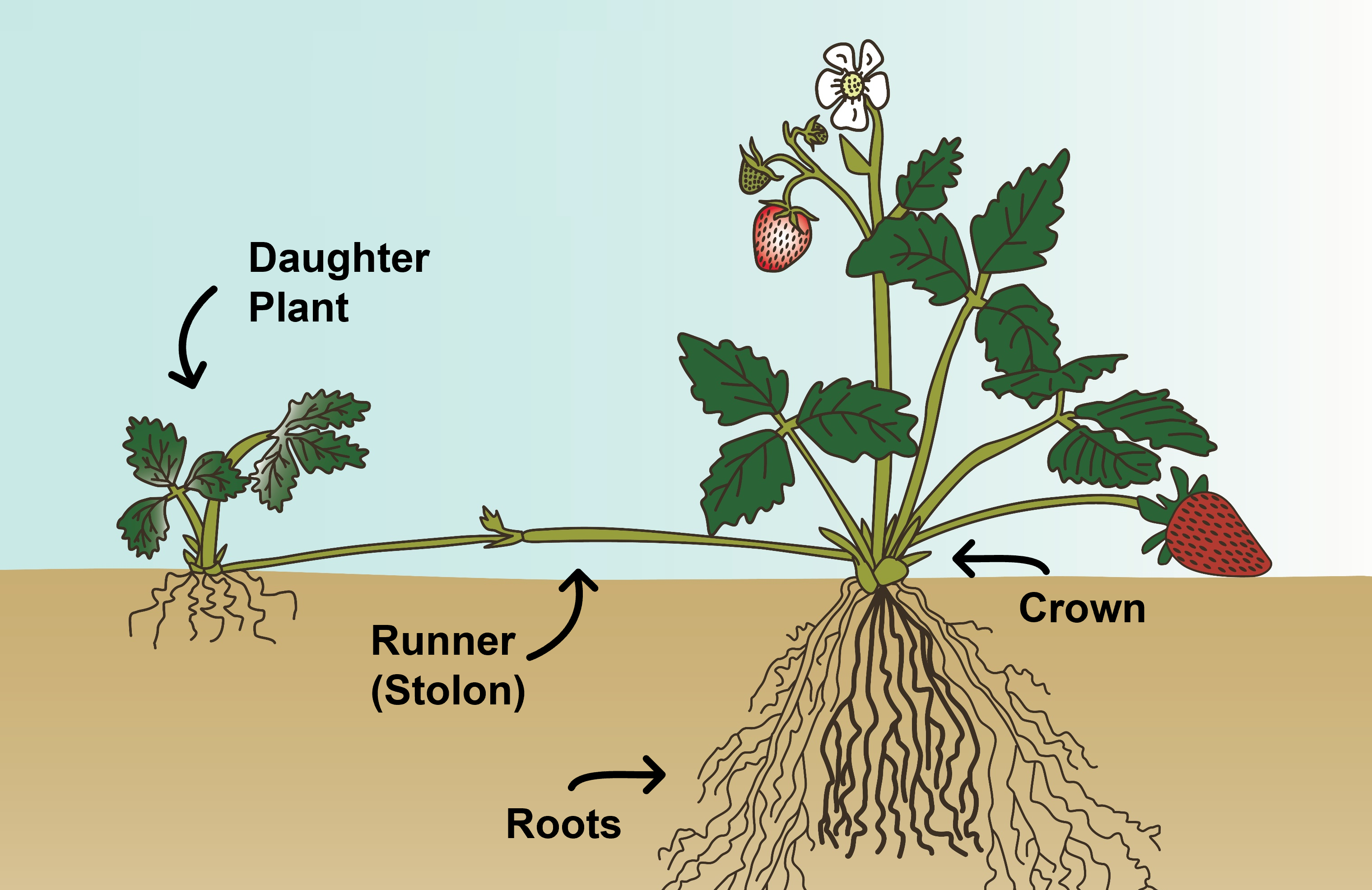
- Runners: Horizontal stems that grow above ground and produce new plants at their nodes.
- Example: Strawberries.
2. Roots:
- Tubers: Swollen underground roots that develop buds, which grow into new plants.
- Example: Dahlia tubers.
3. Leaves:
- Some plants can grow new plants from their leaves if they detach from the parent plant or produce small plantlets along their edges.
- Example: Mother of Thousands.
4. Buds:
- Bulbs: Modified buds that contain a central apical bud and lateral buds, which grow into new plants.
- Example: Onions.
Artificial Vegetative Propagation
Horticulturists and farmers use artificial methods to propagate plants with desirable traits.
1. Cuttings:
- A part of the plant (usually a shoot with leaves) is cut and planted to grow into a new plant.
- A growth promoter can be used to encourage root formation.
2. Layering:
- A shoot of the parent plant is bent and buried in soil, with the tip remaining above ground.
- Roots develop from the buried portion, and the new plant can be separated.
- Example: Blackberries.
3. Grafting:
- Two plants are joined together to combine desirable traits:
- The scion (the shoot of one plant) is attached to the stock (the rooted portion of another plant).
- Example: Apple trees.
4. Micropropagation (Tissue Culture):
- Growth of plants from small tissue samples under sterile conditions on an artificial medium.
- Used to produce large numbers of genetically identical plants.
Comparison of Sexual and Asexual Reproduction
| Feature | Asexual Reproduction (Vegetative Propagation) | Sexual Reproduction |
|---|---|---|
| Number of Parents | One | Two |
| Gametes Involved? | No | Yes |
| Meiosis and Fertilisation | No | Yes |
| Genetic Variation | None (clones) | Offspring are genetically varied |
| Speed | Fast | Slower |
| Resistance to Diseases | Less resistant | More resistant |
Advantages and Disadvantages of Vegetative Propagation
Advantages:
- Produces plants quickly.
- Retains desirable traits (since offspring are clones).
- Does not require external factors like pollinators.
Disadvantages:
- No genetic variation, which can make plants more susceptible to diseases.
- Lack of adaptability to environmental changes.