Costs & Revenue (Leaving Cert Business): Revision Notes
📚Revision Notes
Costs & Revenue
Understanding costs
Costs represent the expenses a business must pay to operate and produce its goods or services. Understanding different types of costs is crucial for business decision-making and financial planning. Costs can be categorised into two main types based on how they behave when production levels change.
Fixed costs
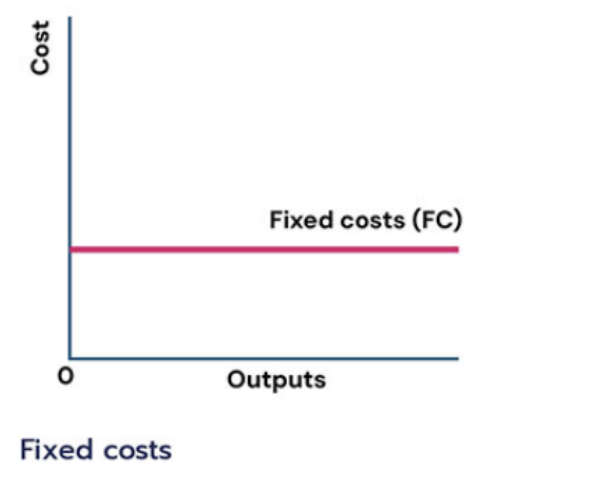
Fixed costs are business expenses that remain constant regardless of how much the company produces or sells. These costs must be paid whether the business makes one unit or one thousand units.
Common examples of fixed costs include:
- Rent for premises
- Insurance premiums
- Loan repayments
- Salaries of permanent staff
- Business rates
Note
The graph above shows how fixed costs behave - they remain at the same level no matter how much output the business produces. This creates a horizontal line when plotted against production levels.
Variable costs
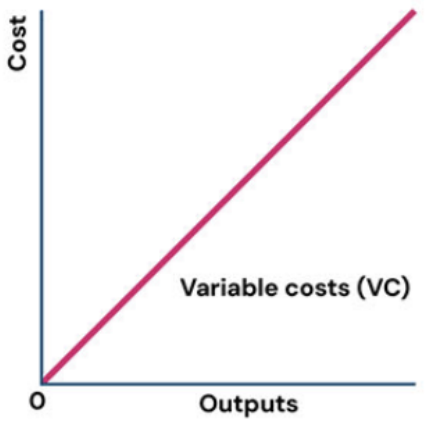
Variable costs change directly with the level of production or business activity. As output increases, these costs increase proportionally. When production decreases, variable costs also fall.
Examples of variable costs include:
- Raw materials
- Direct labour wages
- Energy costs for production
- Packaging materials
- Delivery costs
Note
This graph demonstrates how variable costs behave - they start at zero when there's no production and rise steadily as output increases. This creates an upward-sloping line from the origin.
Why understanding costs matters
Important
Businesses need to clearly identify and categorise their costs because this helps them:
- Estimate total production costs accurately
- Make pricing decisions
- Plan for different levels of production
- Identify areas where costs can be controlled
- Understand how costs behave as the business grows or shrinks
Understanding revenue
Revenue is the total amount of money a business receives from its trading activities. It represents the income generated before any costs are deducted. Revenue is essential for business survival - without it, a company cannot cover its costs or generate profit.
The importance of revenue
Note
Revenue serves as a key performance indicator that shows:
- How much customers value the business's products or services
- The effectiveness of the business's sales and marketing efforts
- The business's ability to compete in the market
- Whether the business can sustain itself financially
Types of revenue streams
A revenue stream refers to a specific source of income for the business. Companies often have multiple revenue streams to reduce risk and increase total income.
Single transactions
Single transaction revenue comes from one-off purchases where customers pay once for a product or service.
Characteristics of single transactions:
- Easy to record and monitor
- Provide flexibility to adjust prices based on market conditions
- Allow businesses to build personal connections with customers
- Can be affected by price competition, potentially reducing profit margins
Examples include:
- A clothing retailer like Zara selling individual items in-store or online
- A restaurant selling meals to walk-in customers
- A concert venue selling tickets to events

Recurring sales
Recurring sales involve regular payments from customers for continued access to products or services. This creates a more predictable and stable income stream.
Types of recurring revenue include:
- Subscription services: Customers pay monthly or annually for ongoing access (e.g., Netflix, Spotify)
- Usage fees: Charges based on how much customers use facilities or services (e.g., gym memberships, mobile phone plans)
- Rental fees: Regular payments for using properties or equipment (e.g., car rentals, office space)
- Maintenance fees: Ongoing charges for support and upkeep services
Note
Benefits of recurring sales:
- Provides predictable income flow
- Builds long-term customer relationships
- Reduces marketing costs for repeat customers
- Creates stable foundation for business planning
Important
Challenges of recurring sales:
- Risk of customer cancellation
- Need to maintain consistent service quality
- Potential for intense competition in subscription markets
- May result in customer disconnection without personal touch
Revenue stream examples
Example
Business Example: Amazon's Multiple Revenue Streams
Amazon demonstrates multiple revenue streams effectively:
- Online retail sales: Selling products through their website and app
- Subscription services: Amazon Prime membership fees
- Cloud computing services: Amazon Web Services (AWS) providing business solutions
This diversification helps Amazon maintain steady income even if one revenue stream faces challenges.
Choosing appropriate revenue streams
Note
When selecting revenue streams, businesses should consider:
- Alignment with core activities: The revenue stream should match the business's main value proposition
- Market needs: Understanding what customers are willing to pay for
- Flexibility: Ability to adapt as customer needs and market conditions change
- Value extension: Ways to increase customer value and differentiate from competitors
Key considerations for costs and revenue
Cost control strategies
Note
Successful businesses actively manage their costs by:
- Regularly reviewing fixed costs to identify savings opportunities
- Monitoring variable costs to ensure efficiency
- Implementing cost control measures during slow periods
- Planning for cost changes as the business expands
Revenue optimisation
Note
To maximise revenue, businesses can:
- Diversify revenue streams to reduce dependency on single sources
- Focus on recurring revenue for stability
- Regularly review pricing strategies
- Invest in customer retention to maintain revenue flows
The relationship between costs and revenue
Understanding both costs and revenue is essential for business success because:
- Profit calculation: Profit = Revenue - Total Costs
- Break-even analysis: Businesses need to know when revenue will cover all costs
- Growth planning: Understanding cost behaviour helps predict financial needs for expansion
- Pricing decisions: Costs provide the baseline for setting profitable prices
Summary
Key Points to Remember:
- Fixed costs stay the same regardless of production levels, while variable costs change with output
- Revenue streams can be single transactions (one-off sales) or recurring sales (ongoing payments)
- Businesses benefit from having multiple revenue streams to reduce risk and increase stability
- Understanding cost behaviour helps businesses make better pricing and production decisions
- Recurring revenue provides more predictable income than single transactions alone