Key Concepts in Climate Justice and Response (Leaving Cert CASD): Revision Notes
📚Revision Notes
Key Concepts in Climate Justice and Response
Introduction to climate justice
Climate change affects everyone, but it doesn't affect everyone equally. This is where the idea of climate justice comes in - it recognises that different countries, communities and individuals have contributed differently to causing climate change, yet they experience its impacts in very unequal ways.
Note
Climate justice is a fundamental concept that connects environmental science with social equity and fairness. It helps us understand why climate solutions must consider both effectiveness and fairness.
Understanding key concepts like mitigation, adaptation, climate debt, ecological debt, and loss and damage helps us see how climate action must be both effective and fair.
Climate change mitigation
What is mitigation? Mitigation means taking action to reduce or prevent greenhouse gas emissions so we can limit how much the climate changes in the future. Think of it as tackling the root causes of climate change - the emissions that are heating up our planet.
Why mitigation matters: Mitigation is absolutely essential if we want to keep global warming within safe limits. The Paris Agreement aims to limit warming to or above pre-industrial levels, and this is only possible through major mitigation efforts worldwide.
Example
Real-world Examples of Mitigation:
- Switching energy systems from fossil fuels (coal, oil, gas) to renewable sources like wind and solar power
- Making buildings more energy efficient through better insulation and retrofitting
- Expanding public transport networks so people rely less on private cars
- Protecting existing forests and planting new ones, as trees absorb carbon dioxide from the atmosphere
Climate change adaptation
What is adaptation? Adaptation involves adjusting human and natural systems so they can cope with climate change impacts that are already happening or are unavoidable. Rather than tackling the causes like mitigation does, adaptation focuses on managing the consequences of climate change.
Why adaptation is necessary: Even with strong mitigation efforts, some climate change is already locked in due to past emissions. Communities need to adapt to survive and thrive despite changing conditions.
Important
There's a crucial limitation with adaptation - without proper mitigation, the scale of adaptation needed could become completely overwhelming. Adaptation has limits and cannot solve climate change on its own.
Example
Real-world Examples of Adaptation:
- Building flood defences in coastal cities like Cork to protect against rising sea levels
- Developing drought-resistant crop varieties for farmers in Sub-Saharan Africa
- Creating early warning systems to help communities prepare for cyclones and hurricanes
- Helping communities relocate from low-lying areas that are becoming uninhabitable due to sea-level rise
Climate debt
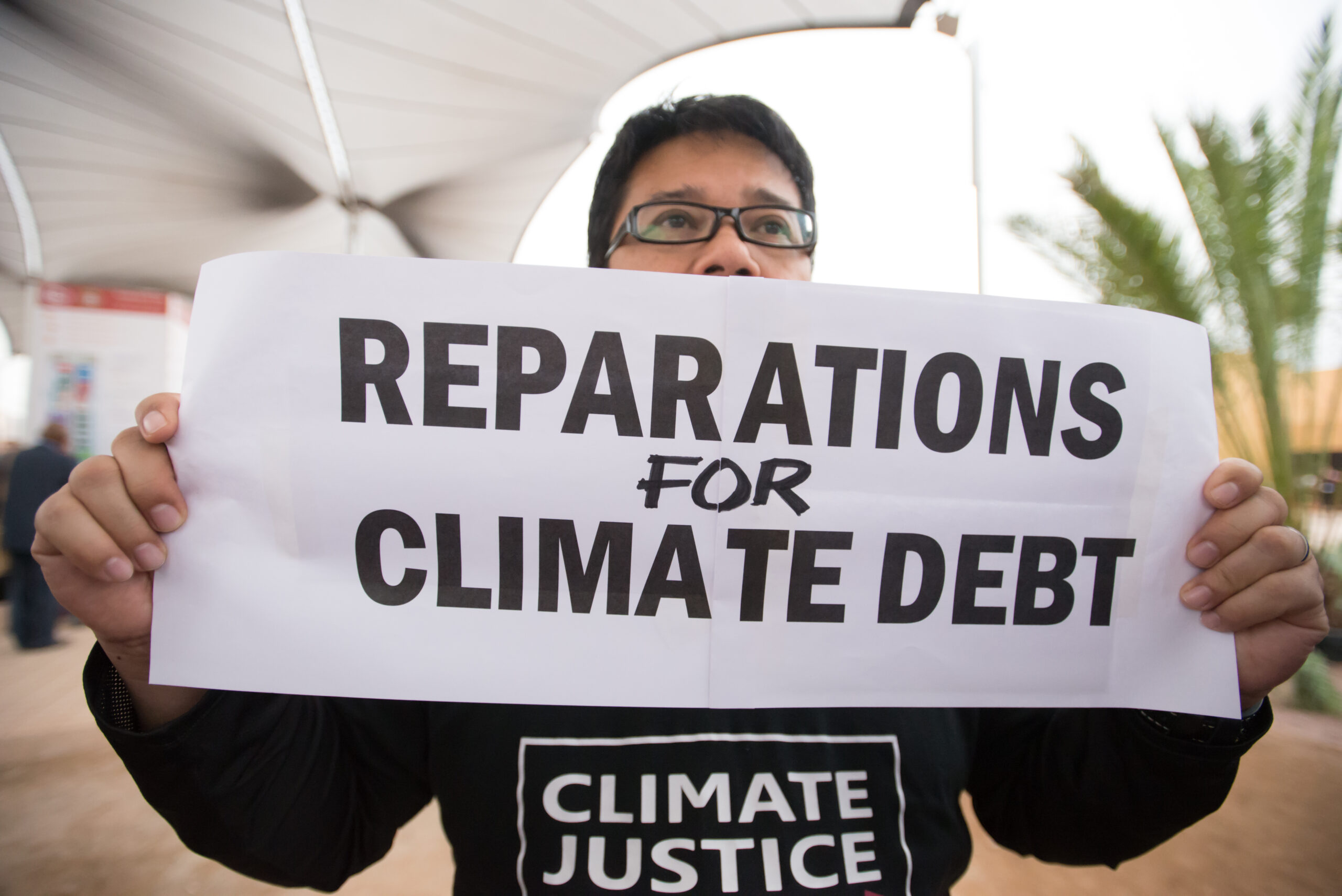
What is climate debt? Climate debt recognises that wealthy, industrialised countries (often called the Global North) owe a 'debt' to poorer countries (the Global South) because of their historical role in causing climate change and the unfair way climate impacts are distributed globally.
Important
The Fundamental Injustice: The countries that have emitted the most greenhouse gases historically (like the United States and EU nations) often face fewer severe climate impacts. Meanwhile, countries that have contributed very little to the problem (like Bangladesh or small island states) face catastrophic consequences.
Climate debt in action: At international climate meetings (COP conferences), there are regular demands for wealthy nations to provide financial support to help poorer countries both adapt to climate change and reduce their own emissions. This reflects the principle that those who caused the problem should help pay for the solutions.
Ecological debt
What is ecological debt? Ecological debt is a broader concept that includes climate debt but goes further to recognise how wealthy countries have overused and exploited natural resources in poorer countries. It's about the total environmental cost of unsustainable consumption patterns.
Example
Examples of Ecological Debt:
- Large-scale deforestation of the Amazon rainforest to provide beef and soy for global markets
- Mining operations in Africa extracting cobalt and lithium for smartphones and electric cars, often with poor working conditions and environmental destruction
- Industrial fishing fleets from wealthy nations depleting fish stocks in West African waters
The global impact: Ecological debt shows how unsustainable consumption in wealthy countries creates long-term environmental harm and deepens global inequality. It demonstrates that environmental problems are often social justice problems too.
Climate loss and damage
What is loss and damage? Loss and damage refers to the harm caused by climate change that cannot be prevented through mitigation or stopped through adaptation. This includes both economic losses (like destroyed crops or infrastructure) and non-economic losses (like cultural heritage or forced migration).
Example
Examples of Irreversible Harm:
- Small island nations like Tuvalu permanently losing land to sea-level rise
- Cultural heritage sites destroyed by climate-related wildfires in Greece or Australia
- Farmers in Mozambique losing entire harvests to extreme weather events like Cyclone Idai
- Millions of people displaced by flooding, such as in Pakistan in 2022
Note
Recent Breakthrough: At COP27 in 2022, countries agreed to establish a Loss and Damage Fund to provide financial support to vulnerable countries facing irreversible climate impacts. This was seen as a major victory for climate justice movements worldwide.
How these concepts connect
Summary
Understanding the Full Picture of Climate Justice:
- Mitigation tackles the root causes by reducing emissions
- Adaptation helps manage the impacts we can't prevent
- Climate debt and ecological debt highlight questions of fairness and historical responsibility between nations
- Loss and damage recognises that some harm is irreversible and requires compensation
Together, these concepts form the foundation of climate justice - the idea that climate action must be both effective in addressing the problem and fair in how the costs and benefits are shared.
Exam tips
Important
Essential Exam Strategies:
When writing about these concepts in your exam:
- Define each concept clearly in one concise sentence
- Provide specific examples - real places, real impacts, real solutions
- Connect to justice and fairness by explaining who caused the problems versus who suffers the consequences
- Show understanding of scale - explain why global cooperation is essential for addressing these challenges
Remember!
Summary
Key Points to Remember:
- Mitigation and adaptation work together - we need both to address climate change effectively
- Climate debt recognises historical responsibility - those who contributed most to the problem should contribute most to solutions
- Ecological debt shows the broader pattern of wealthy countries exploiting resources from poorer regions
- Loss and damage addresses irreversible harm that requires compensation, not just prevention
- Climate justice connects environmental and social issues - effective climate action must also be fair climate action