Innovative Communities (Leaving Cert CASD): Revision Notes
📚Revision Notes
Innovative Communities
Understanding climate adaptation through community innovation
Adaptation refers to how communities adjust to the actual or expected effects of climate change. Around the world, innovative communities are developing creative solutions to protect their livelihoods, culture, and environment from climate challenges. By comparing approaches from different regions, we can see how communities respond to similar threats using vastly different resources and methods.
Note
The comparison between Ireland (representing the Global North) and countries in the Global South reveals fascinating differences in innovation approaches. While Irish communities often have access to advanced technology and financial support, Global South communities frequently rely on traditional knowledge and low-cost innovations.
However, both regions demonstrate remarkable creativity in developing community-led solutions to climate challenges. This shared innovative spirit shows that effective adaptation can happen regardless of available resources.
Irish case studies: High-tech sustainability approaches
Cloughjordan ecovillage, County Tipperary
This pioneering community, established in the early 2000s, represents Ireland's first purpose-built eco-community. Home to approximately 100 residents, Cloughjordan was designed as a living demonstration of sustainable development principles.
Example
Case Study: Cloughjordan Ecovillage Innovation
Climate challenges addressed:
Ireland faces significant challenges including high carbon emissions from fossil fuel dependence and changing rainfall patterns that require both mitigation and adaptation strategies.
Innovative solutions implemented:
-
Energy-efficient housing: All homes meet exceptional energy efficiency standards with advanced insulation systems and low-energy heating
-
Renewable energy systems: A district heating system powered by renewable biomass (woodchip) and solar panels provides clean energy
-
Local food production: Community farms and allotments reduce reliance on imported goods and strengthen food security
-
Sustainable transport: Car-sharing schemes and cycling infrastructure minimise transport emissions
-
Education and knowledge sharing: Regular workshops spread sustainability knowledge beyond the village boundaries
Effectiveness and impact:
The ecovillage has achieved a carbon footprint significantly below Ireland's national average, proving that sustainable community living is both possible and practical. However, its small scale means that not all solutions can easily transfer to larger urban areas.
Aran Islands energy co-operative, County Galway
This community-owned initiative demonstrates how remote communities can achieve energy independence through cooperative action.
Key innovations:
-
Renewable energy mix: Combines wind, solar, and biomass technologies to reduce dependence on imported fossil fuels
-
Community ownership model: Local residents collectively own and manage the energy systems
-
Housing improvements: Better insulation helps homes adapt to increasingly unpredictable weather patterns
Cork city flood adaptation
Urban communities in Cork have developed collaborative approaches to flood management that balance protection with environmental and heritage considerations.
Community engagement features:
-
Collaborative planning: Residents participate actively in discussions about flood defence schemes including tidal barriers and raised infrastructure
-
Integrated approach: Solutions consider flood protection alongside heritage preservation and environmental protection
Global South case studies: Traditional knowledge meets modern challenges
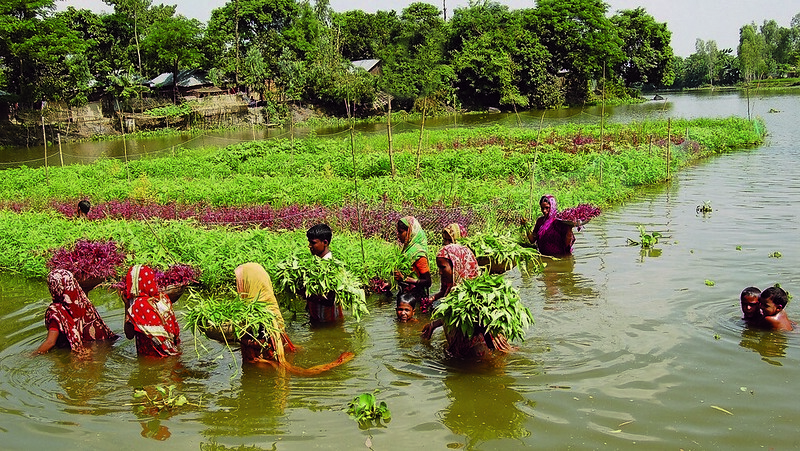
Floating gardens in Bangladesh
Bangladesh faces some of the world's most severe climate change impacts, with low-lying areas regularly flooded by monsoon rains and rising sea levels.
Example
Case Study: Bangladesh Floating Gardens
Climate challenges:
Frequent flooding threatens farmland, creating food insecurity and poverty as farmers lose crops and income annually.
Traditional innovation scaled up:
-
Floating garden construction: Farmers create rafts using water hyacinth and bamboo that float on floodwaters
-
Crop selection: Vegetables like cucumbers, gourds, and leafy greens grow successfully on these floating platforms
-
Flood-resistant farming: Gardens remain productive even when traditional fields become submerged
-
Knowledge transfer: Traditional techniques are being expanded with NGO support to reach more communities
-
Diversification: Some areas experiment with floating schools and homes
Effectiveness:
These low-cost solutions provide food security during flood seasons and use entirely local materials, making them highly accessible. They preserve traditional farming culture while addressing modern climate challenges. However, the gardens remain vulnerable to severe cyclones and long-term sea-level rise.
Solar-powered villages in Kenya
Rural Kenyan communities have embraced community solar projects to address energy poverty while reducing dependence on polluting kerosene.
Note
Benefits achieved:
-
Clean energy access: Reliable electricity in previously unconnected rural areas
-
Health improvements: Reduced indoor air pollution from kerosene lamps
-
Economic opportunities: Small businesses can operate with reliable power
-
Reduced costs: Lower energy expenses compared to purchasing kerosene regularly
Rainwater harvesting in Rajasthan, India
Communities in arid Rajasthan have revived traditional water conservation techniques to cope with drought and unpredictable monsoon patterns.
Traditional methods modernised:
-
Infrastructure revival: Ancient tanks and stepwells are restored and maintained
-
Adaptation strategy: Helps communities manage both drought periods and irregular monsoon rains
-
Food and water security: Strengthens resilience in water-scarce regions
Comparing innovation approaches
Important
Key Differences in Innovation Approaches
Resource differences:
Irish communities typically access greater financial support and advanced technology, enabling high-tech solutions like sophisticated renewable energy systems. Global South communities demonstrate remarkable ingenuity by maximising local materials and traditional knowledge to create effective, low-cost innovations.
Challenge focus:
Ireland prioritises energy transition and flood management as primary concerns, while Global South communities often address immediate survival needs around food and water security under more extreme climate conditions.
Innovation styles:
Both regions show impressive creativity, but through different approaches. Ireland tends towards planned, technology-based solutions, while Global South examples often involve nature-based adaptations that build on generations of traditional knowledge.
Common lessons:
Despite their different contexts, all these communities demonstrate that local innovation - whether high-tech or traditional - proves essential for building resilience to climate change. Community ownership and engagement appear crucial for success in both contexts.
Exam preparation guidance
When analysing these case studies in exams, structure your comparison around four key questions:
Summary
Exam Framework for Case Study Analysis:
-
What climate challenge does the community face? - Be specific about local climate impacts
-
What solution are they implementing? - Describe the innovation clearly
-
How effective is their approach? - Consider both successes and limitations
-
What does this reveal about community resilience and innovation? - Draw broader conclusions
Important
Top exam tip: Always select one case study from Ireland and one from the Global South to demonstrate your understanding of how different communities adapt to climate challenges using the resources available to them.
Remember!
Summary
Key Points to Remember:
-
Adaptation means adjusting to climate change effects - communities worldwide are finding creative ways to do this
-
Irish examples typically use advanced technology and planned approaches, while Global South examples often rely on traditional knowledge and local materials
-
Community ownership and local engagement are crucial for success in both high-tech and traditional approaches
-
All these communities show that innovation can happen at any scale - from floating gardens to renewable energy cooperatives
-
When comparing case studies, focus on the climate challenge, solution, effectiveness, and what it shows about community resilience