Introduction to Acids and Bases (Leaving Cert Chemistry): Revision Notes
📚Revision Notes
Introduction to Acids and Bases
What are acids?
The word "acid" comes from the Latin word acidus, which means sour. This gives us a clue about one of the main properties of acids - they have a sour or sharp taste. However, never taste chemicals in the laboratory as many acids are dangerous and corrosive.
Important
Safety Warning: Never taste chemicals in the laboratory as many acids are dangerous and corrosive.
Acids are substances that have certain characteristic properties:
- They taste sour (though you should never test this!)
- They can be corrosive and dangerous
- They turn blue litmus paper red
- They react with bases to form salts and water
Common acids in everyday life
Many acids are actually part of our daily lives, often without us realising it. The variety of acids around us demonstrates just how important these substances are in both natural and artificial processes.
Note
Acids are found everywhere in nature and in manufactured products, from the vitamin C in our food to the acids that help our digestion.
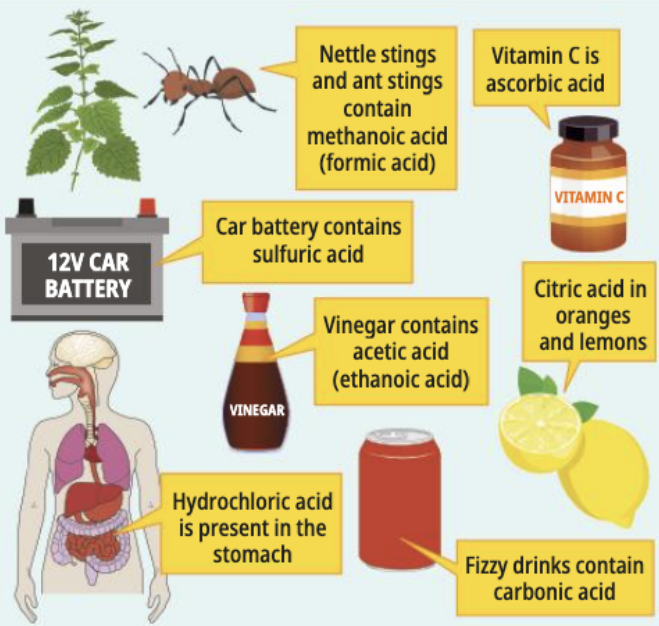
Natural acids:
- Formic acid (methanoic acid) - found in nettle stings and ant bites
- Citric acid - present in citrus fruits like lemons and oranges
- Ascorbic acid - this is vitamin C, found in many fruits and supplements
Acids in food and drink:
- Acetic acid (ethanoic acid) - the acid in vinegar that gives it its sharp taste
- Carbonic acid - formed when carbon dioxide dissolves in water, found in fizzy drinks
Industrial and bodily acids:
- Hydrochloric acid - produced naturally in your stomach to help digest food
- Sulphuric acid - used in car batteries (extremely corrosive!)
What are bases?
Bases are often called the "chemical opposites" of acids. They have different properties and behave differently in chemical reactions.
Key properties of bases:
- They feel slippery or soapy to touch (but don't test this - it can be dangerous!)
- They turn red litmus paper blue
- They react with acids to neutralise them
- Many are corrosive, especially strong bases
Note
Understanding Alkalis
Alkalis are a special type of base - they are bases that dissolve in water. For example, sodium hydroxide (NaOH), also called caustic soda, is a common alkali that dissolves in water and is highly corrosive.
Common bases in everyday life
Just like acids, bases are found in many household products. Understanding where bases are used helps explain why they are so important in cleaning and health applications.
Cleaning products:
- Many household cleaners contain bases because they react with fats and oils to help remove grease
- Oven cleaners and window cleaners often contain basic substances
- These convert oil and grease into soluble soaps that wash away easily
Health and medicine:
- Antacids contain bases like calcium carbonate to neutralise excess stomach acid
- Milk of Magnesia contains magnesium hydroxide, used to treat indigestion
Other household items:
- Drain cleaners often contain strong bases like sodium hydroxide (caustic soda)
- Baking powder contains basic substances used in cooking
- Toothpaste contains basic ingredients to help neutralise acids that cause tooth decay
Testing acids and bases
One of the simplest ways to identify whether a substance is acidic or basic is using litmus paper. This practical test has been used by chemists for many years and remains one of the most reliable simple tests available.
Example
Practical Example: Using Litmus Paper
Step 1: Take a piece of litmus paper (either red or blue)
Step 2: Dip it into the unknown solution
Step 3: Observe the colour change:
- Blue litmus paper turns red when it touches an acid
- Red litmus paper turns blue when it touches a base
This colour change happens because acids and bases have opposite effects on the litmus indicator.
Acid-base reactions
When acids and bases meet, they undergo a special type of reaction called neutralisation. In this reaction:
- The acid and base react together
- They produce a salt and water
- The acidic and basic properties cancel each other out
Example
Example of Neutralisation
Calcium hydroxide (found in limewater) reacts with acids. When dissolved in water, it produces "limewater" which is used to test for the presence of carbon dioxide. This demonstrates how bases can neutralise acids while producing useful products.
Safety with acids and bases
Working safely with acids and bases is absolutely essential in any laboratory or practical situation. These substances can cause serious harm if not handled properly.
Important
Critical Safety Reminders:
- Many acids and bases are corrosive and can cause burns
- Always wear safety glasses and gloves when handling these substances
- Never taste or smell unknown chemicals
- Sodium hydroxide (caustic soda) is particularly dangerous to skin and eyes
- Some acids, like sulphuric acid in car batteries, are extremely hazardous
Summary
Key Points to Remember:
- Acids come from the Latin word meaning "sour" and turn blue litmus paper red
- Bases are the "chemical opposites" of acids and turn red litmus paper blue
- Alkalis are bases that dissolve in water, like sodium hydroxide (caustic soda)
- Common acids include those in vinegar (acetic acid), citrus fruits (citric acid), and your stomach (hydrochloric acid)
- Common bases are found in cleaning products, antacids, and drain cleaners
- Safety first - acids and bases can be corrosive and dangerous, so always handle them carefully in the laboratory