Strengths of Acids and Bases (Leaving Cert Chemistry): Revision Notes
📚Revision Notes
Strengths of Acids and Bases
Understanding the strength of acids and bases is crucial for predicting their behaviour in chemical reactions and calculating pH values. This concept is fundamentally different from concentration and relates to how completely these substances ionise in water.
What determines acid and base strength
The strength of an acid or base depends on its ability to donate or accept protons (hydrogen ions) when dissolved in water. This is a measure of how much the substance ionises, not how much of it is dissolved.
Strong acids are excellent proton donors that almost completely dissociate when added to water. When a strong acid like hydrochloric acid dissolves, virtually all the acid molecules break apart to release hydrogen ions.
Weak acids are poor proton donors that only partially dissociate in water. Most of the acid molecules remain intact, with only a small fraction releasing hydrogen ions.
Similarly, strong bases are excellent proton acceptors that ionise almost completely, whilst weak bases only partially ionise in solution.
Note
The key distinction is the degree of ionisation, not the amount of substance dissolved. A strong acid will ionise almost completely regardless of its concentration.
Strong acids and their properties
The most common strong acids you'll encounter include:
- Hydrochloric acid (HCl)
- Nitric acid (HNO₃)
- Sulphuric acid (H₂SO₄)
When these acids dissolve in water, they undergo complete dissociation. For example, hydrochloric acid reacts as follows:
The forwards arrow indicates this reaction goes to completion - essentially all the HCl molecules donate their protons to water molecules.
Weak acids and partial dissociation
Weak acids include:
- Hydrofluoric acid (HF)
- Methanoic acid (HCOOH)
- Ethanoic acid (CH₃COOH)
- Benzoic acid (C₆H₅COOH)
These acids establish equilibrium in water, meaning the dissociation is reversible and incomplete. For ethanoic acid:
The double arrow shows this is an equilibrium reaction where most acid molecules remain undissociated.
Acid dissociation constants (Ka values)
The strength of an acid can be measured quantitatively using the acid dissociation constant, Ka. This value tells us exactly how strong an acid is by measuring the extent of its dissociation.
The Ka expression for a general acid HA is:
Note
Key points about Ka values:
- Large Ka values (greater than 1) indicate strong acids
- Small Ka values (less than 1) indicate weak acids
- The larger the Ka, the stronger the acid
- Strong acids have Ka values typically between and
- Weak acids have Ka values typically between and
Base strength and Kb values
Just as acids have dissociation constants, bases have base dissociation constants (Kb) that measure their strength as proton acceptors.
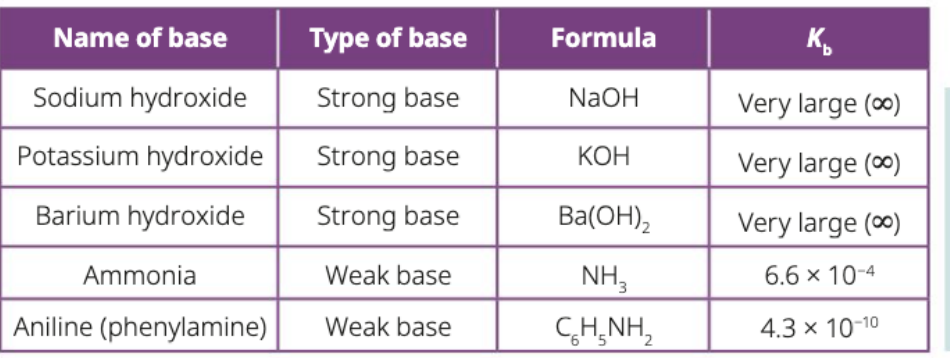
Strong bases include:
- Sodium hydroxide (NaOH)
- Potassium hydroxide (KOH)
- Barium hydroxide (Ba(OH)₂)
These have very large Kb values, indicating complete ionisation.
Weak bases include:
- Ammonia (NH₃)
- Aniline (C₆H₅NH₂)
These have much smaller Kb values, showing they only partially accept protons from water.
Conjugate acid-base pairs
Every acid has a corresponding conjugate base, and every base has a corresponding conjugate acid. These pairs are related by the transfer of a single proton.
Important
Important relationships:
- Strong acids have weak conjugate bases
- Weak acids have stronger conjugate bases (though still usually weak)
- The stronger the acid, the weaker its conjugate base
- This relationship helps predict the direction of acid-base reactions
Example
Worked Example: Conjugate Pairs
When HCl (strong acid) donates a proton, it forms Cl⁻ (very weak conjugate base).
When CH₃COOH (weak acid) donates a proton, it forms CH₃COO⁻ (stronger conjugate base than Cl⁻).
This shows the inverse relationship between acid strength and conjugate base strength.
Concentration versus strength - a crucial distinction
Many students confuse concentration with strength, but these are completely different concepts
Strength refers to the degree of ionisation:
- How much of the acid or base breaks apart in water
- Strong = high degree of ionisation
- Weak = low degree of ionisation
Concentration refers to the amount dissolved:
- How many moles of acid or base are in the solution
- Concentrated = lots of substance dissolved
- Dilute = little substance dissolved
Important
Key exam point: You can have a dilute solution of a strong acid or a concentrated solution of a weak acid. The pH depends on both factors!
pH and acid strength relationships
The pH of a solution depends on the concentration of hydrogen ions, which is determined by both the strength of the acid and its concentration.
For strong acids:
- pH calculation is straightforward because complete dissociation means [H⁺] equals the molarity of the acid
- Even very dilute solutions of strong acids can have low pH values
For weak acids:
- pH calculation is more complex because only a fraction of molecules dissociate
- You need to consider the Ka value and use equilibrium expressions
- Concentrated solutions of weak acids may have higher pH than dilute solutions of strong acids
Important
Common exam mistake: Assuming all solutions of strong acids have low pH regardless of concentration. Remember, a very dilute solution of HCl might have a pH of 4 or 5, not necessarily close to 0.
Practical applications
Note
Understanding acid-base strength helps explain:
- Why some acids are more dangerous to handle than others
- How buffer solutions work (involving weak acid-conjugate base pairs)
- Why certain reactions go to completion whilst others reach equilibrium
- How to choose appropriate indicators for titrations
- The behaviour of acids and bases in biological systems
Summary
Key Points to Remember:
- Strong acids and bases ionise almost completely in water, whilst weak acids and bases only partially ionise
- Ka and Kb values quantify strength - large values mean stronger acids/bases
- Concentration (amount dissolved) is different from strength (degree of ionisation)
- Strong acids have weak conjugate bases, and vice versa
- pH depends on both the strength of the acid/base AND its concentration