Energy Levels, Sublevels and Atomic Orbitals (Leaving Cert Chemistry): Revision Notes
📚Revision Notes
Energy Levels, Sublevels and Atomic Orbitals
Energy Levels and Sublevels
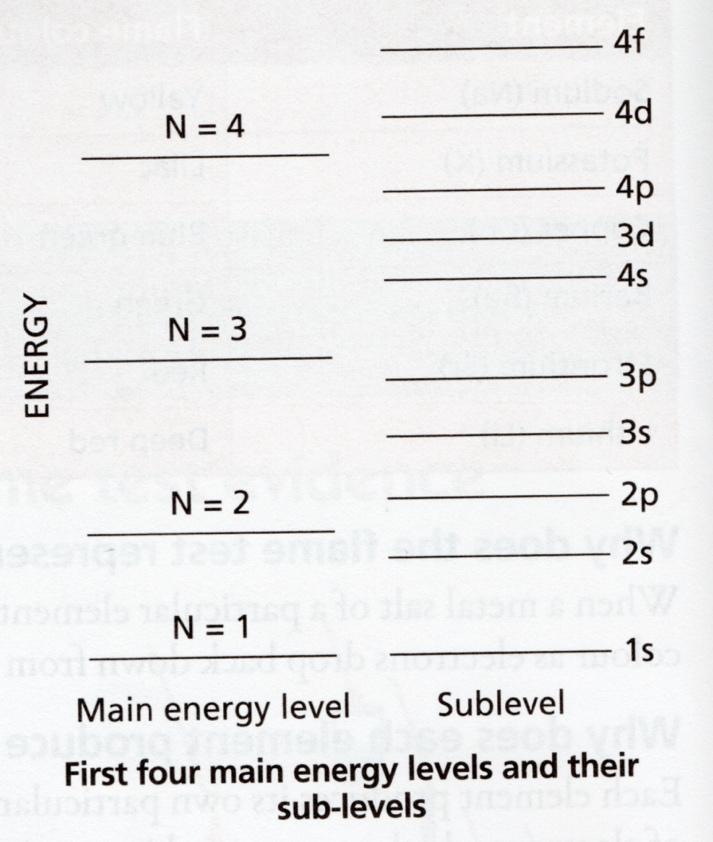
The diagram below shows first the first 4 main energy levels and their sublevels.
- In a closer and more exact study of the emission line Spectra of elements it was noted that what appeared to be a single line on a line spectrum was really two or more lines which were very close together.
- To explain this, scientists proposed that each main level excluding the 1st was made up of a number of sublevels.
- The sublevels were assigned the letters s, p, d and f in order of their energy value. The s sublevel was given the lowest energy, and the f sublevel was given the highest energy.
- The number of sublevels is the same as the number of the main level. Therefore, the main level one has one sublevel called the 1s, the second main level, 2, has two sublevels, the 2s and 2p sub levels and so on.
Organisation of Particles in Atoms of Elements Nos. 1–20
Atoms consist of three fundamental particles: protons, neutrons, and electrons. The protons and neutrons are located in the nucleus, while the electrons orbit in energy levels, or shells, around the nucleus.
For elements with atomic numbers 1–20, the electrons are arranged in main energy levels, also called shells, around the nucleus. The number of electrons in each energy level follows the rule 2n², where n is the number of the energy level:
-
First energy level: maximum of 2 electrons
-
Second energy level: maximum of 8 electrons
-
Third energy level: maximum of 8 electrons (due to limitations in this range)
-
Fourth energy level: remaining electrons. For example:
-
Hydrogen (Z = 1) has 1 electron: 1 in the first energy level.
-
Carbon (Z = 6) has 6 electrons: 2 in the first level, 4 in the second.
-
Calcium (Z = 20) has 20 electrons: 2 in the first, 8 in the second, 8 in the third, and 2 in the fourth.
Classification of the First Twenty Elements Based on Outer Electrons
The chemical properties of an element are largely determined by the number of electrons in its outermost shell, also known as the valence electrons. The first twenty elements can be grouped based on these valence electrons:
- Group 1 (Alkali Metals): 1 valence electron (e.g., Hydrogen, Lithium, Sodium, Potassium).
- Group 2 (Alkaline Earth Metals): 2 valence electrons (e.g., Beryllium, Magnesium, Calcium).
- Group 13: 3 valence electrons (e.g., Boron, Aluminium).
- Group 14: 4 valence electrons (e.g., Carbon, Silicon).
- Group 15: 5 valence electrons (e.g., Nitrogen, Phosphorus).
- Group 16: 6 valence electrons (e.g., Oxygen, Sulphur).
- Group 17 (Halogens): 7 valence electrons (e.g., Fluorine, Chlorine).
- Group 18 (Noble Gases): Full outer shell (Helium has 2 electrons, others have 8, e.g., Neon, Argon). Elements in the same group exhibit similar chemical properties due to having the same number of outer electrons.
Heisenberg's Uncertainty Principle
Note
Heisenberg's uncertainty principle states that it is impossible to measure the position and velocity of an electron at the same time.
The Heisenberg Uncertainty Principle, formulated by Werner Heisenberg, is a fundamental concept in quantum mechanics. It states that it is impossible to simultaneously know both the exact position and momentum of a particle, such as an electron, with perfect accuracy. The more precisely you know the position of an electron, the less precisely you can know its momentum, and vice versa.
- Implication: This uncertainty arises because electrons do not behave like classical particles with defined trajectories. Instead, they are better understood in terms of probabilities.
- Example: If you try to measure an electron's exact location, you introduce uncertainty in measuring its momentum (mass × velocity). Conversely, if you know its momentum very well, its position becomes highly uncertain. This principle highlights the limits of our ability to measure certain properties at the quantum level and is key to understanding the behaviour of subatomic particles like electrons.
Wave Nature of the Electron:
Electrons exhibit wave-particle duality, meaning they have properties of both particles and waves. This concept was proposed by Louis de Broglie, who suggested that particles such as electrons could behave like waves under certain conditions.
- Electron Waves: Electrons can form standing waves as they move around the nucleus. This wave-like behaviour is essential in explaining phenomena like electron diffraction, where electrons behave similarly to light waves when passed through a crystal or a small opening.
- Atomic Orbitals: The wave nature of the electron helps explain the formation of atomic orbitals, where electrons exist in specific regions around the nucleus. These regions, or orbitals, are defined by the probability of finding an electron in a given space, rather than the electron following a fixed path like a planet orbiting the Sun.
Note
Exam Tip: You may be asked to explain the implications of the Heisenberg Uncertainty Principle and how it differs from classical physics. For the wave nature of the electron, be prepared to discuss how this duality helps explain atomic orbitals and why electrons cannot be thought of as tiny particles following defined paths. Understanding these principles will also help in describing the modern quantum model of the atom.
Atomic Orbitals
Note
An atomic orbital is a region of space where it is most likely to find an electron.
Then the Austrian scientist Erwin Schrödinger developed mathematical equations to describe the probability of finding an electron in an Atom. As a result of Schrödinger's work, orbitals were used to describe the movement of electrons in an Atom.
Properties of Atomic Orbitals
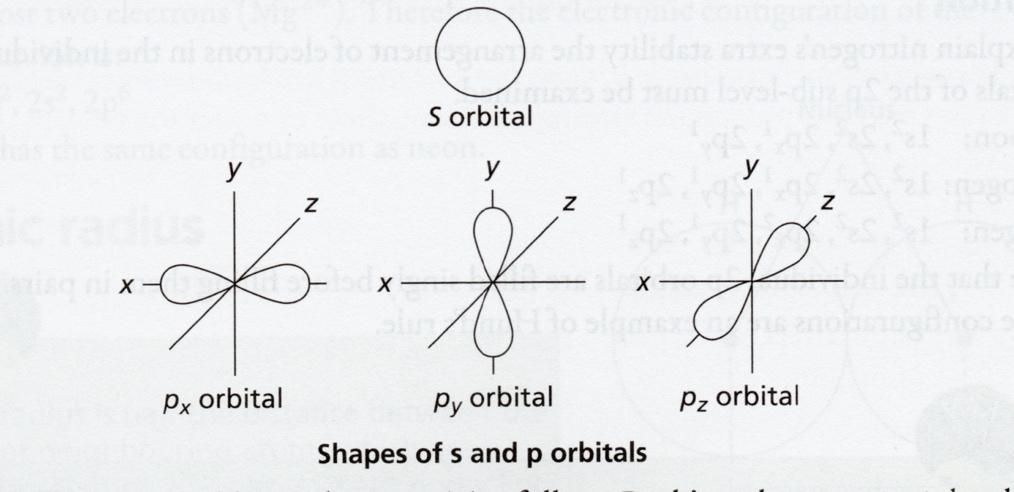
It is required that you know the shapes of the s and p orbitals.
Each orbital can hold 2 electrons. This follows Paulie's exclusion principle where he stated that no more than two electrons can occupy an orbital and when they do they must have opposite spin.
Note
Aufbau principle: electrons occupy the lowest energy level available when the electron is in the ground state.
The s orbitals are spherical there is only one s orbital for each sublevel.
The p orbitals have a dumbbell shape. There are three p orbitals for each sub level. They are called the px, py and the pz orbitals.
These p orbitals are at right angles to each other as shown in the diagram. It is important to note that any p sublevel can accommodate 6 electrons.
There are five d orbitals. It is not required that you know the names or shapes of these orbitals. It is important to note that the d sublevel can accommodate 10 electrons.
Energy Levels and Sub-levels:
The first 36 elements have electrons arranged in main energy levels (n = 1, 2, 3, etc.), which are further divided into sub-levels (s, p, d, f). The sub-levels are filled in a specific order of increasing energy.
- 1st Energy Level: Contains 1s (holds a maximum of 2 electrons).
- 2nd Energy Level: Contains 2s (2 electrons) and 2p (6 electrons).
- 3rd Energy Level: Contains 3s (2 electrons), 3p (6 electrons), and part of 3d (but 3d is not filled until after 4s).
- 4th Energy Level: Contains 4s (2 electrons) and part of 4p (starts being filled from element 31 onwards). The order of filling is based on increasing energy, and follows this sequence: 1s → 2s → 2p → 3s → 3p → 4s → 3d → 4p.
Electronic Configuration of the First 36 Elements:
Here is how the electrons are arranged in the first 36 elements (with element numbers and names included for reference):
- Hydrogen (H): 1s¹
- Helium (He): 1s²
- Lithium (Li): 1s² 2s¹
- Beryllium (Be): 1s² 2s²
- Boron (B): 1s² 2s² 2p¹
- Carbon (C): 1s² 2s² 2p²
- Nitrogen (N): 1s² 2s² 2p³
- Oxygen (O): 1s² 2s² 2p⁴
- Fluorine (F): 1s² 2s² 2p⁵
- Neon (Ne): 1s² 2s² 2p⁶
- Sodium (Na): 1s² 2s² 2p⁶ 3s¹
- Magnesium (Mg): 1s² 2s² 2p⁶ 3s²
- Aluminium (Al): 1s² 2s² 2p⁶ 3s² 3p¹
- Silicon (Si): 1s² 2s² 2p⁶ 3s² 3p²
- Phosphorus (P): 1s² 2s² 2p⁶ 3s² 3p³
- Sulfur (S): 1s² 2s² 2p⁶ 3s² 3p⁴
- Chlorine (Cl): 1s² 2s² 2p⁶ 3s² 3p⁵
- Argon (Ar): 1s² 2s² 2p⁶ 3s² 3p⁶
- Potassium (K): 1s² 2s² 2p⁶ 3s² 3p⁶ 4s¹
- Calcium (Ca): 1s² 2s² 2p⁶ 3s² 3p⁶ 4s²
- Scandium (Sc): 1s² 2s² 2p⁶ 3s² 3p⁶ 4s² 3d¹
- Titanium (Ti): 1s² 2s² 2p⁶ 3s² 3p⁶ 4s² 3d²
- Vanadium (V): 1s² 2s² 2p⁶ 3s² 3p⁶ 4s² 3d³
- Chromium (Cr): 1s² 2s² 2p⁶ 3s² 3p⁶ 4s¹ 3d⁵ (an exception where 4s and 3d orbitals exchange electrons for stability)
- Manganese (Mn): 1s² 2s² 2p⁶ 3s² 3p⁶ 4s² 3d⁵
- Iron (Fe): 1s² 2s² 2p⁶ 3s² 3p⁶ 4s² 3d⁶
- Cobalt (Co): 1s² 2s² 2p⁶ 3s² 3p⁶ 4s² 3d⁷
- Nickel (Ni): 1s² 2s² 2p⁶ 3s² 3p⁶ 4s² 3d⁸
- Copper (Cu): 1s² 2s² 2p⁶ 3s² 3p⁶ 4s¹ 3d¹⁰ (another exception for stability)
- Zinc (Zn): 1s² 2s² 2p⁶ 3s² 3p⁶ 4s² 3d¹⁰
- Gallium (Ga): 1s² 2s² 2p⁶ 3s² 3p⁶ 4s² 3d¹⁰ 4p¹
- Germanium (Ge): 1s² 2s² 2p⁶ 3s² 3p⁶ 4s² 3d¹⁰ 4p²
- Arsenic (As): 1s² 2s² 2p⁶ 3s² 3p⁶ 4s² 3d¹⁰ 4p³
- Selenium (Se): 1s² 2s² 2p⁶ 3s² 3p⁶ 4s² 3d¹⁰ 4p⁴
- Bromine (Br): 1s² 2s² 2p⁶ 3s² 3p⁶ 4s² 3d¹⁰ 4p⁵
- Krypton (Kr): 1s² 2s² 2p⁶ 3s² 3p⁶ 4s² 3d¹⁰ 4p⁶
Note
Exam Tip: Be familiar with the order of filling energy levels and how to write electronic configurations for elements up to 36. Remember the exceptions for chromium and copper, which are often highlighted in exams.
Examples
Example
Example 1: s,p type configurations Write out the electronic configurations of carbon, oxygen and nitrogen explain why nitrogen has extra stability.
To explain nitrogen's extra stability the arrangement of electrons in the individual orbitals of the two p sublevel must be examined.
Note that the individual 2p orbitals are filled singly before filling them in pairs the above configurations are an example of Hund's rule.
Hund's rule: when more than one orbital of equal energy exists, electrons tend to fill them singly before filling them in pairs.
Nitrogen has extra stability as the two-p sub level is half full and a half full sublevel is the next most stable to a full sublevel.
:::
Example
Example 2: s,p,d electronic configurations Write out the electronic configurations of scandium, chromium and copper and explain why copper and chromium have unusual configurations.
Scandium has 21 electrons, and its electronic configuration is:
Chromium has 24 electrons and its electronic configuration is:
Note the unusual configuration of chromium where one of the four S electrons moves into the 3D sublevel. Two half-filled sublevels give extra stability.
Electronic Configuration of Ions
What is the electronic configuration of the magnesium ion ? What neutral atom has the same configuration?
The magnesium atom has 12 electrons and therefore the magnesium ion has 10 electrons as it has lost 2 electrons. Therefore, the electronic configuration of the magnesium ion is:
This ion has the same configuration as neon