Oxidation and Reduction (LC 2027) (Leaving Cert Chemistry): Revision Notes
📚Revision Notes
Balancing Redox Equations
Introduction
When dealing with complex redox reactions, the simple trial-and-error method can become quite challenging. For more complicated equations, it's much more effective to use a systematic approach based on oxidation numbers. This method helps us balance redox equations by focusing on the electron transfer that occurs during the reaction.
The five-step method for balancing redox equations
This systematic approach breaks down the balancing process into manageable steps, making it easier to handle even the most complex redox reactions.
Note
This five-step method is particularly effective for complex redox reactions where simple inspection methods become unwieldy. By focusing on electron transfer, you can systematically balance even the most challenging equations.
Step 1: Assign oxidation numbers to all atoms
Begin by determining the oxidation state of each element in both the reactants and products. This helps identify which elements are being oxidised and which are being reduced.
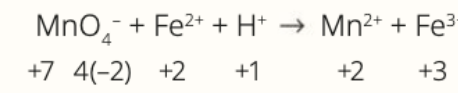
Step 2: Identify which elements change oxidation number
Look for elements that have different oxidation states on the reactant and product sides. These are the elements involved in the redox process.
Step 3: Determine the electrons lost and gained
Calculate how many electrons each element loses or gains during the reaction. Remember that:
Important
Key Electron Transfer Rules:
- An increase in oxidation number represents a loss of electrons (oxidation)
- A decrease in oxidation number represents a gain of electrons (reduction)
Step 4: Work out the ratio of oxidising agent to reducing agent
To ensure that the total number of electrons lost equals the total number gained, you need to determine the correct ratio between the oxidising and reducing agents. This maintains electron balance in the equation.
Step 5: Balance the remaining items using the inspection method
After establishing the correct ratios from Step 4, balance the remaining elements (usually oxygen and hydrogen atoms) by inspection. Oxygen atoms are typically balanced last, followed by hydrogen atoms.
Verifying your balanced equation
Once you've balanced the equation, it's essential to verify that it's correct by checking two things:
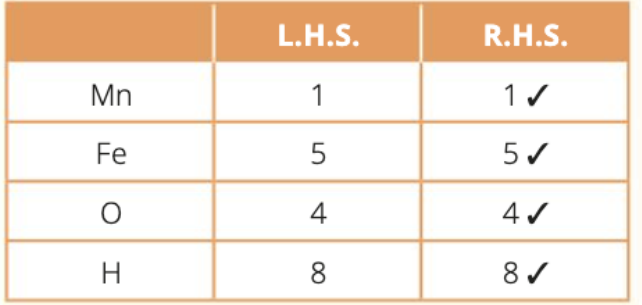
Atom balance verification
Count the number of atoms of each element on both sides of the equation to ensure they're equal.
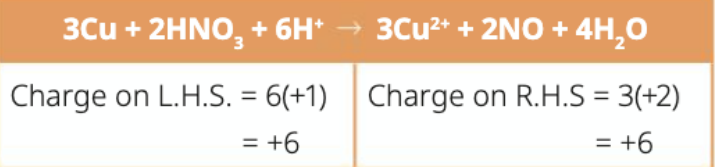
Charge balance verification
Calculate the total charge on both sides of the equation to confirm they're equal.
Worked examples
Example
Worked Example 1: Permanganate and Iron Reaction
When permanganate ions react with iron(II) ions in acidic solution:
- Manganese changes from +7 to +2 oxidation state (gains 5 electrons)
- Iron changes from +2 to +3 oxidation state (loses 1 electron)
- The ratio needed is 1 MnO₄⁻ to 5 Fe²⁺ to balance electron transfer
Example
Worked Example 2: Copper and Nitric Acid Reaction
For the reaction between copper and nitric acid:
- Copper is oxidised from 0 to +2 (loses 2 electrons)
- Nitrogen is reduced from +5 to +2 (gains 3 electrons)
- The balanced ratio requires 3 Cu atoms for every 2 HNO₃ molecules
Example
Worked Example 3: Iodine and Thiosulfate Reaction
In the iodine-thiosulfate reaction:
- Each I₂ molecule gains 2 electrons (reduction)
- Two S₂O₃²⁻ ions together lose 2 electrons (oxidation)
- The ratio is 1:2 for I₂ to S₂O₃²⁻
Important exam tips
When balancing redox equations in exams, remember these key points:
Summary
Key Exam Strategies:
- Always use oxidation numbers - You're very unlikely to get the correct ratio of oxidising agent to reducing agent if you simply try to balance by inspection
- Show your working clearly - Indicate the correct charges on each species in the equation to avoid losing marks
- Double-check both atoms and charges - Ensure that both mass and charge are conserved in your final equation
- Work systematically - Follow the five steps in order rather than jumping ahead
Common mistakes to avoid
Important
Critical Points to Remember:
- Forgetting to balance the charge as well as the atoms
- Not showing oxidation numbers clearly
- Attempting to balance complex equations by trial-and-error alone
- Missing the step of determining electron transfer ratios
Remember!
Summary
Key Points to Remember:
- Use the systematic five-step method for balancing complex redox equations rather than trial-and-error
- Oxidation numbers are crucial - they help identify electron transfer and determine the correct ratios
- Always verify your answer by checking that both atoms and charges balance on both sides
- Show all working clearly in exams, including oxidation numbers and electron transfer calculations
- The key principle is electron balance - electrons lost must equal electrons gained in any redox reaction