Electron Transfer (Leaving Cert Chemistry): Revision Notes
📚Revision Notes
Electron Transfer
Understanding how electrons move between atoms and molecules is fundamental to mastering redox chemistry. When chemical reactions involve the transfer of electrons from one substance to another, we call these redox reactions - a combination of reduction and oxidation processes that always occur together.
Note
Electron transfer reactions are among the most important chemical processes in nature, occurring in everything from photosynthesis and cellular respiration to battery operation and metal corrosion.
What are oxidation and reduction?
In terms of electron transfer, oxidation and reduction have very specific meanings that you must remember:
Important
Critical Definitions:
- Oxidation is the loss of electrons by an atom, ion, or molecule
- Reduction is the gain of electrons by an atom, ion, or molecule
These processes are opposite but complementary - when one substance loses electrons (gets oxidised), another substance must gain those electrons (gets reduced). This is why oxidation and reduction always happen simultaneously in chemical reactions.
The OIL RIG memory aid
To help you remember these definitions, use the famous OIL RIG mnemonic device:
Important
OIL RIG Memory Aid:
- Oxidation Is Loss (of electrons)
- Reduction Is Gain (of electrons)
This simple memory aid will serve you well throughout your chemistry studies and in exams.
Examples of electron transfer reactions
Let's examine some specific reactions to see how electron transfer works in practice.
Magnesium and oxygen reaction
When magnesium burns in oxygen, a classic redox reaction occurs:
Example
Worked Example: Magnesium and Oxygen
In this reaction:
- Each magnesium atom loses two electrons (oxidation)
- Each oxygen atom gains two electrons (reduction)
- The electrons lost by magnesium are gained by oxygen
Metal displacement reactions
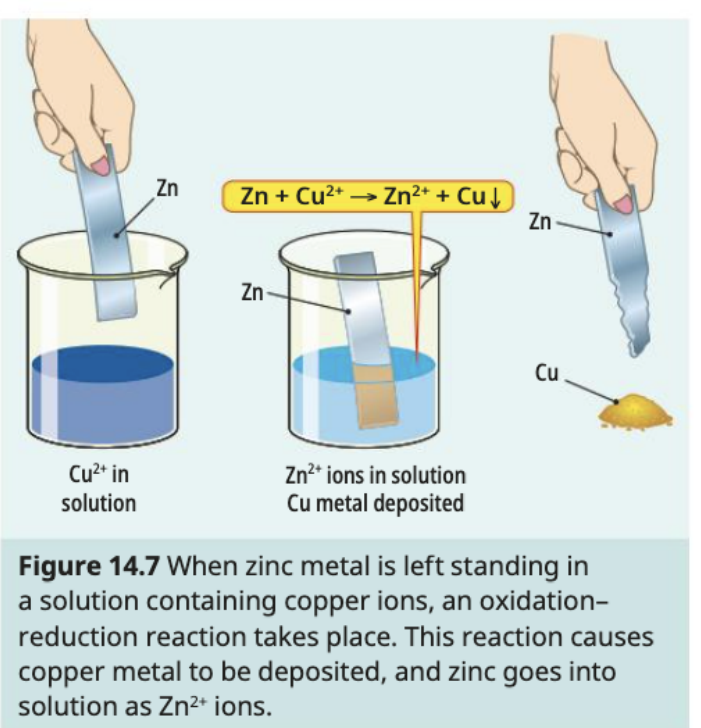
A excellent example of electron transfer can be seen when zinc metal is placed in a solution containing copper ions:
Example
Worked Example: Zinc and Copper Displacement
The reaction is:
- The zinc atom loses two electrons to become (oxidation)
- The ion gains two electrons to become copper metal (reduction)
- You can observe this visually as the blue copper sulphate solution fades and brown copper metal deposits on the zinc strip
Halogen displacement reaction
Another clear example involves iodide ions and chlorine gas:
Example
Worked Example: Iodide and Chlorine
The reaction is:
- Each iodide ion loses one electron (oxidation)
- Each chlorine atom gains one electron (reduction)
Understanding oxidising and reducing agents
In redox reactions, we can identify two important types of substances:
Oxidising agents (oxidants)
An oxidising agent is a substance that:
- Causes oxidation in other substances
- Accepts electrons from other substances
- Gets reduced itself during the reaction
Note
Common oxidising agents include oxygen, chlorine, and metal ions like .
Reducing agents (reductants)
A reducing agent is a substance that:
- Causes reduction in other substances
- Donates electrons to other substances
- Gets oxidised itself during the reaction
Note
Common reducing agents include metals like zinc and magnesium, and hydrogen gas.
Real-world applications
Understanding electron transfer isn't just academic - these reactions have many practical applications in everyday life.
Oxidising agents in daily life

Common oxidising agents you encounter include:
- Hydrogen peroxide () - used for bleaching hair by breaking down pigment molecules
- Iodine () - used as an antiseptic because it kills germs by oxidising their cellular components
- Chlorine gas () - used to purify drinking water by destroying harmful bacteria
- Sodium hypochlorite (NaClO) - the active ingredient in household bleach
Reducing agents in daily life
Important reducing agents include:
- Carbon - used in metal extraction from ores, such as producing iron from iron ore
- Aluminium - also used for extracting metals from their ores
- Sulphur dioxide () - used as a food preservative (E220) and for bleaching organic materials
- Vitamin C (Ascorbic acid) - helps your body absorb iron by converting ions to ions
Identifying agents in reactions
When analysing a redox reaction, follow these steps to identify the oxidising and reducing agents:
Note
Step-by-Step Identification Process:
- Determine what gets oxidised (loses electrons) - this substance is the reducing agent
- Determine what gets reduced (gains electrons) - this substance is the oxidising agent
- Remember: the oxidising agent gets reduced, and the reducing agent gets oxidised
For example, in the reaction:
- Zn loses electrons (gets oxidised), so Zn is the reducing agent
- gains electrons (gets reduced), so is the oxidising agent
Worked example
Let's work through a typical exam question to practice these concepts.
Example
Worked Example: Exam Question Practice
Question: In the reaction , identify which species is oxidised, which is reduced, and name the oxidising and reducing agents.
Solution approach:
Step 1: Track electron changes
- Each loses one electron to become (oxidation)
- Each Cl atom gains one electron to become (reduction)
Step 2: Identify the agents
- gets oxidised, so is the reducing agent
- gets reduced, so is the oxidising agent
Summary
Key Points to Remember:
-
OIL RIG: Oxidation Is Loss, Reduction Is Gain (of electrons)
-
Oxidation and reduction always occur together - you cannot have one without the other in a chemical reaction
-
The oxidising agent gets reduced (it gains the electrons) and the reducing agent gets oxidised (it loses the electrons)
-
Electron transfer reactions are everywhere - from the rusting of iron to the functioning of batteries and the processes in your own body
-
Practice identifying which species lose and gain electrons in reactions - this skill is essential for exam success