The Alkaline Earth Metals (Leaving Cert Chemistry): Revision Notes
📚Revision Notes
The Alkaline Earth Metals
Introduction and location
The alkaline earth metals are found in Group 2 of the Periodic Table. These elements are called "alkaline earth metals" because they form alkaline (basic) solutions when they react with water.
Note
The name "alkaline earth metals" also comes from the fact that many of their compounds are found naturally in the Earth's crust, particularly in earth-like minerals and rocks.
The three main alkaline earth metals you need to know for your Leaving Cert are:
- Beryllium (Be)
- Magnesium (Mg)
- Calcium (Ca)
These metals have low ionisation energies and low electronegativity values, which means they readily form ionic compounds by losing their two outermost electrons.
Physical properties
All alkaline earth metals share similar physical characteristics that make them easily identifiable:
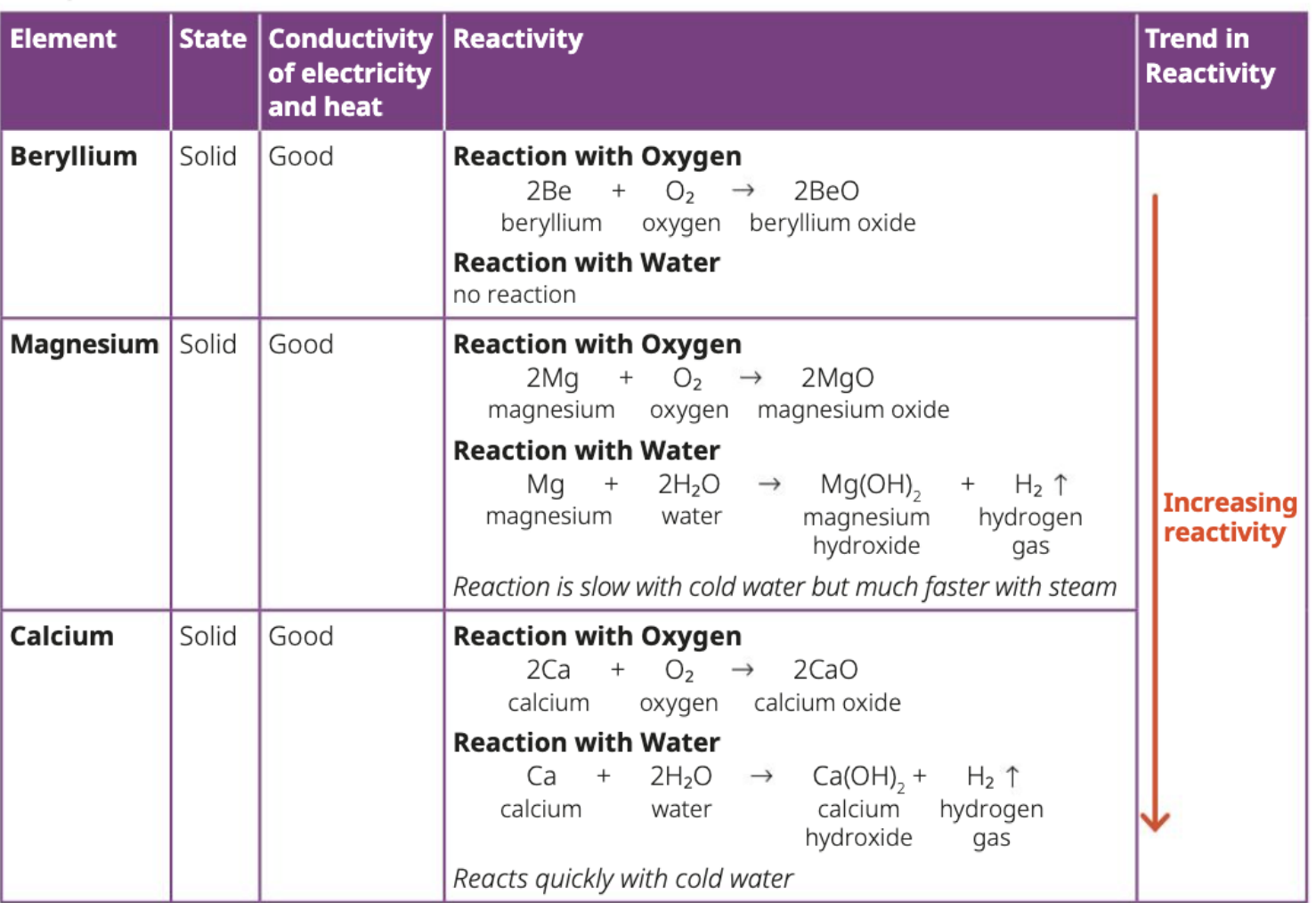
- Physical state: All are solid at room temperature
- Appearance: Shiny, silvery-looking metals
- Conductivity: Good conductors of both electricity and heat
- Reactivity: All are reactive elements, but they vary in how reactive they are
Note
The tendency to lose two electrons is a key feature of all the chemical reactions of the alkaline earth metals, including their reactions with oxygen, water and acids.
Chemical reactions and equations
Reactions with oxygen
All alkaline earth metals react with oxygen to form metal oxides:
Example
Chemical Equations: Reactions with Oxygen
- Beryllium: (beryllium oxide)
- Magnesium: (magnesium oxide)
- Calcium: (calcium oxide)
Reactions with water
The alkaline earth metals show different levels of reactivity with water:
- Beryllium: No reaction with water
- Magnesium: Reacts slowly with cold water but much faster with steam
- Calcium: Reacts quickly with cold water
In these water reactions, hydrogen gas is produced along with the metal hydroxide.
Reactivity trends down the group
There is a clear pattern in reactivity as you move down Group 2:
Important
Reactivity increases down the group: Be < Mg < Ca
This is a crucial trend that frequently appears in exams!
This increasing reactivity occurs because:
- The atomic radius increases as you go down the group
- The shielding effect of inner electrons increases
- These two factors cause the first ionisation energy to decrease down the group
- Therefore, the electrons in the outermost energy levels are more easily lost
- This means the reactivity increases as you go down the group
Key characteristics summary
The properties of the alkaline earth metals demonstrate their unique position in the periodic table:
- All alkaline earth metals are reactive elements because they have low first ionisation energy values, meaning they readily lose their two outermost electrons
- They are less reactive than the alkali metals but still too reactive to occur freely in nature as pure metals
- Instead, they are found in stable compounds such as magnesium oxide and calcium carbonate (), which is commonly called limestone
- Since alkaline earth metals have low ionisation energies and low electronegativity values, they readily form ionic compounds by losing their two outermost electrons
Important exam points
Important
Critical Information for Exams
- Beryllium is unique among the alkaline earth metals as it forms both ionic (e.g. in BeO) and covalent bonding (e.g. in , the bonding is covalent with electronegativity difference = 1.57)
- Remember that reactivity increases down the group - this is the opposite of what happens with ionisation energy
- The chemical equations for reactions with oxygen and water are commonly asked in exams
- Understanding the trend explanation (atomic radius, shielding effect, ionisation energy) is crucial for exam success
Summary
Key Points to Remember:
- Alkaline earth metals are Group 2 elements that readily lose two electrons to form ionic compounds
- Physical properties: solid, shiny, good conductors of electricity and heat
- Reactivity increases down the group: beryllium < magnesium < calcium
- All react with oxygen to form oxides, but only magnesium and calcium react with water to produce hydrogen gas
- The increasing reactivity trend is explained by decreasing ionisation energy down the group due to increasing atomic size and shielding effect