The Halogens (Leaving Cert Chemistry): Revision Notes
📚Revision Notes
The Halogens
Introduction to Group 17
The halogens are a family of elements found in Group 17 of the Periodic Table. The name "halogen" comes from the Greek language and means "producer of salt". This name perfectly describes these elements because they readily react with metals to produce various types of salts.
Note
The Greek origin of "halogen" (halo = salt, gen = producer) directly reflects the most characteristic property of these elements - their ability to form salts when they react with metals.
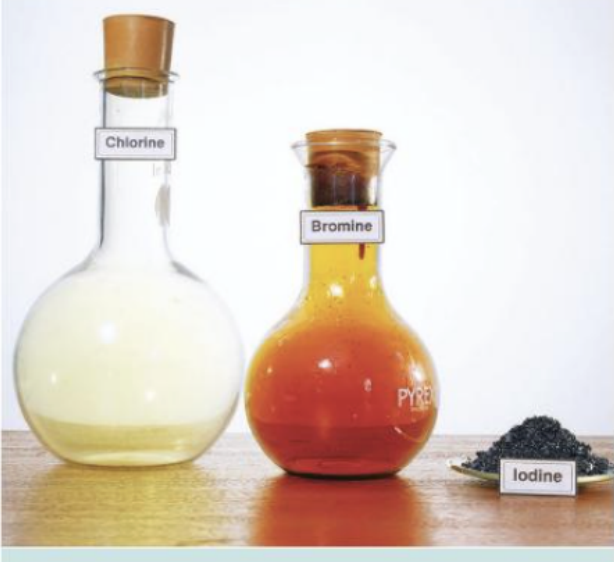
The photograph above shows three of the most common halogens in their natural states, demonstrating their distinctive colours and physical properties.
Physical properties
States of matter at room temperature
The halogens exist in different physical states at room temperature, which helps us understand the London dispersion forces between their molecules:
- Fluorine (F₂): Pale yellow gas
- Chlorine (Cl₂): Pale green-yellow gas
- Bromine (Br₂): Dark red volatile liquid
- Iodine (I₂): Purple-black solid
Note
The progression from gas to liquid to solid down the group demonstrates how intermolecular forces increase as molecular size increases. Larger molecules have stronger London dispersion forces, requiring more energy to separate them.
The fact that bromine is a liquid at room temperature shows it has stronger intermolecular forces than the gaseous halogens. Bromine vapour fills its container because it has a relatively low boiling point and evaporates easily to form a reddish-brown vapour.
Electrical and thermal conductivity
All halogens are poor conductors of both electricity and heat. This is because they are non-metals and do not contain free-moving electrons that can carry electrical current or thermal energy effectively.
Sublimation
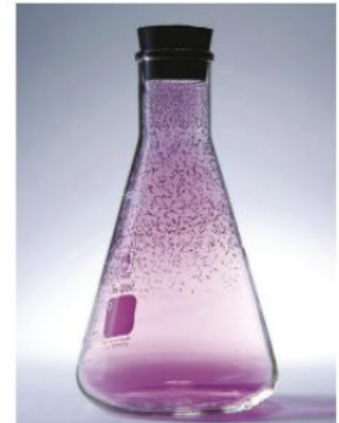
An interesting property of iodine is that it undergoes sublimation when heated. Sublimation means the substance changes directly from a solid to a gas without passing through the liquid phase. This creates distinctive purple vapours that are easy to observe in laboratory demonstrations.
Chemical properties and reactions
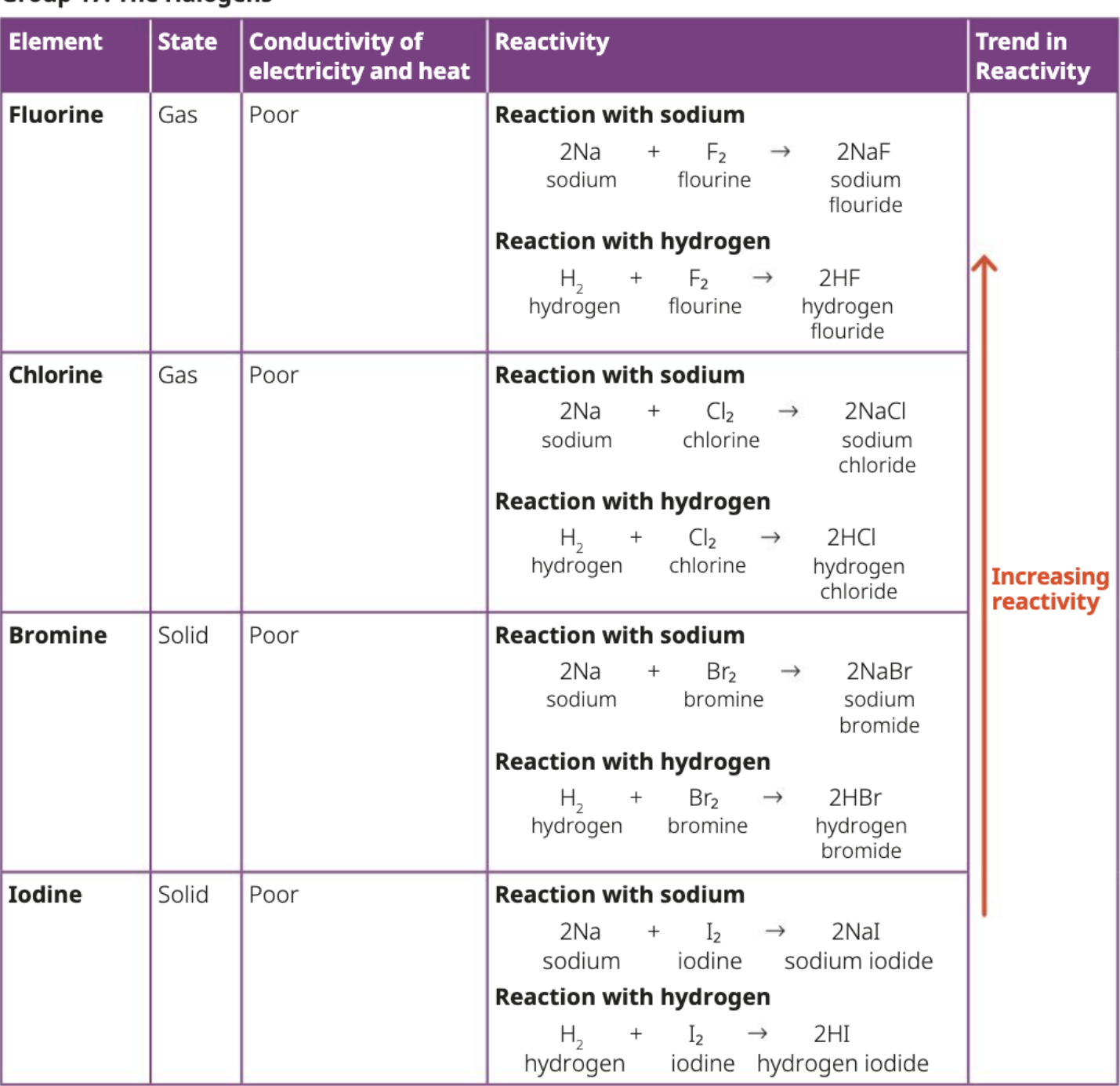
The table above summarises the key chemical reactions of the halogens. Let's examine these patterns:
Reactions with sodium metal
All halogens react vigorously with sodium metal to produce sodium halides (salts):
Example
Chemical Reactions with Sodium Metal
- Fluorine: (sodium fluoride)
- Chlorine: (sodium chloride - table salt)
- Bromine: (sodium bromide)
- Iodine: (sodium iodide)
These reactions demonstrate why halogens are called "salt producers".
Reactions with hydrogen gas
Halogens also react with hydrogen gas to form hydrogen halides, which dissolve in water to form acids:
- Fluorine: (hydrogen fluoride)
- Chlorine: (hydrogen chloride)
- Bromine: (hydrogen bromide)
- Iodine: (hydrogen iodide)
Reactivity trends
Why reactivity increases up the group
Unlike many other groups in the Periodic Table, the reactivity of halogens increases as you move up the group. This means:
Important
Reactivity Order: Fluorine > Chlorine > Bromine > Iodine
This is the opposite trend to most other groups in the Periodic Table, where reactivity typically increases down the group.
This trend occurs because of three key factors:
1. Atomic radius decreases up the group
As you move up Group 17, the atoms become smaller. This means the outermost electrons are closer to the positively charged nucleus.
2. Screening effect decreases up the group
There are fewer inner electron shells to shield the outermost electrons from the nuclear attraction as you move up the group.
3. First ionisation energy increases up the group
The combination of smaller atomic radius and less screening means it becomes easier for halogens higher up the group to attract and gain electrons from other substances.
Note
Because halogens gain reactivity by attracting electrons from other substances, the elements that can do this most effectively (those higher up the group) are the most reactive. This explains why fluorine is the most reactive non-metal in the entire periodic table.
Displacement reactions
One of the most important concepts in halogen chemistry is displacement reactions. A more reactive halogen can displace a less reactive halogen from its compounds.

The equation above shows chlorine displacing bromine from bromide ions:
Example
Displacement Reaction Example
Chemical equation:
Observation:
- Before reaction: Colourless chlorine gas and colourless bromide ions
- After reaction: Colourless chloride ions and red bromine
The colour change from colourless to red provides clear visual evidence that the reaction has occurred.
General rule for displacement reactions
Important
Displacement Rule: More reactive halogens displace less reactive halogens from solutions of their ions.
This means:
- Fluorine can displace chlorine, bromine, and iodine
- Chlorine can displace bromine and iodine
- Bromine can displace iodine only
- Iodine cannot displace any other halogen
Why displacement occurs
Displacement happens because the more electronegative halogen has a stronger attraction for electrons. For example, chlorine atoms (electronegativity = 3.16) have a greater attraction for electrons than bromine atoms (electronegativity = 2.96). Therefore, chlorine can take electrons from bromide ions, converting them to bromine molecules while the chlorine becomes chloride ions.
Summary
Key Points to Remember:
- Halogens are Group 17 elements that get their name from the Greek meaning "producer of salt"
- Physical states vary: F₂ and Cl₂ are gases, Br₂ is a liquid, I₂ is a solid at room temperature
- Reactivity increases up the group due to decreasing atomic radius and screening effect
- All halogens react with metals to form salts and with hydrogen to form acids
- More reactive halogens displace less reactive ones from their compound solutions - this creates distinctive colour changes that are easy to observe