Trends in Atomic Radii (Leaving Cert Chemistry): Revision Notes
📚Revision Notes
Trends in Atomic Radii
What is atomic radius?
Atomic radius is a measure of the size of an atom, but since atoms don't have fixed boundaries, we need a practical way to define it. The atomic radius (also called covalent radius) is the distance from the nucleus to the outermost electrons that participate in chemical bonding.
Note
The covalent radius of an atom is half the distance between the nuclei of two identical atoms that are joined together by a single covalent bond.
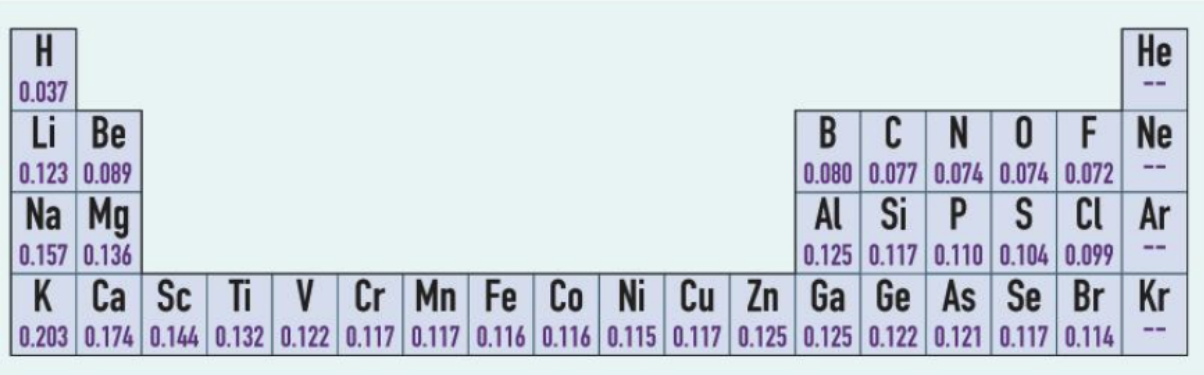
For example, in a hydrogen molecule (H), the distance between the two hydrogen nuclei is 0.074 nanometres, so the covalent radius of hydrogen is 0.037 nm.
Trends across periods (left to right)
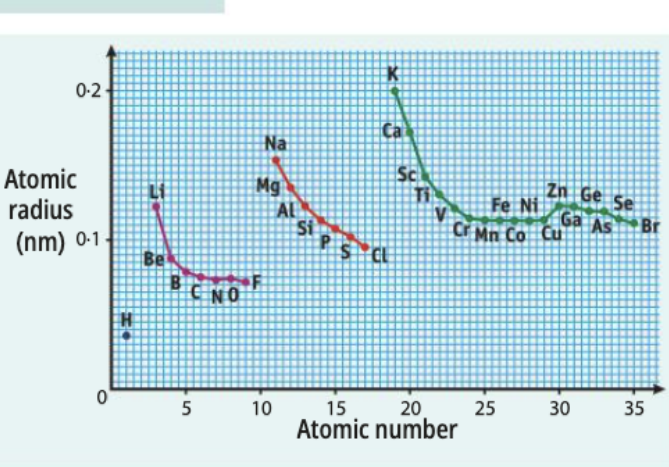
As you move from left to right across a period in the periodic table, atomic radius decreases. This happens for two main reasons:
1. Increase in nuclear charge
- Each element across a period has one more proton in its nucleus than the previous element
- More protons create a stronger positive charge that pulls the electrons closer to the nucleus
- This stronger attractive force makes the atom smaller overall
2. Same number of energy levels
- All elements in the same period have their outermost electrons in the same energy level
- Since there are no additional electron shells being added, the only major change is the increased nuclear pull
- The electrons experience a greater effective nuclear charge, drawing them closer to the centre
Trends down groups (top to bottom)
As you move down a group in the periodic table, atomic radius increases. This occurs for these key reasons:
1. Additional energy levels
- Each element down a group has one more electron shell (energy level) than the element above it
- These extra electron shells are located further from the nucleus
- The outermost electrons are now much further away, making the atom larger overall
2. Screening effect of inner electrons
- Inner electron shells act as a "shield" between the nucleus and the outermost electrons
- This screening effect reduces the effective nuclear charge felt by the outer electrons
- Even though there are more protons in the nucleus, their attractive force is partially blocked by the inner electrons
Understanding the screening effect
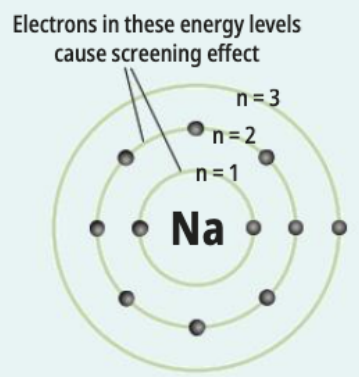
The screening effect is crucial for understanding atomic radius trends. Inner electrons don't completely block the nuclear charge, but they do reduce its impact on outer electrons.
Important
Understanding the Screening Effect
The screening effect becomes progressively stronger as you move down a group because there are more inner electron shells to "shield" the outer electrons from the full nuclear charge.
Example
Example: Comparing Group 1 Elements
- Lithium: electrons in energy levels n=1 and n=2, with some screening of the outer electron
- Sodium: electrons in n=1, n=2, and n=3 levels, with greater screening effect
- Potassium: has even more inner electron shells, creating stronger screening
As you move down a group, the screening effect becomes more significant, allowing the atomic radius to increase despite the higher nuclear charge.
Key factors affecting atomic radius
Note
Three Key Factors Determining Atomic Size
- Nuclear charge: More protons = stronger attraction = smaller radius
- Number of energy levels: More electron shells = electrons further out = larger radius
- Screening effect: More inner electrons = less effective nuclear pull = larger radius
The interplay between these factors determines the overall size of an atom and explains the predictable patterns we observe in the periodic table.
Summary
Key Points to Remember:
- Atomic radius decreases across periods (left to right) due to increasing nuclear charge pulling electrons closer
- Atomic radius increases down groups (top to bottom) due to additional energy levels and increased screening effect
- Covalent radius is half the distance between nuclei of two bonded identical atoms
- Noble gases don't have covalent radii values because they rarely form covalent bonds with themselves
- The screening effect of inner electrons reduces the effective nuclear charge felt by outer electrons, allowing atoms to be larger than expected based on nuclear charge alone