The Internet & World Wide Web (Leaving Cert Computer Science): Revision Notes
📚Revision Notes
The Internet & World Wide Web
Network
Note
Network: A collection of interconnected devices that communicate with each other to share resources and information.
Networks are classified by their size, scope and purpose. There are networks for personal areas, homes, businesses, cities etc.
The Internet
Note
The Internet : A global network of interconnected networks used to provide and exchange information using standardised communication protocols.
Note
The World Wide Web : A network of connected documents such as website and other web resources hosted over the Internet. These resource are all connected via hyperlinks
A web browser is an application that allows users to access, retrieve and view information on the World Wide Web. It acts as an interface between users and the Internet. When a user requests a web page from a particular website, the browser retrieves the files from a web server and renders the resource back to the user.
To access the resource, users typically input a URL into the browser, which stands for Uniform Resource Locator. This is a reference (address) to a resource on the Internet.
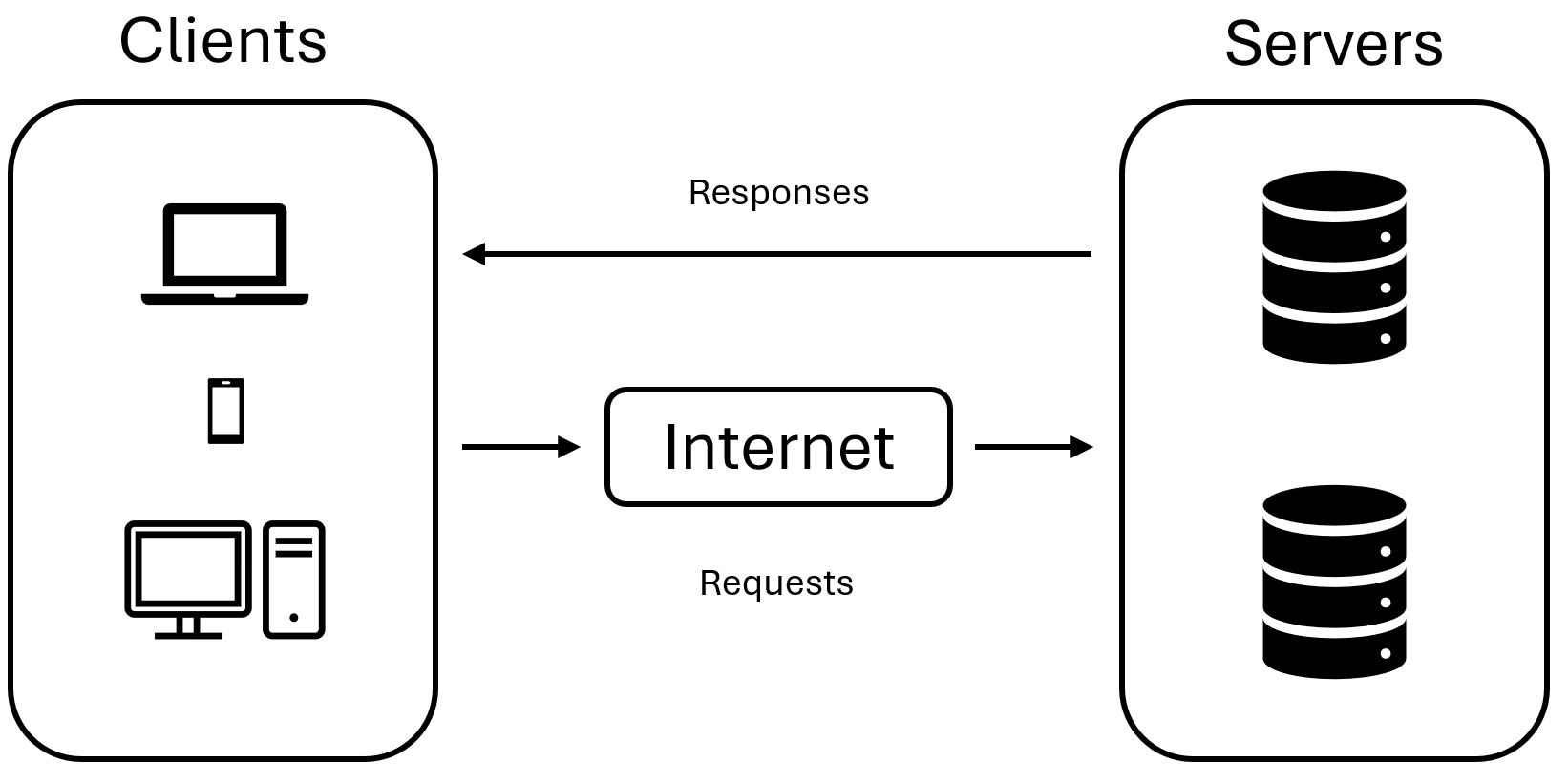
The process is known as the client-server model. Your computer acts as client and issues a request to access some resource. The server responds to the client by providing the requested service or resource.
Communication Protocols
Note
Communication Protocol: A set of predetermined rules and conventions to describe how data should be transmitted and received over a network.
Protocol are established to ensure consistent, reliable and standardised communication between devices regardless of hardware, software or their architecture.
Communication protocols are organised into layers each with specific functions. The OSI (Open Systems Interconnection) model is a conceptual framework that divides network communication into seven layers.
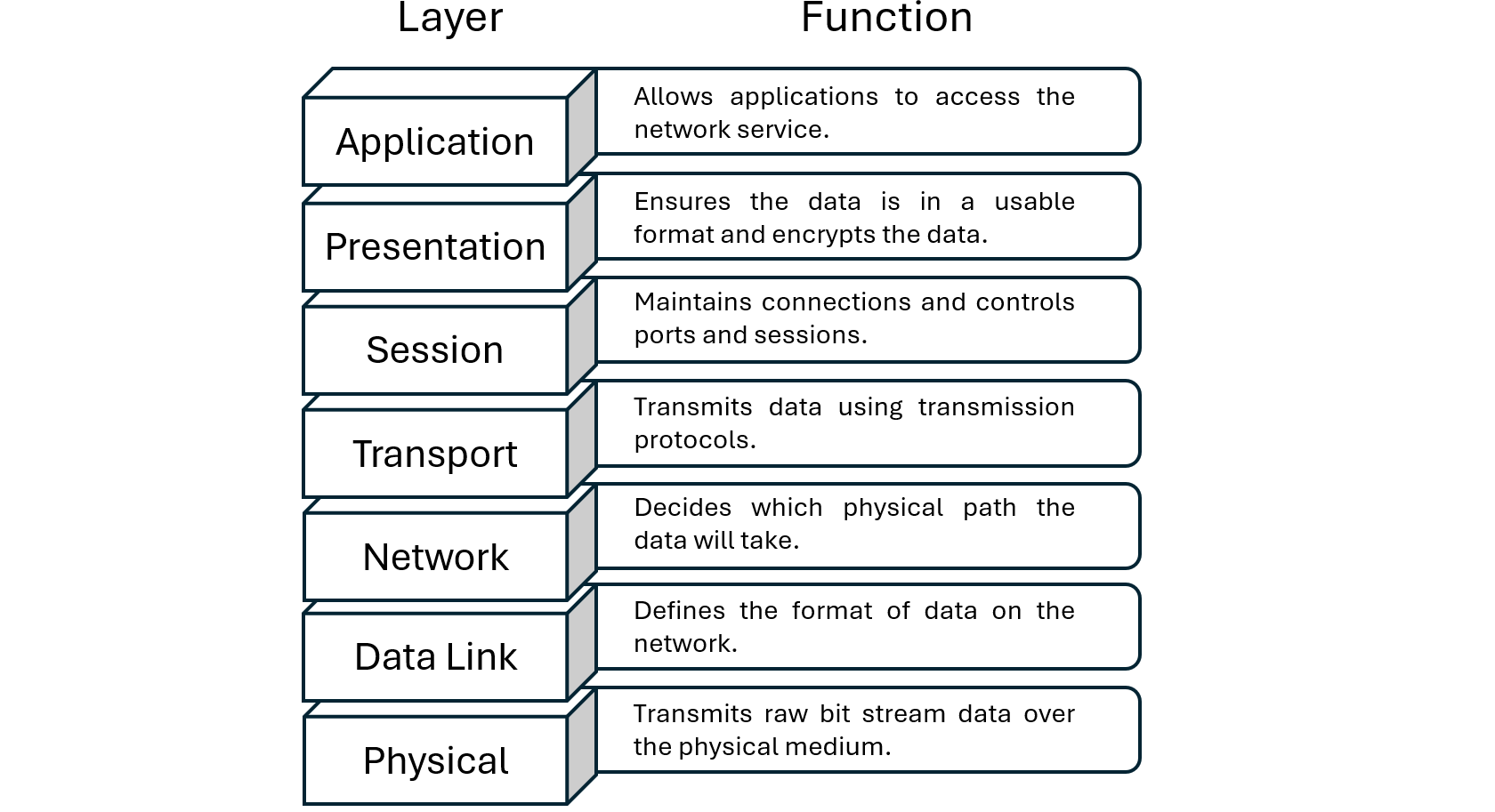
Requests travel down through each protocol layer in the client, through the Internet and then back up through the protocol layers in the server.
Note
There are many protocols for each layer, the Leaving Cert only covers the main ones.
HTTP & HTTPS
Layer : Application
Note
HTTP stands for Hypertext Transfer Protocol and is used for transmitting hypertext over the Internet.
HTTP is request-response protocol :
- The client sends a HTTP request to a server.
- The web server receives the request, processes it and determines the appropriate response.
- The server sends the HTTP response back to the client.
- The client receives the responses and processes it. For web browsers, this typically means rendering the HTML to the client.
Note
HTTPS stands for Hypertext Transfer Protocol Secure and is an extension of HTTPS that automatically encrypts the data that is being transmitted.
TCP
Layer : Transport
Note
TCP stands for Transmission Control Protocol and ensures that data is transmitted reliably between computers and applications.
- TCP first establishes a connection between the client and the server.
- The data is broken up into packets for more efficient routing, each tracked by TCP using a sequence number.
- After each packet has been transferred, the connection is terminated.
Note
Exam Focus SEC 2021 Section A Question 7
IP
Layer : Network
Note
IP stands for Internet Protocol and is used for routing and addressing packets of data so that they can travel across network and arrive at the correct destination.
- Data is encapsulated into IP packet consisting of a header and the payload. The header contains information for the routing including the source and destination IP address.
- The IP packet is sent and routed until it reaches the destination.
TCP / IP Protocol Suite
The TCP / IP Protocol Suite is a set of communication protocols used to interconnect network devices over the Internet.
TCP keeps track of the packet information and ensures secure and reliable transmission while IP is responsible for the creation of the packets such as their addressing and routing.
The TCP / IP is composed of four layers, each responsible for a specific purpose.

- Application Layer : Responsible for encoding and decoding the data into a form that is understood by the client and server devices using protocols such as HTTPS.
- Transport Layer: Breaks down the data into packets where each packet is assigned a sequence number. The recipient uses this information to assemble the packets in the correct order and allows the recipient to identify missing packets.
- Network Layer: Handles the routing of data packets across network boundaries, providing logical addressing and packet forwarding. The network then knows where to send the message and where it came from.
- Data Link Layer: Enables the physical transfer of packets between nodes on a network or between one network to another.
Note
The network layer is also known as the Internet layer.
Note
The TCP/IP Model should not be confused with the OSI Model. The TCP/IP is a framework specifically designed for communication on the Internet while the OSI Model is a conceptual framework used to standardise network communication.
Wi-Fi
Note
Wi-Fi (Wireless Fidelity) is a radio wave technology that allows enables devices like computers smartphones to communicate over a network and access the Internet without the need for physical cables
VoIP
Note
VoIP stands for Voice over Internet Protocol which allows voice communication and multimedia sessions over the Internet.
VoIP converts voice signals into digit data packets and transmits them over the network, enabling telephone calls, video calls and other forms of communication without relying on traditional telephone lines.
Network Hardware
Network hardware facilitates and manages data communication within a network.
Router
Function : Forwards data packets between computer networks. They provide and usually additional features such as firewall protection.
Gateway
Function : Connects networks using different protocols and facilitates communicate between them, for example, two different networks in an organisation.
Bridge
Function : Connects and philtres traffic between two or more network segments, creating a larger network.
Network Switch
Function : Forwards data packets only to devices that need to receive it.
Repeater
Function : Regenerates signals to extends the range of a network by re-transmitting the data.
Cloud Computing
Note
Cloud computing is a technology that enables on-demand access to a shared pool of computing resources, such as servers, storage, databases, networking, software, and analytics, over the Internet
Advantages of Cloud Computing
- Cost Efficiency
- Users and organisations do not need to invest in expensive hardware and can instead pay for only what they use to cloud providers. Maintenance costs are also reduced as the cloud providers handle hardware and software upkeep.
- Disaster Recovery
- Cloud provider offer comprehensive backup and recovery options, maintaining business continuity.
- Collaboration
- Cloud providers support tools and platforms that enable multiple users to work on the same project simultaneously.
Disadvantages of Cloud Computing
- Security & Privacy
- Storing sensitive data on the cloud can raise concerns about unauthorised access and data breaches.
- Data Transmission Costs
- Transferring large volumes of data to and from the cloud can be expensive. Latency can affect performance, especially for real-time applications.
- Limited Control
- Cloud users have less control over the underlying infrastructure compared to on-premise solutions.
Note
Exam Focus SEC 2022 Section A Question 8