Challenges and Ground Conditions (Leaving Cert Construction Studies): Revision Notes
📚Revision Notes
Foundations: Challenges and ground conditions
Settlement of foundations
Settlement occurs when a building moves downward below its original position. This happens due to changes in the soil condition beneath the foundation. Settlement can develop over many years and affects both new and existing buildings.
Types of settlement
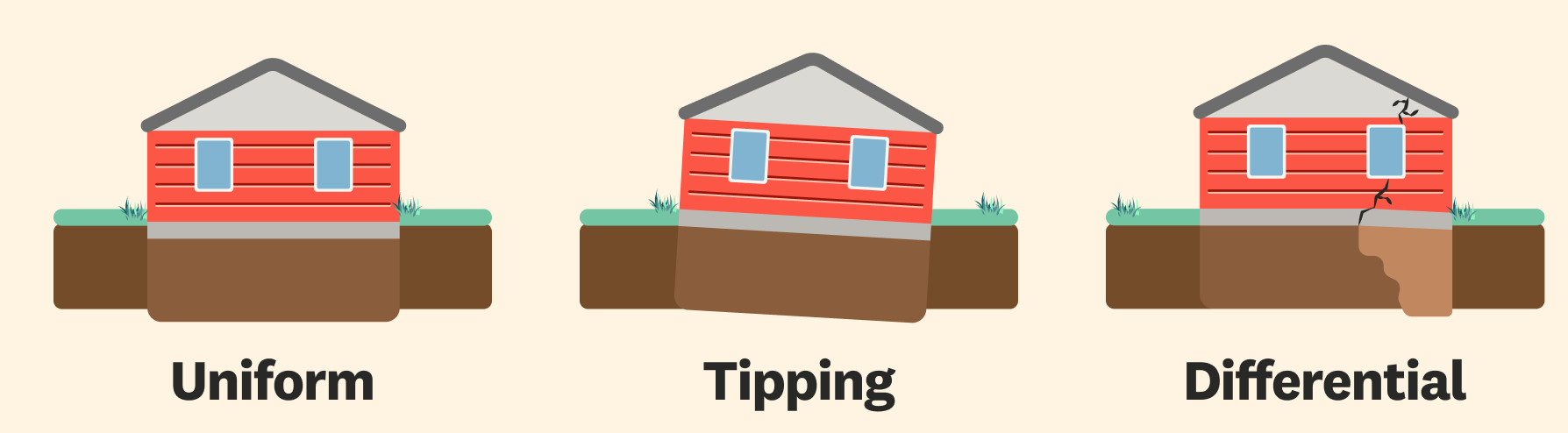
Total settlement happens when the entire building moves uniformly downward from its starting position. The building settles evenly as a complete unit.
Differential settlement occurs when only part of the structure settles below the rest of the building. This type creates the most serious problems because it causes distortion and structural defects throughout the building.
Important
Differential settlement is far more dangerous than total settlement because it creates uneven stresses that can cause structural failure and severe cracking throughout the building.
Causes of settlement
Several factors can trigger foundation settlement:
- Consolidation of soil: The ground becomes more dense as water gets squeezed out by compression pressure from the building's weight
- Water removal from soil: Nearby trees can extract moisture from the soil, causing it to shrink
- Plastic flow of soil: Building pressure can cause solid masses like clay to form and shift beneath the structure
- Cohesive soils bulging: The building's weight can make silty soils bulge outward
- Soil erosion: Wind or water erosion around the foundation weakens the structural support
- Frost heave: Repeated freezing and thawing of ground water causes soil movement
Note
Understanding these causes helps builders identify potential settlement risks during the site assessment phase and take appropriate preventive measures.
Building near trees
Trees provide aesthetic value and help new buildings blend with their surroundings. However, trees create significant challenges for foundations that must be carefully managed.
Problems caused by trees
When trees grow too close to buildings, their roots absorb large amounts of water from the soil around the foundations. This moisture removal causes soil shrinkage, which makes the structure unsound and creates cracks in the building's façade.
The cracks typically appear widest at ground level and narrow as they extend upward on the building.
Tree removal effects
Removing problematic trees doesn't always solve foundation issues. When a tree is removed, the area where it stood can fill with water, causing the ground to swell. This swelling effect, called heave, can create new cracks in the building's façade.
Note
Both keeping trees and removing them can cause foundation problems through different mechanisms - shrinkage from water extraction or swelling from water accumulation after removal.
Safe distance rule
A simple rule prevents both shrinkage and swelling problems: the minimum distance from a building to any tree must equal the tree's mature height (the height it will reach when fully grown).
This rule applies whether keeping existing trees or planting new ones.
Important
Safe Distance Rule: Distance from building = Mature height of tree
This fundamental rule prevents both water extraction damage and future heave problems from tree removal.
Effects of frost
Water beneath the ground surface can freeze during cold weather, forming ice. When water freezes, it expands and forces soil particles apart. Throughout a cold season, this soil movement can lift foundations upward.
When the ground thaws, foundations may settle back down, but not necessarily to their exact original position. This process is called frost heave.
Important
Frost heave is a cyclical problem that worsens over time. If frost heave continues over several seasons, it can cause major structural problems in the building.
If frost heave continues over several seasons, it can cause major structural problems in the building.
Pyrite
Pyrite is a mineral sometimes found in the hardcore layer beneath foundations. When pyrite gets exposed to moisture, it undergoes a chemical reaction that forms sulphuric acid. This acid then reacts with calcium carbonates present in the hardcore.
Over time, these reactions cause swelling in the hardcore layer. The swelling lifts internal floor slabs and damages interior structural supports that rest on them.
Note
The pyrite reaction is a slow chemical process that can take years to manifest visible damage, making it particularly challenging to detect during initial construction phases.
Summary
Key Points to Remember:
- Settlement moves buildings downward; differential settlement is more dangerous than total settlement
- Trees should be positioned at a distance equal to their mature height to prevent foundation problems
- Both keeping trees and removing them can cause foundation damage through different mechanisms
- Frost heave lifts foundations through repeated freeze-thaw cycles in cold climates
- Pyrite in hardcore creates long-term swelling problems that damage internal structures