Early Settlement (Leaving Cert Construction Studies): Revision Notes
📚Revision Notes
Early Settlement
Built heritage refers to historic buildings and structures that form part of our architectural history. It includes the physical remains of our ancestors' settlements and reflects the building methods, materials, and design standards of the time. Studying built heritage helps us understand how construction techniques have developed and how they influence modern building practices.
Categories of Ireland's Architectural Heritage
The National Inventory of Architectural Heritage (NIAH) classifies Ireland's architectural heritage into the following groups:
- Fortified buildings: Castles, defence towers, ringforts, military buildings.
- Religious structures: Cathedrals, churches, shrines, monasteries.
- Formal architecture: State institutions, estate homes, public buildings.
- Informal architecture: Vernacular buildings, rural cottages.
Built Heritage – Early Eras
1. Prehistoric Settlement
- The first evidence of organised farming in Ireland comes from the Céide Fields in Co. Mayo. These 5,000-year-old stone field walls, house sites, and tombs show how land was cleared and divided for crops and animals.
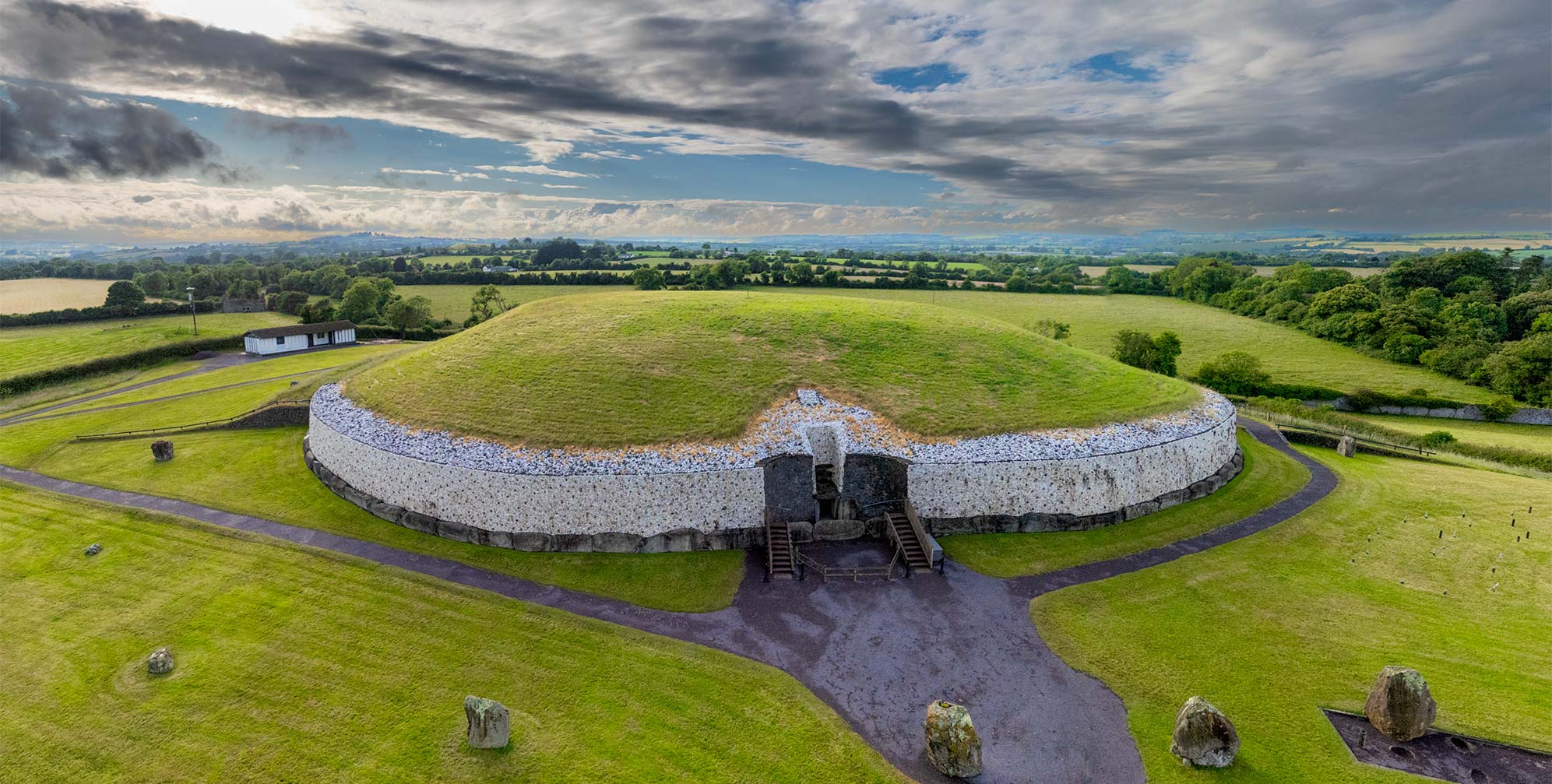
- People built passage tombs, the most famous being Newgrange in Co. Meath (c. 3200 BC).
- Large stones were arranged in overlapping layers (corbelling) to create a self-supporting roof. The passage aligns with the rising sun on the winter solstice, flooding the inner chamber with light.
- Court tombs like Creevykeel in Co. Sligo had open courtyards leading to roofed burial chambers, used for ceremonies as well as burials.
- Construction in this era was mainly dry-stone (no mortar), using local stone. Roofs were corbelled or timber-framed with thatch where timber was available.
- By the Bronze and Iron Ages, settlements often appeared near sources of copper, tin, and iron. Mount Gabriel in Co. Cork is an example of prehistoric copper mining, showing how access to materials influenced where people lived.
2. Pre-Christian
- In late prehistoric Ireland, most rural families lived in ringforts (also called raths). These were circular enclosures made from earth banks or stone walls, with houses and farm buildings inside.
- The main purposes were protection from wild animals and raiders, shelter for livestock, and marking ownership of land.
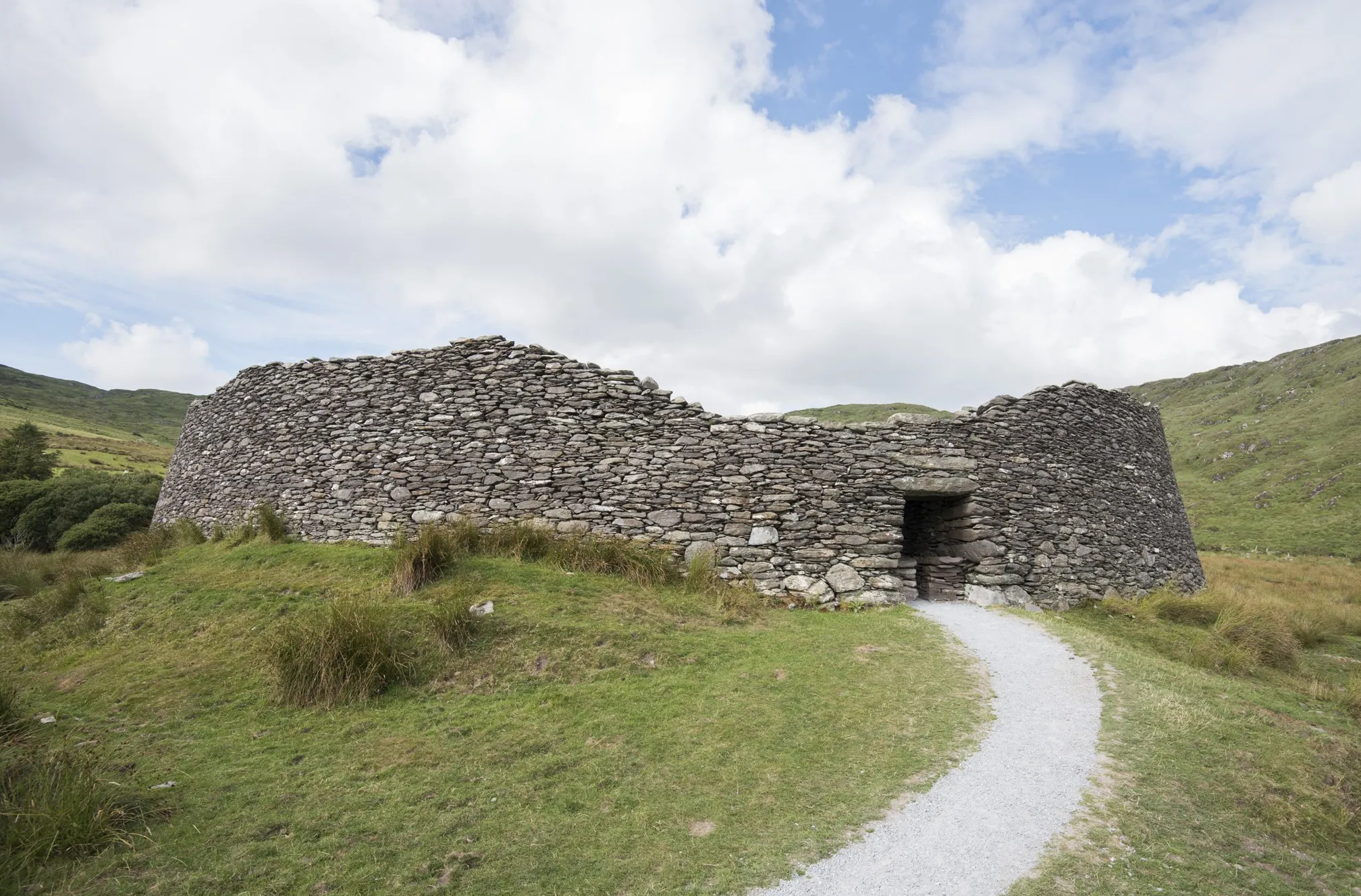
- In more exposed or high-status locations, people built stone forts. These had much thicker dry-stone walls and sometimes multiple rings of defence.
- Dún Aonghasa on Inis Mór, Co. Galway is a dramatic example — a semi-circular fort built on the edge of a cliff for both defence and visibility.
- Staigue Fort in Co. Kerry has high walls with internal steps, allowing defenders to patrol the top.
- Building methods used local stone fitted without mortar, showing advanced skill in dry-stone construction.
3. Early Christian
- From the 5th century onwards, monasteries became important centres of religion, learning, and craftwork.
- Famous examples include Glendalough in Co. Wicklow and Clonmacnoise in Co. Offaly.
- Round towers (cloigtheach) were built within monastic sites. These tall, circular stone towers had doors raised several metres above ground and small windows. They served as bell towers, storehouses, and safe refuges during raids.
- Early Christian churches were usually small and built in stone, with steeply pitched roofs and little decoration.
- Beehive huts (stone cells) were used by monks in remote locations such as Skellig Michael in Co. Kerry. Built using corbelling, the overlapping stone layers formed a watertight domed roof.
- The construction techniques of this period combined stone masonry with an understanding of weather protection and durability, influencing Irish building for centuries.

4. Viking Settlement
- From the late 8th century, Vikings began arriving in Ireland, attacking coastal areas and monasteries.
- Over time, they established longphorts. These were fortified harbours that developed into the first towns in Ireland, such as Dublin, Waterford, Wexford, Cork, and Limerick.
- These towns had planned street layouts with narrow streets arranged in an organised pattern. This improved defence and encouraged trade.
- Viking houses were usually timber-framed with wattle-and-daub walls (woven sticks covered with mud and straw) and thatched roofs.
- Coastal and riverside locations gave access to trade routes, increasing the use of imported goods and materials in Ireland.
- Few Viking buildings survive, but excavations at Wood Quay in Dublin have revealed house foundations, workshops, and artefacts, showing skilled craftsmanship in metalwork, shipbuilding, and trade.
- Viking towns became centres for commerce, governance, and cultural exchange, influencing the growth of later Irish towns
Example
Case Study – Wood Quay, Dublin
In the 1970s, archaeologists uncovered the remains of around 150 Viking-age houses at Wood Quay, Dublin, along with workshops, fences, paths, and part of a 12th-century city wall. The site provided an exceptional insight into Viking settlement in Ireland, with artefacts preserved in waterlogged soil. Despite its importance, Dublin Corporation went ahead with plans to build new offices on the site. Protests, court cases, and campaigns such as "Save Wood Quay" failed to stop construction, and much of the archaeology was destroyed before it could be fully recorded. The Wood Quay controversy is now seen as one of Ireland's greatest heritage losses, highlighting the tension between development and preservation.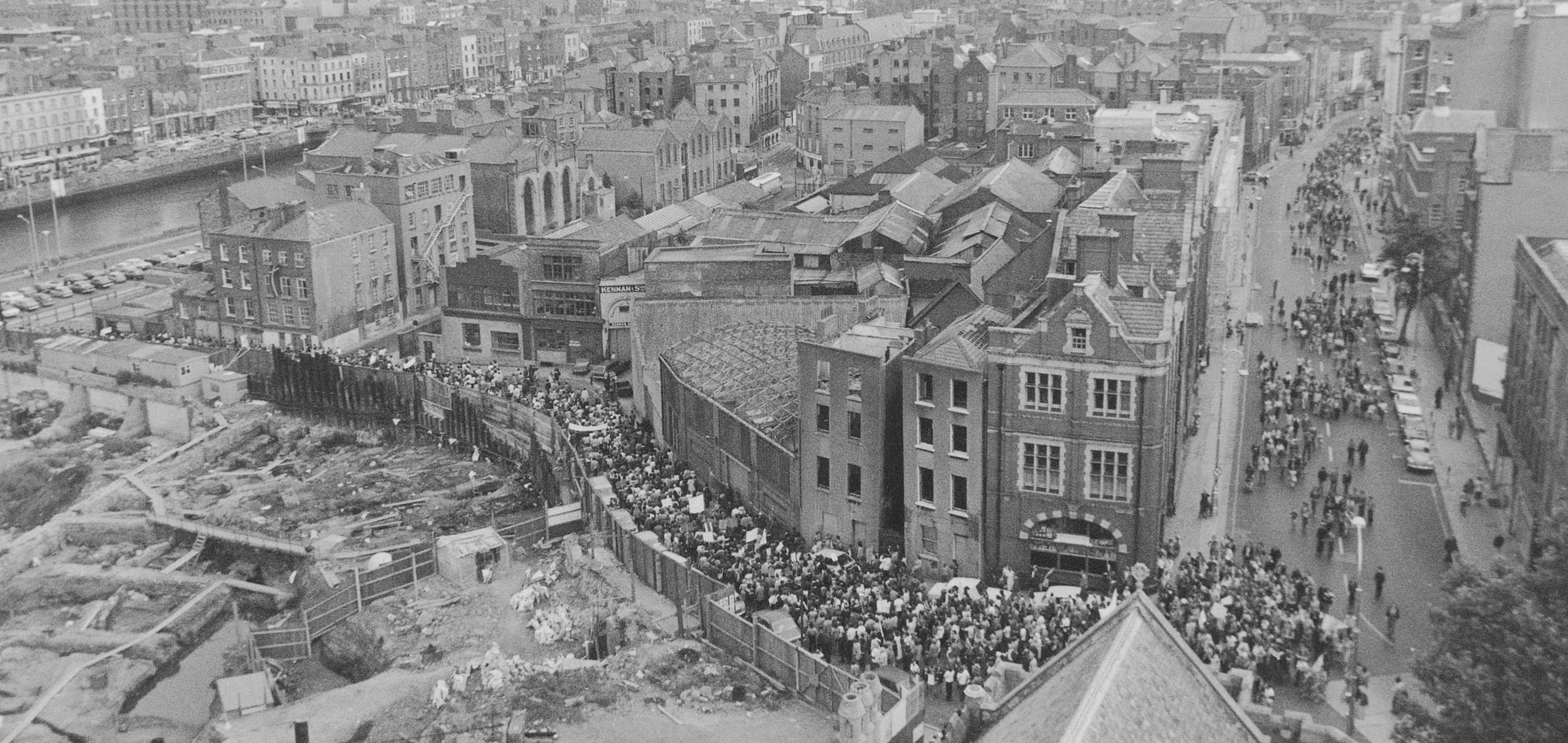
| Era | Key Features | Main Purpose | Irish Examples |
|---|---|---|---|
| Prehistoric Settlement | • Stone field systems (Céide Fields) • Passage tombs with corbelled roofs and solstice alignment • Court tombs with open courtyards • Dry-stone construction using local stone • Settlements near copper, tin, and iron sources | • Farming • Burial and ceremonial use | • Céide Fields • Newgrange • Creevykeel • Mount Gabriel |
| Pre-Christian | • Ringforts (earth or stone) • Stone forts with thicker walls and multiple rings • Dry-stone walling without mortar | • Defence from attack • Shelter for livestock • Status symbol | • Dún Aonghasa • Staigue Fort |
| Early Christian | • Monasteries as centres of religion and learning • Round towers with raised doors and small windows • Small stone churches with steep roofs • Beehive huts built with corbelling | • Religious worship • Education • Refuge during raids | • Glendalough • Clonmacnoise • Skellig Michael |
| Viking Settlement | • Longphorts (fortified harbours) • Planned narrow street layouts • Timber-framed houses with wattle-and-daub walls • Coastal or riverside locations | • Trade • Defence • Town development | • Dublin • Waterford • Wexford • Cork • Limerick • Wood Quay excavation |