Urban Development (Leaving Cert Construction Studies): Revision Notes
📚Revision Notes
Urban development
Introduction to development planning
Urban development planning works at multiple scales, from the broad neighbourhood level down to individual buildings. Effective planning considers three key layers:
- Neighbourhood/locality - the wider community context
- Site - the specific development location
- Home (building) - individual structures
This multi-scale approach ensures that new developments fit well within their existing environment whilst meeting the needs of residents and the wider community.
What is urban development?
Urban development involves shaping towns and cities to create desirable places where people can work and live comfortably. Development can range from single buildings to entire neighbourhoods. The goal is not just to provide housing, but to build genuine communities that enhance quality of life.
Note
Good urban planning puts the community - both the place and its people - at the centre of development decisions, rather than focusing solely on buildings.
Essential elements for sustainable urban development
For urban areas to grow in a sustainable way, planners must carefully balance three essential elements:
- Community development
- Economic development
- Viable natural environment
Note
Community Development
This focuses on building genuine communities rather than just providing accommodation. Local service centres should be developed within neighbourhoods to serve residents' daily needs. The aim is to create places where people feel connected to their area and neighbours.
Note
Economic Development
Urban areas must provide economic opportunities for residents. Development should plan for shops, businesses, factories, offices and other economic centres that create jobs and support local prosperity. A thriving local economy is essential for community sustainability.
Note
Viable Natural Environment
All development must protect and work with the natural environment. New building should not damage the local ecosystem or create environmental problems. This includes considering factors like green spaces, wildlife corridors, and sustainable building practices.
These three elements overlap and depend on each other - successful urban development requires all three working together.
Modern urban design principles
Modern urban planners aim to create sustainable communities with good access to amenities and transport links. The focus is on neighbourhoods where essential services like shops, schools and offices are within easy walking distance.
The clustered neighbourhood model
Modern urban planning often organises residential areas into clustered neighbourhoods, each built around a local neighbourhood centre. These centres typically include:
- Local shops (e.g. grocery, pharmacy)
- Childcare and primary education facilities
- Bus stops and transport connections
- Community amenities (e.g. parks, sports facilities, libraries)
Multiple neighbourhoods are linked within walking or cycling distance, reducing reliance on private cars for everyday activities.
Neighbourhoods also connect to a larger district centre, which provides:
- Shopping centres and supermarkets
- Healthcare facilities (clinics, GPs, hospitals)
- Restaurants, cinemas, and leisure venues
- High-density housing and apartments
- Access to national public transport (train stations, regional bus routes)
This structure supports sustainable urban development, ensuring most daily needs are met locally while still offering access to regional services and infrastructure.
Street design considerations
Street layout
The layout of streets and building lines creates the local character of urban areas - this is called the urban structure. Good street design respects existing street patterns and widths to maintain consistency with historic surroundings.
New developments should not simply copy historic styles, but should understand and build upon the principles that made historic development successful and attractive.
Street façade
New buildings should match the character and potential of the existing built environment. They should continue the traditions and architectural styles of the local neighbourhood to create visual continuity.
Note
Active frontage describes street characteristics that help animate an area, making it feel safer and more welcoming. This includes:
- Well-positioned windows with interesting details
- Attractive plasterwork and building colours
- Clear signage and visual interest
In contrast, dead frontage refers to blank, uninteresting buildings that reduce visual interest and make areas feel unwelcoming.
Curtilage and privacy
Curtilage refers to the land immediately surrounding a building, including any associated structures like garages or sheds. It can be defined by trees, fences, hedges and other boundaries.
Urban areas have high housing density, but residents still need reasonable privacy. To maintain privacy between neighbouring properties:
Important
Privacy Requirements:
- The minimum recommended distance between houses back to back is 22 metres
- Visual screening should be provided above eye level at site boundaries
- Careful positioning of windows and outdoor spaces helps prevent overlooking
Parking solutions
Urban residential areas can accommodate parking in several ways depending on housing density:
In-curtilage parking works well for lower-density areas, where each home has its own driveway or garage within its boundaries.
Communal parking suits higher-density developments, where residents share parking areas that serve multiple homes.
Many developments use a mixed approach, combining both on-street and off-street parking to balance convenience with visual appearance.
Home Zone concept
The Home Zone concept, originally developed in the United Kingdom, brings together many modern urban planning principles. Home Zone developments create mixed residential communities that promote:
- Mixed accommodation types - different housing types (family homes, apartments, elderly accommodation) within the same development to suit different residents' needs.
- Emphasis on public spaces - open spaces and community areas that are overlooked by homes, creating natural surveillance and community interaction.
- Traffic calming measures - reduced speed zones and traffic calming features that create a more relaxed, pedestrian-friendly environment.
Traffic calming techniques
Traffic calming helps create safer, more pleasant residential areas. Common measures include:
- Speed bumps and raised crossings
- Curved streets that encourage slower driving
- Tight corner turns that naturally reduce speed
- Extended pavements and pedestrian crossings
These features make streets more attractive for walking whilst maintaining vehicle access.
Community participation in planning
Urban planners develop policies and plans, but they also consult with local community members. Local people interact with their area daily and often understand practical challenges that may arise with new developments.
Note
Involving local residents in development planning adds to the positive effects of good urban design. Community input helps ensure developments work practically for the people who will use them most.
Urban sprawl challenges
Important
Urban sprawl is the uncontrolled, low-density expansion of urban areas into surrounding rural land. It typically involves poorly planned, car-dependent development, with scattered housing, retail, and infrastructure spread over a large area.
Urban sprawl represents one of the biggest challenges facing urban development today.
Important
Problems Created by Urban Sprawl:
Inadequate services and infrastructure - sprawling developments often lack local service centres, forcing residents to travel longer distances for daily needs.
Increased car dependency - without local services and with low housing density, public transport becomes unviable, increasing reliance on private cars.
Limited public space - sprawling areas typically have lots of private space but very little public space for community activities.
Environmental impact - sprawl consumes more land and creates more traffic, increasing environmental damage.
Out-of-town shopping centres compound these problems by drawing activity away from town and city centres, encouraging further car use.
Better planning that prevents urban sprawl can create higher-quality urban environments that serve communities more effectively.
Urban Sprawl in Philadelphia: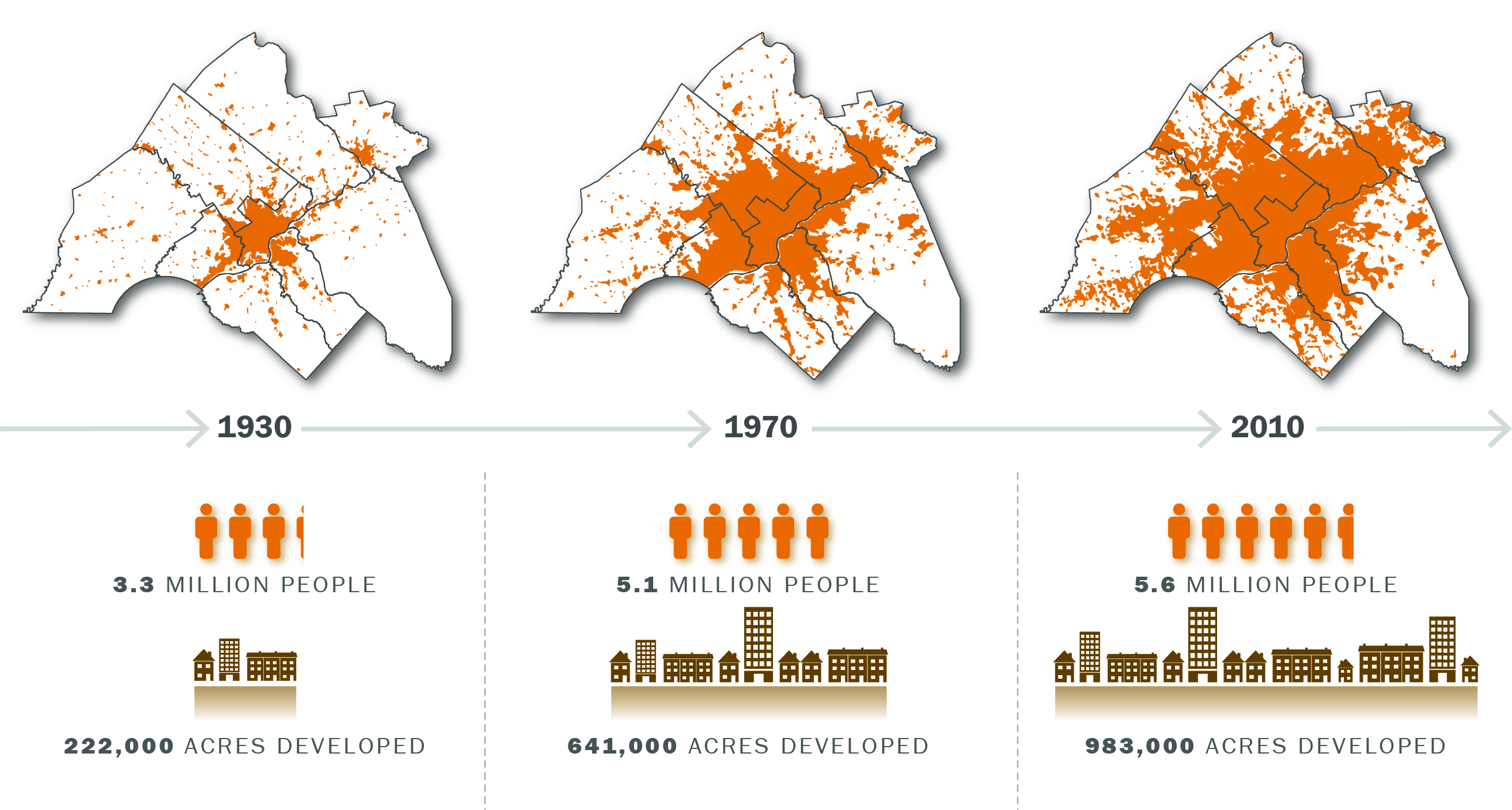
Summary
Key Points to Remember:
-
Urban development works at three scales: neighbourhood, site, and individual building - all must work together
-
Sustainable urban development balances three essential elements: community development, economic opportunities, and environmental protection
-
Modern urban design clusters neighbourhoods around local service centres, with most amenities within walking distance
-
Street design elements (layout, façade, curtilage, parking) all contribute to creating attractive, functional urban areas
-
Community participation in planning ensures developments meet real local needs and work practically for residents