Passive Housing (Leaving Cert Construction Studies): Revision Notes
📚Revision Notes
Passive Housing
Sustainability and Passive Design
What is a Passive House?
- A passive house is not a construction method, but an internationally recognised building standard that focuses on comfort, sustainability, and economy.
- It should not be confused with an energy-efficient house, which simply uses less energy than average.
- A passive house can maintain a comfortable indoor temperature without the use of active heating or cooling systems.
Key Features
- Passive houses use careful design, insulation, and airtight construction to reduce heat loss and make the most of natural heat from the sun.
- They can reduce purchased energy use by up to 85–90 percent compared to traditional houses.
- In Ireland, passive buildings include one-off houses, schools, healthcare buildings, and social housing developments (such as in Dungannon, Co. Tyrone).
- The Passive House Association of Ireland (PHAI) works to promote and educate people about passive housing.
Criteria for Passive Certification
To be certified as a passive house, a building must meet strict criteria:
- The annual heating demand must be no more than 1.5 litres of heating oil per square metre per year.
- The building must be extremely airtight, with an air change rate of no more than 0.6 per hour at a pressure difference of 50 Pascals.
- It must be super-insulated, with an average U-value of less than 0.15 kilowatt hours per square metre per year.
- There must be no thermal bridges (cold spots where heat can escape).
- The design should be a compact building form with the smallest possible surface area in relation to its volume.
- The building must make passive use of solar energy through correct orientation.
- All glazing and window frames must have a U-value of less than 0.8 kilowatt hours per square metre per year and be triple-glazed.
- Household appliances should be A1-rated for efficiency.
- The total energy use for heating, hot water, ventilation, and household electricity must be no more than 120 kilowatt hours per square metre per year.
Note
Criteria for Passive Certification
- Annual heating demand: ≤ 1.5 litres of heating oil/m²/year.
- Airtightness: Air change rate ≤ 0.6 per hour at 50 Pascals.
- Super-insulation: Average U-value < 0.15 kWh/m²/year.
- No thermal bridges (cold spots where heat escapes).
- Compact building form (minimum surface area relative to volume).
- Solar energy use: Correct building orientation.
- High-performance glazing: U-value < 0.8 kWh/m²/year (triple-glazed).
- A1-rated appliances.
- Total energy use (heating, hot water, ventilation, electricity) ≤ 120 kWh/m²/year.
Airtightness
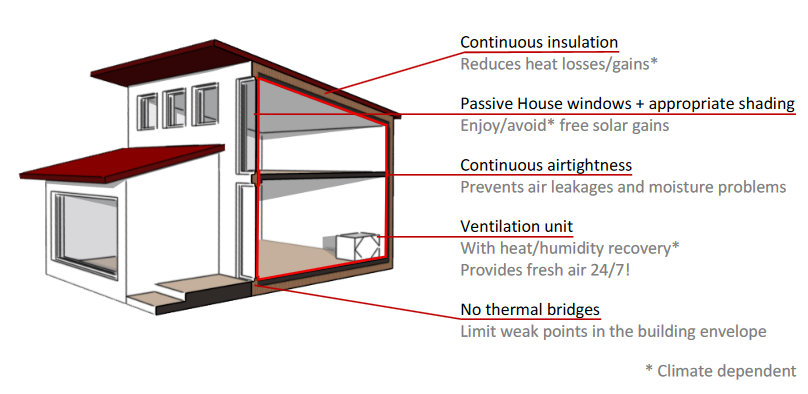
- Airtightness prevents heat loss by stopping air leaks through the gaps in the building.
- Common leakage points: wall/floor junctions, windows and doors, roof junctions, service pipe penetrations, chimneys, attic hatches.
- Testing methods:
- Blower door test – measures air change rate.
- Thermal imaging – shows cold spots and leakage paths.
- Smoke tests – detect air movement to show where air is escaping.
Orientation
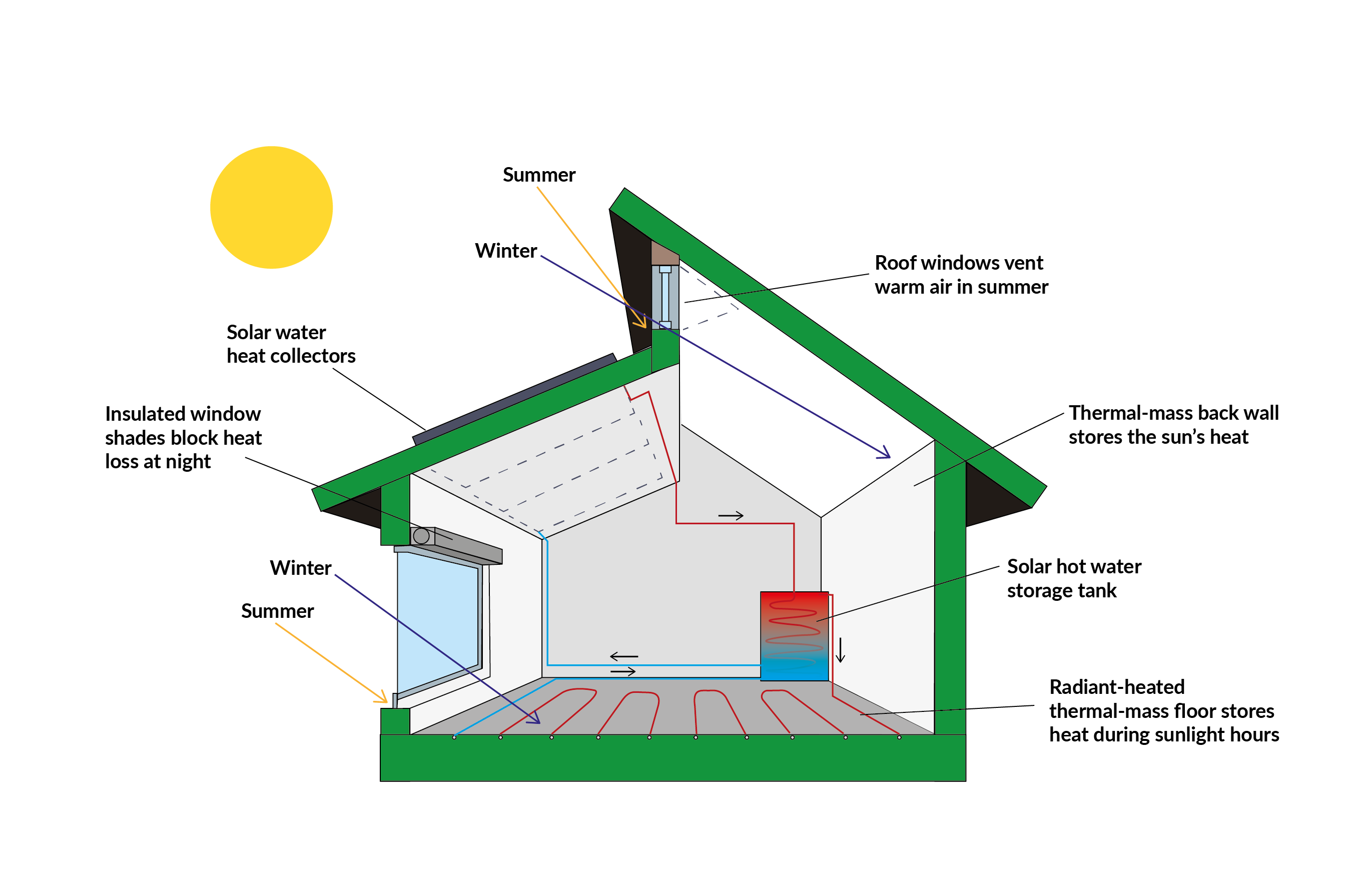
- Correct orientation allows a building to gain the most heat from the sun.
- Building must be oriented for maximum solar gain:
- Large windows should face within 20 degrees of south.
- Large north-facing glazing should be avoided to reduce heat loss.
- Correct orientation works with internal layout so rooms used during the day get most sunlight when needed.
- Triple glazing and low-e coatings can make south-facing windows up to five times more efficient than standard double glazing.
Compact Building Form
- A compact form reduces heat loss by having a smaller surface area compared to its volume.
- For passive certification, the compactness ratio should be 0.7 or less.
- Complex or sprawling building shapes lose more heat.
Passive Foundations
- Passive foundations are highly insulated to prevent heat loss into the ground.
- They stop cold bridging by creating a break between the ground and the inside of the house.
Passive Walls
- Walls must be airtight and have very high levels of insulation.
- A plaster finish without cracks ensures airtightness.
- Example (block wall):
- External render, external leaf, 250 mm insulation, internal leaf, plaster.
- Example (timber frame):
- External render, external leaf, cavity, insulation layers, vapour barrier, plasterboard.
Passive Windows and Doors
- 15% of heat lost through doors; 10% through windows.
- Doors and windows must be airtight and highly insulated.
- Heat loss through frames should be minimised by keeping frame sizes small compared to the glass area.
- Triple glazing is essential, and frames must be filled with insulation to prevent cold bridging.
Passive Roofs
- Traditional roofs need additional insulation and airtight membranes to meet passive standards.
Advantages of Passive Design
- Passive houses have very low energy consumption, using 75–90 percent less purchased energy than traditional houses.
- They provide a consistent indoor temperature of around 18–21°C all year.
- They have a lower environmental impact, producing less carbon dioxide because less fuel is burned for heating.
Disadvantages of Passive Design
- A passive house requires a high level of workmanship to meet the precise construction standards.
- Precise detailing for airtightness, insulation, and other features takes a lot of time during the build.
- There is a lack of available expertise in passive construction in some parts of Ireland.
- The initial building cost can be higher than for a traditional home.