Water System (Leaving Cert Construction Studies): Revision Notes
📚Revision Notes
Water system
A water system distributes water efficiently throughout a dwelling. Each component must be selected carefully to ensure proper operation and maintain reliable water supply to all fixtures.
Water storage components
Water storage tanks
Different systems require different storage tank arrangements based on their heating method and operational requirements:
Note
Understanding the difference between direct and indirect systems is crucial for selecting the correct storage tank configuration.
Direct hot water systems need one storage tank with a capacity of 230 litres. This tank provides the main water supply to the system and serves as the primary storage point.
Indirect hot water systems require a secondary storage tank in addition to the main tank. This secondary tank must have a capacity of 45 litres and supports the indirect heating process by providing additional storage for the heating circuit.
Cold water storage tanks are insulated against cold weather to prevent freezing and maintain water quality throughout seasonal temperature variations.
Hot water cylinder
The hot water cylinder stores heated water from the boiler and serves as the main source of hot water for the dwelling. Standard cylinders have a capacity of 135 litres and are constructed from copper for durability and heat conduction.
Cylinders are heavily insulated to prevent heat loss and maintain water temperature. Insulation methods include:
- Insulation foam wrapped around the cylinder
- Lagging jackets fitted over the cylinder exterior
Important
Proper insulation reduces energy costs and maintains consistent hot water temperatures. Poor insulation can result in significant heat loss and increased energy bills.
Pipework systems
Materials and construction
Water pipes are manufactured from two main materials, each offering distinct advantages for different installation scenarios:
Plastic pipes offer several advantages:
- Better insulation properties than copper
- Push-to-fit junctions for easier installation
- Lower material costs
- Generally preferred for new installations
Copper pipes provide:
- Excellent durability and longevity
- Superior heat conduction
- Traditional construction method
- Higher material costs but proven reliability
Note
Both materials can be used effectively depending on system requirements and budget considerations. Many modern installations combine both materials to optimise performance and cost.
Valve systems
Water systems use various valve types to control flow and ensure proper operation. Each valve type serves specific functions within the overall system.
Ball valves
Ball valves function as stop valves containing a ball with a centre hole. Water flows when the hole aligns with the pipe. These valves provide complete on/off control and are commonly positioned near appliances like boilers for easy maintenance access.
Gate valves
Gate valves operate as stop valves using a wheel mechanism. Turning the wheel moves an internal pin that closes or restricts water flow. These valves can either completely stop water or regulate flow rates, making them useful near appliances requiring variable water supply.
Drain-off valves
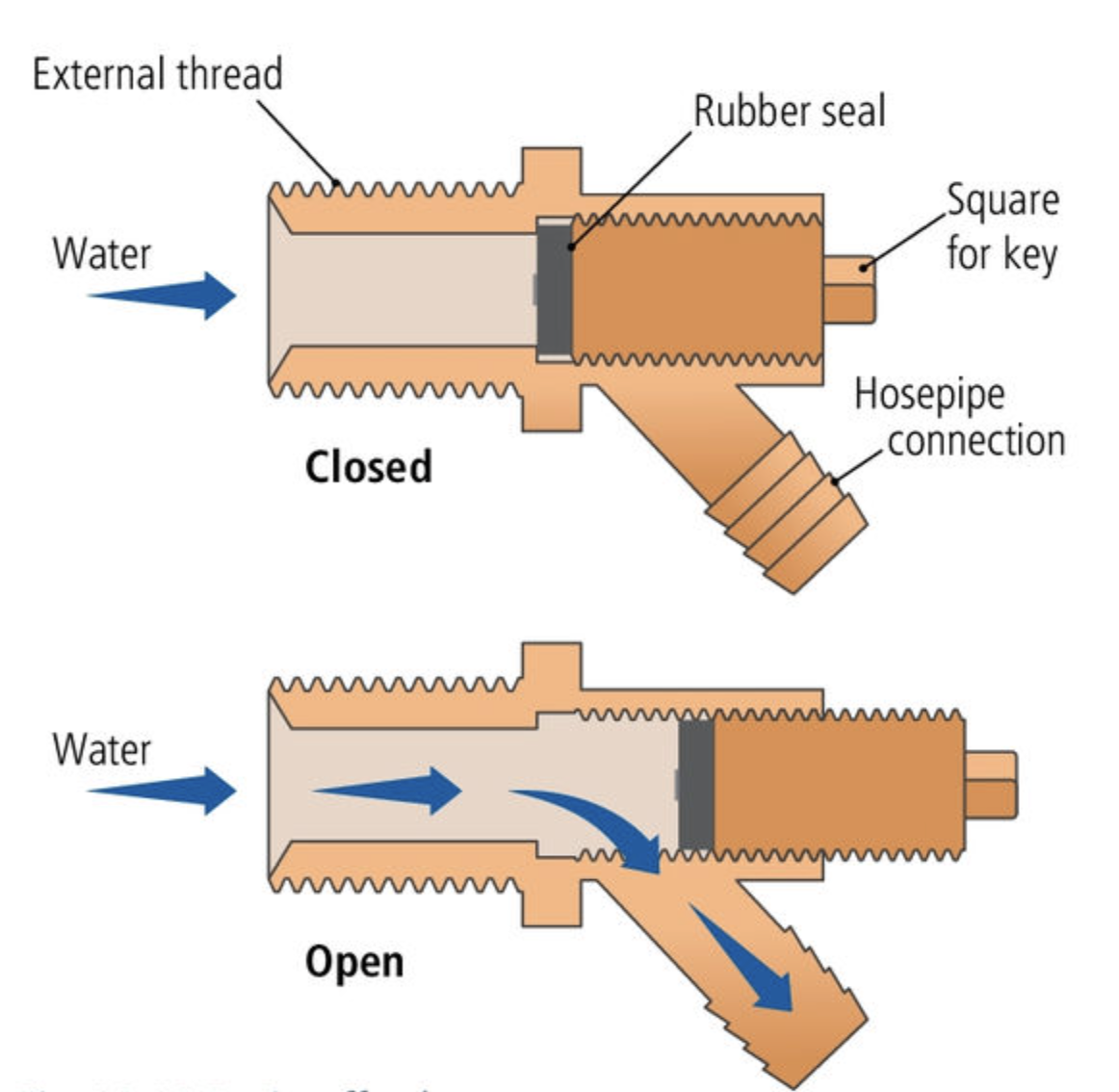
These valves allow system drainage without disconnecting pipework. They feature external threads and rubber seals for secure operation. In the closed position, they maintain system pressure. When opened, they permit water drainage from boilers, cylinders, or complete system sections.
Important
Drain-off valves are essential for system maintenance and must be easily accessible. Always ensure these valves are functioning properly to avoid complications during maintenance work.
Check valves
Check valves (also called non-return valves) permit water flow in one direction only. This prevents pressure loss and back siphonage, where water flows in the wrong direction. They maintain system pressure and ensure proper water distribution throughout the dwelling.
Float valves
Float valves automatically control water supply based on water level. They work with a hollow floating sphere that triggers valve closure when water reaches a predetermined height. These valves are typically found in toilet cisterns and storage tanks.
Taps
Taps control water supply at point of use in sinks, bathtubs, and other fixtures. Multiple designs exist, with common types including traditional turn taps and modern lever-operated versions.
Pipe fittings
Fittings connect different pipework sections and are manufactured in various shapes, sizes, and materials including plastic, copper, and cast iron. They serve multiple functions:
- Splitting water connections to serve multiple outlets
- Changing pipe direction to navigate around obstacles
- Extending pipework to reach distant locations
- Connecting different pipe sizes or materials
Proper fitting selection ensures reliable connections and system flexibility throughout the installation.
Water distribution system
The water distribution system forms the backbone of the entire water supply, ensuring reliable delivery from the mains connection to all points of use within the dwelling.
Mains connection
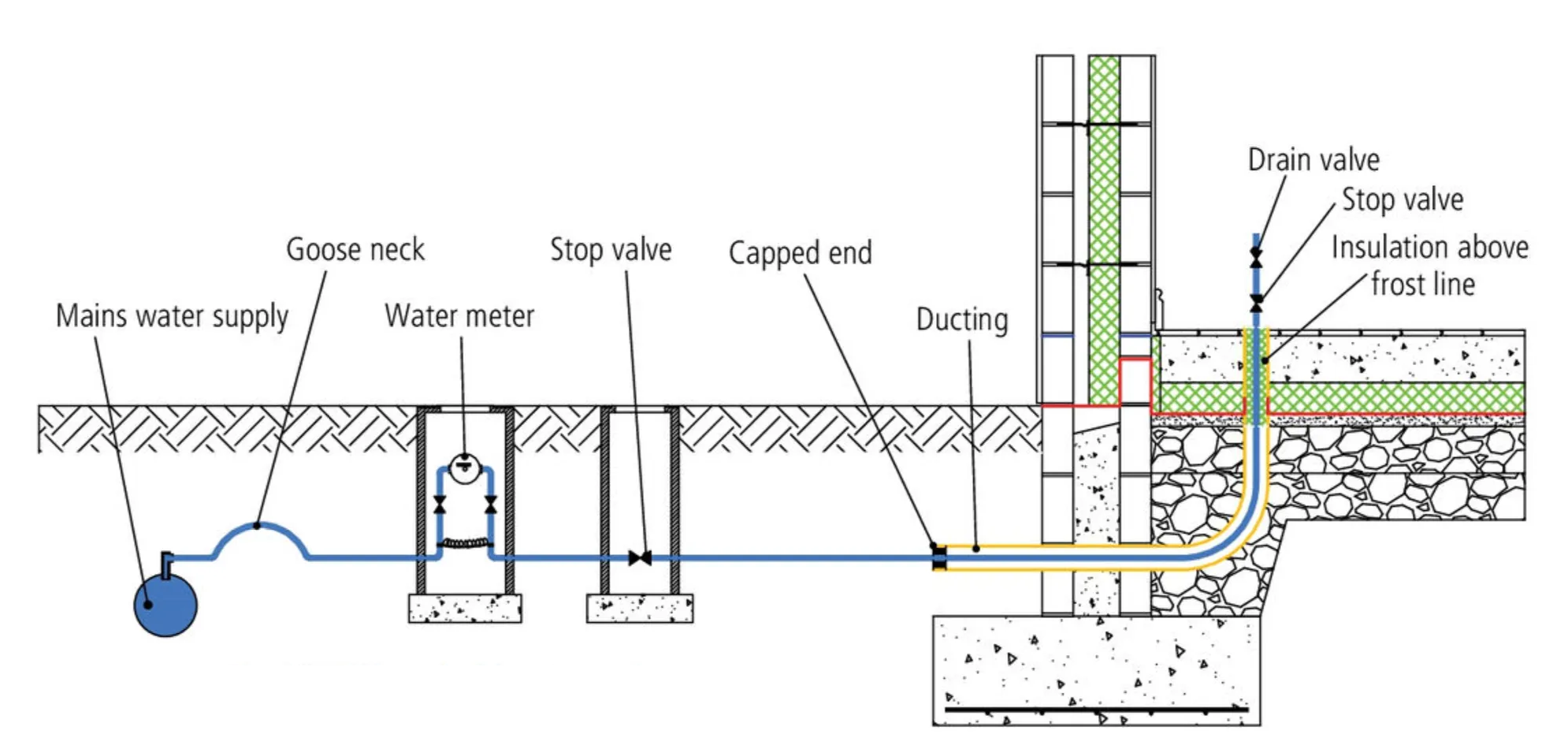
Water enters homes through the mains pipe connection. This connection is housed in a chamber beneath the pavement outside the dwelling. From the mains connection, water travels directly to the kitchen sink as the primary supply point.
Internal distribution
The distribution system includes several critical components that work together to provide reliable water supply:
Note
The internal distribution system follows a hierarchical approach, with the kitchen sink receiving priority supply as the primary drinking water source.
Stop valves are positioned at the mains pipe connection outside the property and beneath the sink. These provide isolation points for maintenance and emergency shut-off.
Drain valves are installed above stop valves to enable system drainage when required for maintenance or repairs.
Pipe routing follows a logical path from the external mains, through the property foundation, and up to supply points. Pipes require proper insulation above the frost line to prevent freezing damage.
Important
Pipes must be properly insulated above the frost line to prevent freezing damage, which can cause burst pipes and significant water damage to the property.
The distribution system ensures reliable water supply to all fixtures whilst providing control points for maintenance and emergency situations.
Summary
Key Points to Remember:
- Storage capacities: Direct systems need 230L tanks, indirect systems need 45L secondary tanks, cylinders are standard 135L
- Material choice: Plastic pipes offer easier installation and lower costs, copper provides durability
- Valve functions: Each valve type serves specific purposes - ball valves for on/off, check valves prevent backflow, float valves control levels
- System design: Water enters at mains connection, travels to kitchen sink first, then distributes throughout the dwelling
- Maintenance access: Stop valves and drain valves positioned strategically for system isolation and drainage during repairs