Brick (Leaving Cert Construction Studies): Revision Notes
📚Revision Notes
Brick
What is brick?
Brick is a popular construction material made from clay that has been shaped, moulded, and fired in a kiln. Bricks became particularly fashionable during the Georgian period and remain a desirable choice for building facades, walls, and footpaths today.
Note
The Georgian period (1714-1830) saw a significant increase in brick usage due to building regulations following the Great Fire of London, which encouraged the use of fire-resistant materials over timber construction.
Manufacturing process
The production of brick follows a straightforward process:
- Raw material preparation: Clay is the primary ingredient, mixed thoroughly with water
- Moulding: The clay mixture is pushed into specially designed moulds to create uniform brick shapes
- Firing: The moulded bricks are placed in a kiln where they are heated to high temperatures
- Hardening: The intense heat transforms the clay into hard, durable bricks ready for construction
Note
Kiln temperatures typically reach between 900-1200°C (1652-2192°F) during the firing process. This high temperature is crucial for achieving the chemical and physical changes that give bricks their strength and durability.
Key characteristics and benefits
Bricks offer several advantages as a building material:
- Recyclable: Bricks can be salvaged and reused multiple times, making them an environmentally sustainable choice
- Variety: Available in different colours, allowing builders to create decorative patterns and visual interest in walls
- Durability: The firing process creates a strong, weather-resistant material
- Aesthetic appeal: Provide an attractive facade that enhances building appearance
Important
The recyclability of bricks makes them one of the most environmentally friendly construction materials. Unlike concrete or other composite materials, bricks maintain their structural integrity through multiple uses, significantly reducing construction waste.
Brick bonding patterns
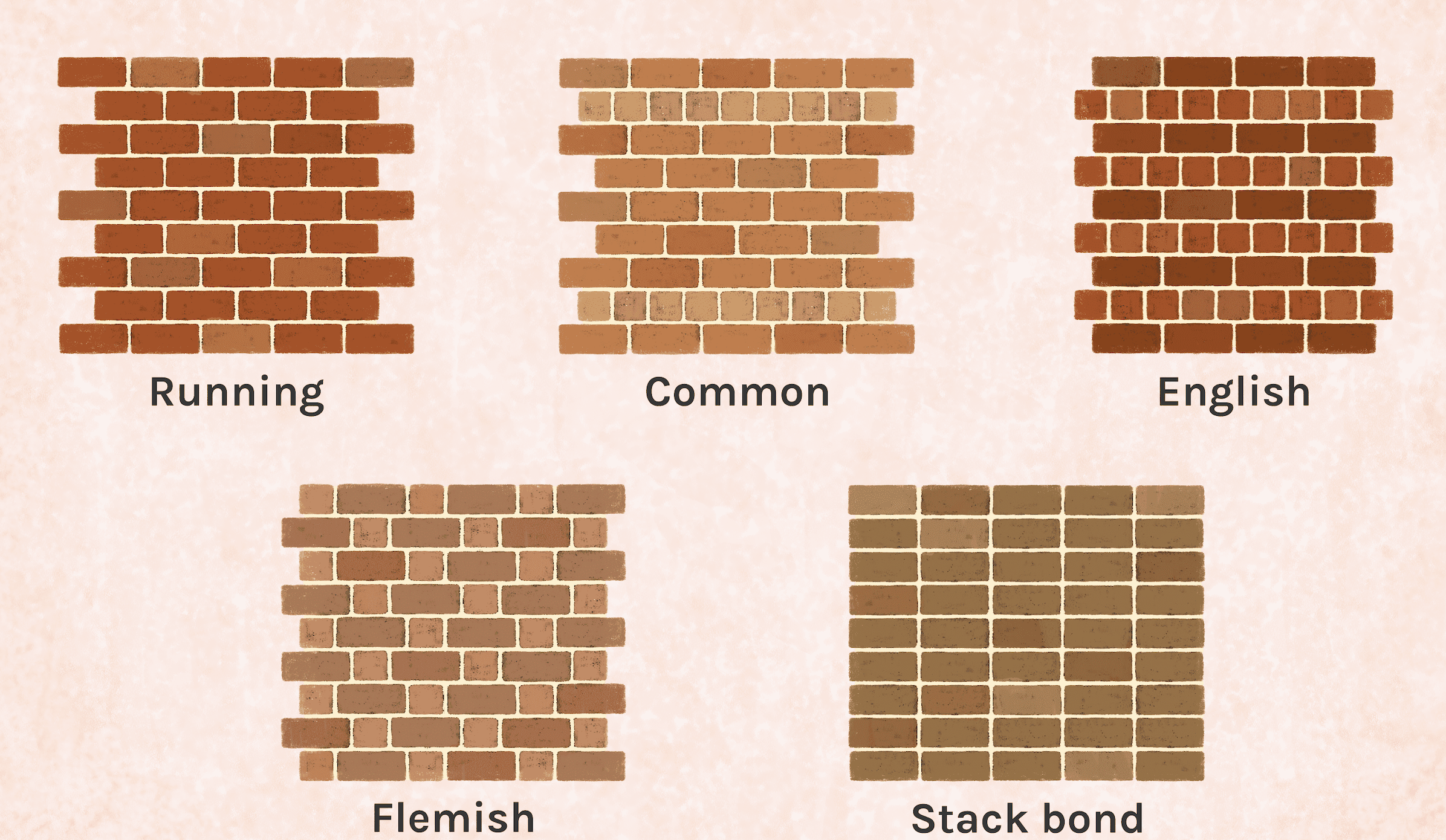
The way bricks are laid creates different visual and structural effects. Understanding these patterns is essential for both structural integrity and visual appeal. Common bonding patterns include:
- Running bond
- Stacked bond
- English bond
- Flemish bond
Running bond
The most basic pattern where each brick overlaps the joints of the bricks below by half a brick length. This creates horizontal lines across the wall surface.
Example
Pattern Example: Running Bond
In running bond, if you look at any brick, the brick directly above it will be positioned so that its centre aligns with the joint between two bricks below. This creates a staggered, offset pattern that distributes structural loads effectively.
Stacked bond
Bricks are laid directly on top of each other with aligned vertical joints, creating a grid-like appearance with strong horizontal and vertical lines.
English bond
Alternates between rows of stretchers (bricks laid lengthwise) and headers (bricks laid widthwise), creating a strong structural bond with varied visual texture.
Example
Pattern Example: English Bond Structure
- Row 1: All stretchers (long face visible)
- Row 2: All headers (short end visible)
- Row 3: All stretchers (offset from Row 1)
- Row 4: All headers (aligned with Row 2)
This alternating pattern provides excellent structural strength due to the interlocking arrangement.
Flemish bond
Each row contains alternating stretchers and headers, creating a distinctive pattern where long and short brick faces alternate within the same course.
Construction context
Understanding brick patterns helps appreciate how materials can be arranged systematically. Similar to stone coursing (where stones are laid in considered layers), brick bonding ensures both structural integrity and visual appeal in construction projects.
Summary
Key Points to Remember:
- Brick is manufactured from clay through moulding and kiln firing
- Bricks are recyclable and can be reused multiple times
- Different bonding patterns serve both structural and decorative purposes
- Running bond and English bond are among the most structurally sound patterns
- Brick became particularly popular during the Georgian architectural period