Cement (Leaving Cert Construction Studies): Revision Notes
📚Revision Notes
Cement
What is cement?
Cement is a construction material that forms the basis of many building products like mortar, plaster and concrete. In Ireland, Portland cement is the most commonly used type. This fine, grey powder undergoes a chemical reaction called hydration when mixed with water.
Note
The hydration process is fundamental to cement's effectiveness - it's what transforms a simple powder and water mixture into the strong, durable material we rely on in construction.
The hydration process occurs in two stages. First, the cement mixture begins to stiffen. Then it gradually gains strength over time. This chemical reaction continues as long as cement and water remain in contact.
Portland cement manufacturing
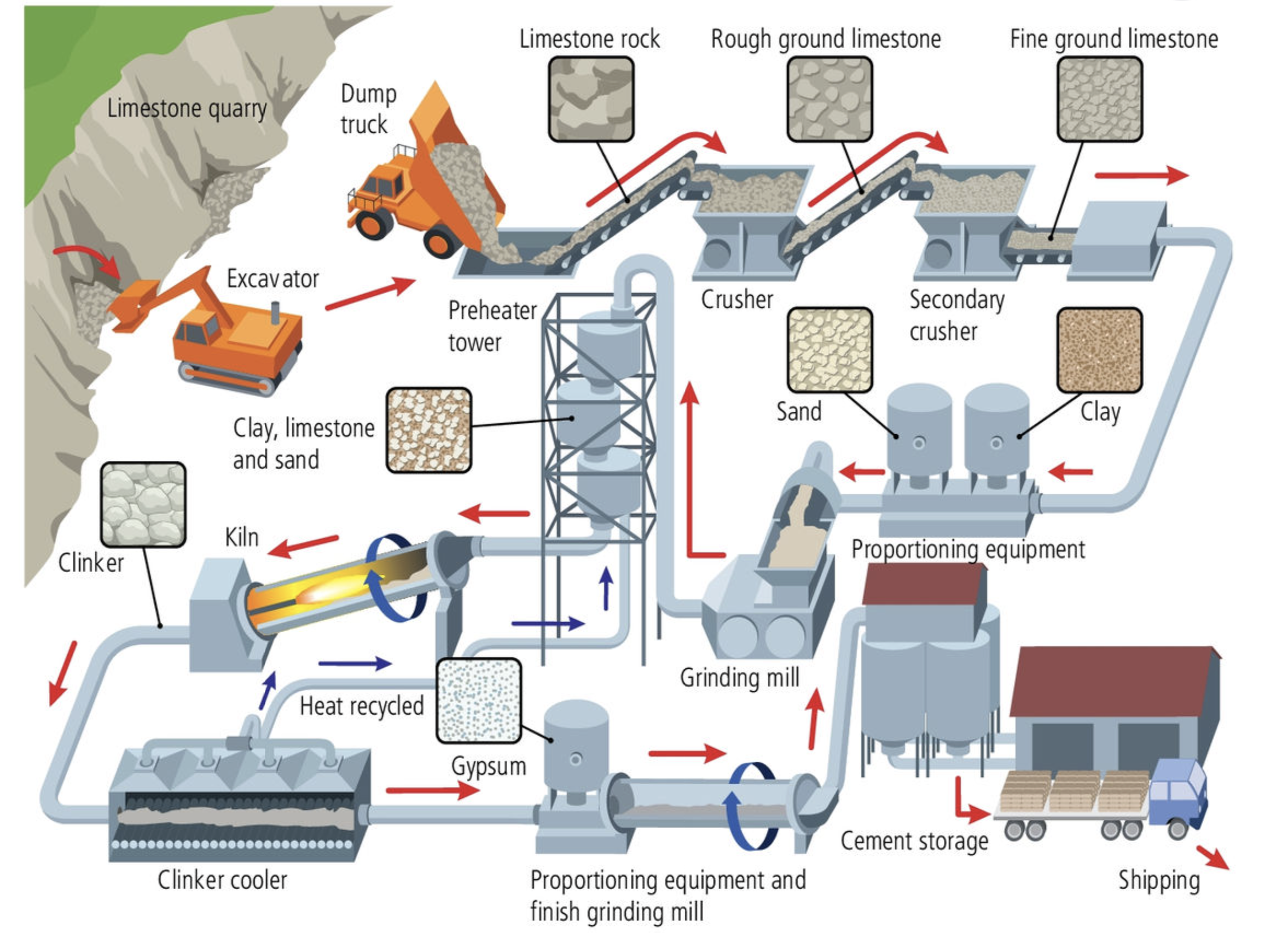
Portland cement production involves heating limestone (calcium) and clay together to create clinker. The manufacturing process follows these key stages:
- Raw material extraction: Limestone is quarried and clay is sourced
- Crushing and grinding: Materials are broken down into smaller pieces
- Proportioning: Raw materials are mixed in correct ratios
- Heating: The mixture is heated in a kiln to form clinker
- Final grinding: Clinker is ground with gypsum to create fine cement powder
- Storage and shipping: Finished cement is stored and distributed
Important
The heating stage is critical - temperatures must reach approximately 1,450°C to properly form clinker. This high-temperature process is what gives Portland cement its binding properties.
Understanding concrete
Concrete forms when cement combines with water and aggregates. Aggregates are granular materials including sand, gravel and stone. These materials are graded by size:
- Coarse aggregates: Natural gravel, crushed rock and stones larger than 5mm diameter
- Fine aggregates: Materials that pass through a 5mm sieve
The resulting concrete can be used for foundations, floor slabs, walls and various pre-cast products.
Batching and mixing concrete
Batching refers to measuring materials before mixing concrete. This can be done by weight or volume:
- Weight batching: Materials are individually weighed - most accurate method used in ready-mix systems
- Volume batching: More common for smaller amounts or domestic mixers
Important
Weight batching is always preferred when precision is crucial. Volume batching can lead to inconsistencies due to material compaction and moisture content variations.
During mixing, water and cement react chemically to form a paste. This paste coats the aggregates and binds everything together as the mixture sets and hardens.
Concrete mix proportions
A standard concrete mix ratio is 1:2:3 (cement : sand : gravel). This mix produces strong, durable concrete suitable for most construction work. However, the amount of Portland cement must be correctly balanced to avoid problems.
Important
Too little Portland cement causes:
- Harsh, rough concrete and slabs
- Excess water rising to the surface (bleeding)
- Difficulty finishing the concrete surface
- Weak or poor-quality surface
Important
Too much Portland cement results in:
- Cracking due to shrinkage as the concrete dries
- Rapid drying, making the concrete harder to work with
Workability testing
Workability describes concrete's ability to be shaped into moulds and compacted properly. Good workability means concrete can be formed, compacted and screeded without trouble. The amount of water and aggregates determines workability levels.
The slump test
This simple test measures concrete workability by examining how concrete behaves when support is removed. 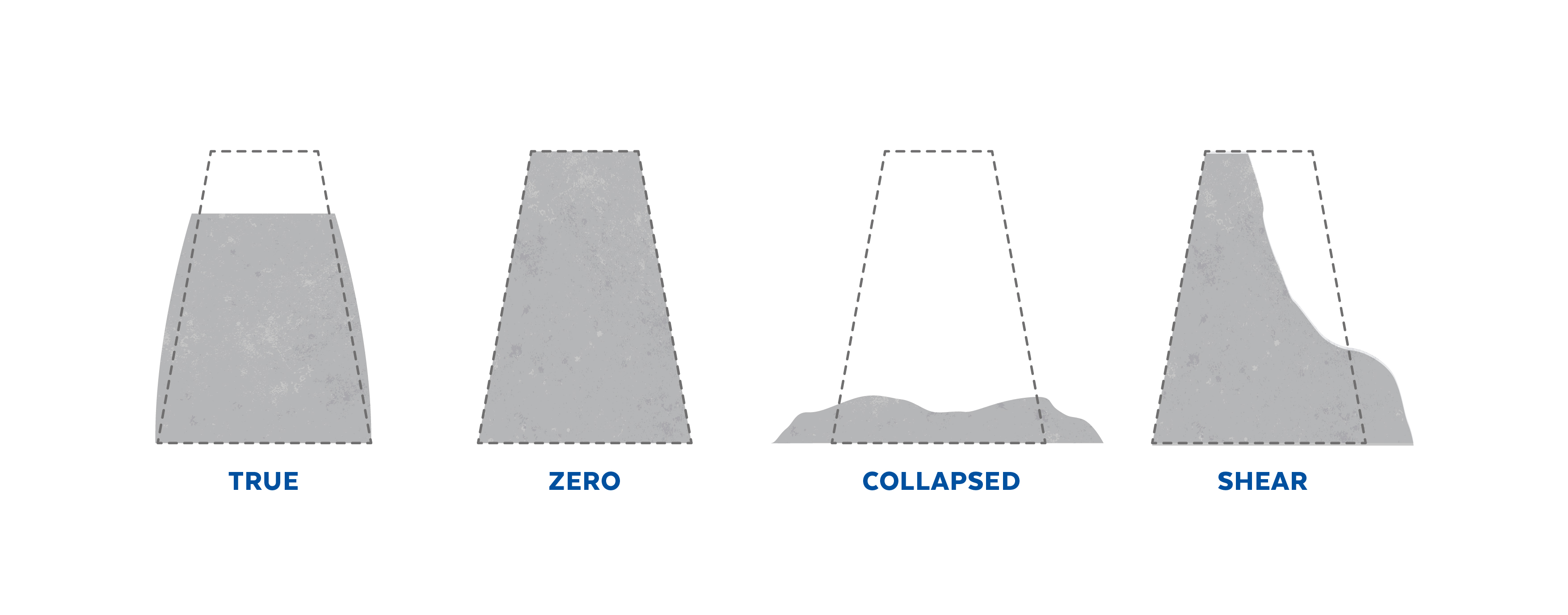 The test requires:
- Three concrete samples from different batch sections
- Mixing tray, truncated cone, steel tamping rod
- Metre stick and smooth surface
Example
Worked Example: Slump Test Procedure
Step 1: Take samples from different parts of the batch (avoid first or last portions)
Step 2: Clean sampling equipment thoroughly
Step 3: Re-mix samples completely on tray
Step 4: Ensure cone and surface are clean and damp
Step 5: Fill cone in three layers, rodding each layer 25 times
Step 6: Level off cone top after filling
Step 7: Lift cone straight up and measure height difference
Summary
Results interpretation:
- 0-50mm slump = low workability
- 50-75mm slump = medium workability
- Results must show true slump (not collapse or shear)
Placing and compacting concrete
Fresh concrete requires proper containment in formwork - boarding or sheeting that holds wet concrete as it sets. Formwork is typically made from timber and can be reused. During placement, concrete is tamped and vibrated to remove air bubbles.
Note
Proper formwork design is essential for achieving the desired concrete shape and finish. Poor formwork can lead to surface defects, dimensional inaccuracies, or even structural failure.
Curing concrete
Curing achieves optimal strength and hardness in concrete. The process involves spraying water directly onto concrete or onto mats placed over it. This water protects concrete from extreme temperatures and dry conditions that harm the curing process.
Important
Properly cured concrete develops strength with minimal cracking risk. Inadequate curing can result in up to 50% reduction in final strength, making this process critical for structural integrity.
Strength testing
Concrete strength varies between batches. The concrete cube test determines whether concrete meets British Standards requirements.
Cube test procedure
Equipment needed:
- Cast iron cube moulds, concrete samples, spanners, oil
- Tamping bar, float, damp cloths, plastic sheets
Example
Worked Example: Cube Test Method
Step 1: Fill clean moulds with concrete in 50mm layers
Step 2: Tamp each layer to compact concrete
Step 3: Smooth off cube tops, removing surplus concrete
Step 4: Cover with damp cloth and plastic sheet
Step 5: Store for 24 hours at 15-25°C
Step 6: Remove moulds carefully after unbolting
Step 7: Store cubes for 28 days to allow hardening
Step 8: Send to laboratory for compression testing
Results indicate compressive strength and British Standard compliance.
Reinforced concrete
Concrete performs excellently under compression but poorly under tension. Steel reinforcement addresses this weakness. Steel, being stronger in tension than compression, makes ideal reinforcement material.
Steel reinforcement, known as rebar (reinforcing bar), can be:
- Placed in concrete as individual lengths
- Formed into mesh or cage structures
In foundations, cages are positioned in excavated areas with rebar chairs for support, then concrete is poured around them.
Pre-stressing concrete
Pre-tensioning and post-tensioning are advanced reinforcement techniques that provide several advantages:
Note
Advantages of pre-stressing:
- Larger loads can be carried
- Wider spans are achievable
- Reduced component weight (stronger materials need fewer components)
- Materials can connect to create large high-strength areas
Important
Drawbacks include:
- Special steel requirements
- Higher costs
- High control and finish standards needed
- Specialist equipment necessary
Pre-tensioning process
Steel wire tendons are stretched between anchors before concrete pouring. After concrete hardens sufficiently, wires are released from anchors. This creates upward buckling tendency in the middle, but concrete straightens under load. Lintels and suspended concrete floors commonly use pre-tensioning.
Post-tensioning process
Here, concrete hardens before steel tensioning. Flexible ducts are positioned before concrete pouring. After setting, steel tendons feed through ducts and anchor at one end. Stressing jacks apply required tension, with grouting filling spaces between tendons and ducting to prevent moisture contact with steel. This method suits large-scale projects like bridges and roads.
Concrete blocks
Concrete blocks are pre-cast products sold in bulk. They come in solid or hollow varieties:
Solid blocks: Used for cavity wall construction and domestic purposes
Hollow blocks: Common in uninsulated buildings like garages and large sheds. In dwellings, they must be south-facing and cannot bear loads. Internal cavities reduce heat gain.
Additional block types:
- Fine texture blocks: Smooth finish blocks found in schools and offices, can be painted directly
- High-strength blocks: Higher cement content than standard blocks
- Aerated blocks: Lightweight products for general construction
Summary
Key Points to Remember:
- Portland cement is made by heating limestone and clay to form clinker, then grinding with gypsum
- Hydration occurs when cement and water react chemically, causing concrete to stiffen then gain strength
- The 1:2:3 cement:sand ratio produces high-strength concrete for most applications
- Workability testing uses the slump test to ensure concrete can be properly shaped and compacted
- Reinforced concrete uses steel bars or mesh to provide tensile strength where concrete is weak in tension