Stair Construction (Leaving Cert Construction Studies): Revision Notes
📚Revision Notes
Stair construction
Basic components and materials
Timber stairs are typically constructed using pine, ash, or oak timber. The staircase is built within a designated space called a stairwell, usually positioned against an external wall for structural support.
Note
Stairwell Positioning
Positioning the staircase against an external wall provides essential structural support and helps distribute the loads effectively throughout the building framework.
Every staircase consists of three fundamental components:
- Two strings: The angled structural members that support the steps
- Steps: Made up of the horizontal tread and vertical riser sections
The strings serve as the main structural framework, whilst the treads provide the walking surface and risers close the vertical gaps between steps.
String types and construction methods
There are two main approaches to stair string construction, each offering different structural and aesthetic benefits.
Closed string construction
In closed string stairs, both the tread and riser components are housed within grooves cut into the string itself. This creates a continuous, uninterrupted appearance along the string's edge.
The construction process involves:
- Creating housing joints in the string to accommodate each step
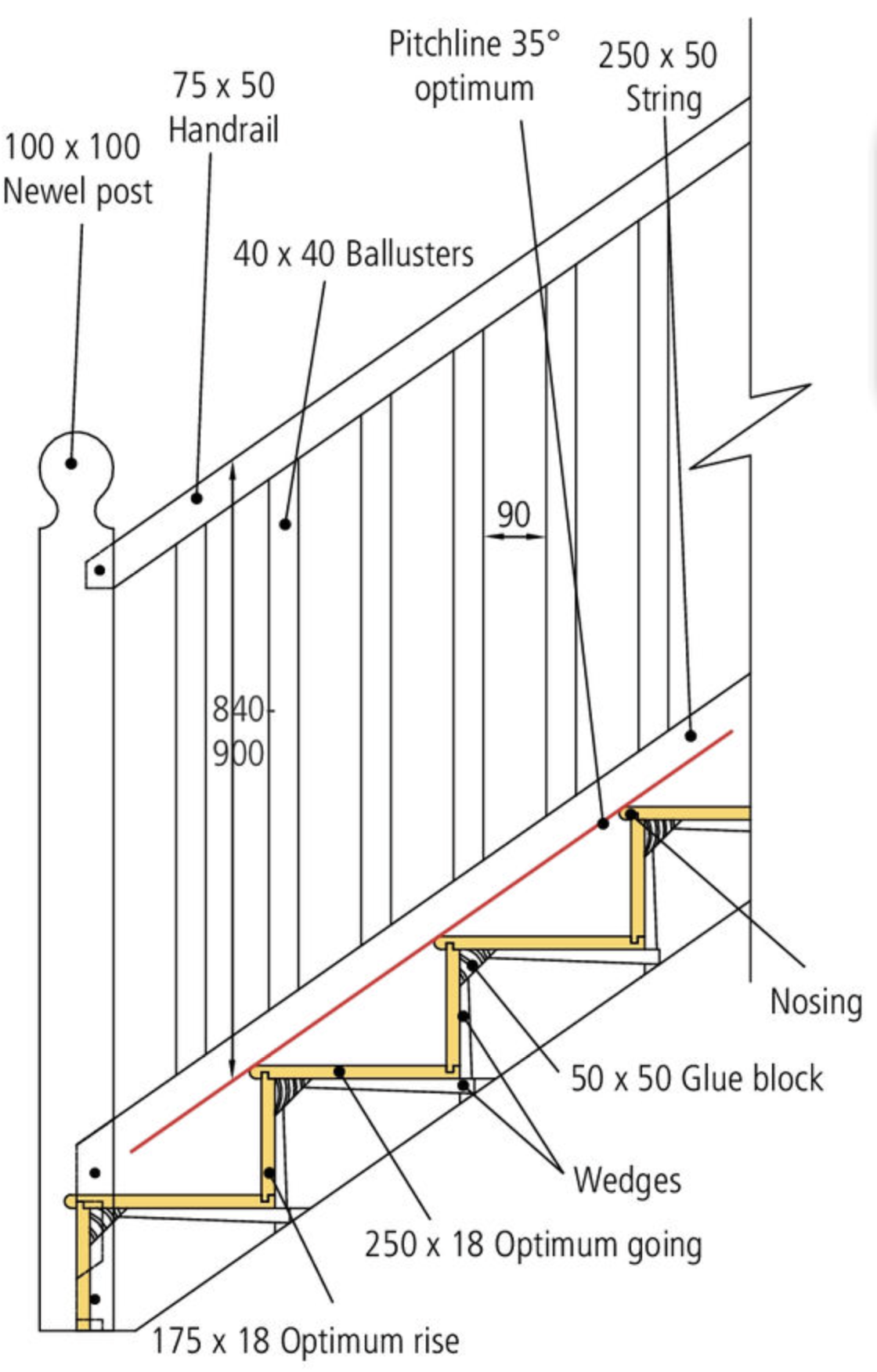
- Using wedges and triangular glue blocks underneath each tread and riser
- Securing components with screws at 240mm centres
- Maintaining a 50mm margin from the string edge
Note
Wedges and Glue Blocks
The wedges are glued into position and help prevent movement whilst increasing overall stiffness. Glue blocks (typically 50 × 50 × 75mm) are fitted beneath each step to reduce creaking and provide additional structural integrity.
Open string construction
Open string stairs feature a string that is cut to follow the profile of the steps. This exposes the ends of the treads and creates a more decorative appearance.
Key characteristics include:
- The string board is cut to accommodate step profiles directly
- Glue blocks are still used underneath for structural stability
- A return nosing may be attached to the exposed tread ends
- The construction allows for more elaborate finishing details
Note
Aesthetic vs Structural Considerations
While open string construction offers more decorative possibilities, it requires careful attention to structural detailing since the string is cut to follow the step profile, potentially reducing its structural capacity compared to closed string construction.
Structural connections and fixing methods
Newel post connections
Strings are secured at the top and bottom of the staircase through different connection methods depending on their position.
At the bottom, an outer string connects to the newel post using a mortise and tenon joint secured with dowels. This creates a strong structural connection that can withstand the forces generated during use.
At the top of the staircase, where the string meets the upper floor, it is hooked over the trimmer joist. This trimmer joist forms part of the floor structure and provides a solid fixing point.
Important
Critical Connection Points
The connection between the newel post and string uses a double haunched tenon joint to reduce torsional forces and provide greater stability. Poor connections at these points are a common cause of stair failure and must be executed with precision.
Technical specifications
Typical dimensional requirements include:
- 100 × 100mm newel posts
- 75 × 50mm handrails
- 40 × 40mm balusters
- 250 × 50mm strings
- Housing depths of 12-15mm
- Optimum string pitch of 35°
Safety requirements and building regulations
Stair design must comply with specific safety requirements to ensure user protection.
Important
Building Regulation Compliance
All stair construction must meet current building regulations. Non-compliance can result in dangerous conditions and legal issues during building inspection or sale.
Dimensional constraints
Building regulations specify maximum and minimum dimensions:
- Maximum rise per step: 220mm
- Minimum going per step: 220mm
- Maximum steps per flight: 16 steps
- Door clearance: Minimum 400mm clear space required for door swing
Design relationship
The relationship between rise (R) and going (G) must satisfy the formula:
This ensures a comfortable stride length and safe stepping pattern for users.
Design calculations
Stair design requires precise calculations to ensure compliance with building regulations whilst fitting the available space.
Important
Precision in Calculations
Accurate calculations are essential - small errors in rise and going calculations can result in uncomfortable or dangerous stairs that fail building regulation requirements.
Calculation process
Step 1: Determine number of steps
- Measure the total rise between floors
- Divide by the maximum number of steps (16) to establish if this is feasible
- Adjust the number of steps to achieve a practical rise dimension
Step 2: Calculate going dimension
- Use the rise value in the formula
- Solve for G to determine the going measurement
- Verify this meets minimum going requirements (220mm minimum)
Step 3: Check compliance
- Confirm the rise is 220mm or less
- Confirm the going is 220mm or more
- Ensure the calculation falls within 550-700mm range
Example
Worked Example: Calculating Stair Dimensions
For a total rise of 2700mm:
Step 1: Determine number of steps
- Dividing by 15 steps gives 180mm rise per step
Step 2: Calculate going dimension
- Using
- This gives
- Selecting 250mm going satisfies all requirements
Step 3: Check compliance
- Rise: 180mm ✓ (under 220mm maximum)
- Going: 250mm ✓ (over 220mm minimum)
- Formula check: ✓ (within 550-700mm range)
Final result: 15 steps with 180mm rise and 250mm going
Summary
Key Points to Remember:
- Timber stairs use pine, ash, or oak and are built in stairwells against external walls
- Closed strings house the steps within grooves, whilst open strings are cut to follow the step profile
- Structural connections use mortise and tenon joints with dowels, and strings hook over trimmer joists at the top