Timber Frame Building (Leaving Cert Construction Studies): Revision Notes
📚Revision Notes
Timber frame building foundations
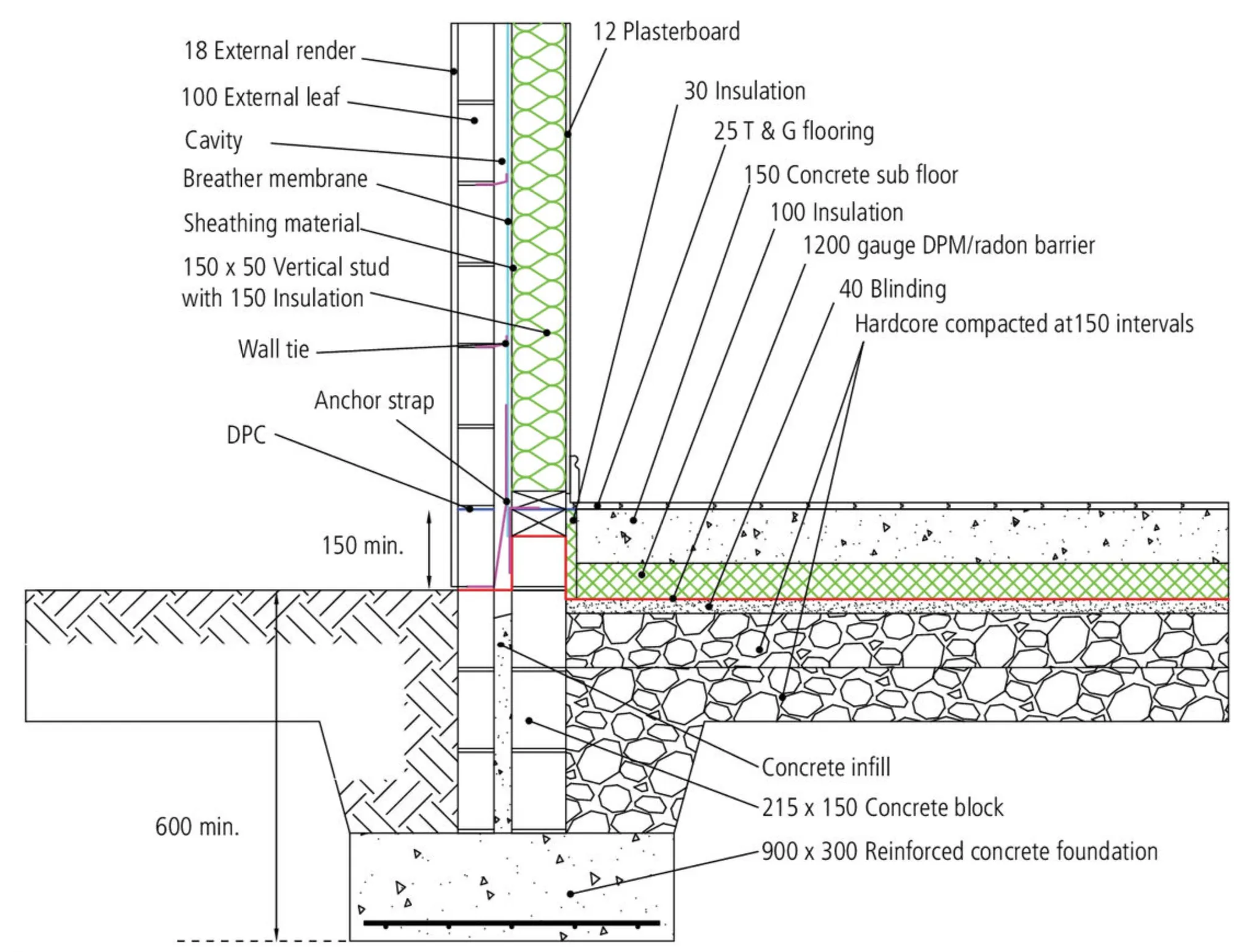
Timber frame buildings use a foundation system that closely matches the approach taken for traditional cavity wall houses. The main difference lies in how the timber frame structure connects to and builds upon this foundation base. Understanding this foundation system is essential because it provides the stable platform that supports the entire timber frame superstructure.
The foundation work follows the same principles as conventional construction until ground level is reached. At this point, the pre-manufactured timber frame panels are transported to the construction site and need to be securely attached to the foundation structure.
Note
The beauty of this system is that builders can use familiar foundation construction techniques right up to ground level, making the transition to timber frame construction much more manageable for traditional construction teams.
Foundation construction process
The construction process begins with excavating and preparing the foundation in exactly the same way as a traditional cavity wall dwelling. This means builders can use familiar techniques and follow established procedures for the groundwork phase.
Once the foundation reaches ground level, the key difference becomes apparent. Instead of continuing with traditional blockwork for the walls, the pre-fabricated timber frame panels are brought to site. These panels must be positioned accurately and securely connected to the foundation structure to ensure the building's stability.
The connection between the timber frame and foundation is achieved using galvanised steel straps. These straps serve a crucial role by fixing the panels both to the rising wall and to each other, creating a strong and rigid overall structure.
Important
The galvanising process is critical because it prevents the steel from rusting, ensuring long-term structural integrity. Without proper galvanising, the steel straps could corrode and compromise the entire connection system.
Foundation layer specifications
The foundation system consists of multiple layers, each serving a specific purpose. Working from the bottom upwards, the foundation includes several carefully engineered components.
The excavation is filled with hardcore material that is compacted at 150mm intervals to create a stable base. Above this sits a 40mm layer of blinding, which provides a smooth surface for the next layer.
The main structural foundation consists of a reinforced concrete foundation measuring 900mm wide by 300mm deep. This provides the primary load-bearing capacity for the entire structure. The foundation width of 900mm ensures adequate load distribution, while the 300mm depth provides sufficient structural strength.
Rising from the concrete foundation, concrete blocks measuring 215mm by 150mm form the rising wall that will support the timber frame panels. The minimum height requirement is 150mm above ground level, ensuring proper separation between the timber elements and ground moisture.
Example
Foundation Layer Build-up Example:
Starting from the bottom:
- Hardcore base - Compacted at 150mm intervals for stability
- Blinding layer - 40mm smooth concrete surface
- Main foundation - 900mm × 300mm reinforced concrete
- Rising wall - 215mm × 150mm concrete blocks (min. 150mm above ground)
Panel connection system
The timber frame panels connect to the foundation through a carefully designed system. The panels are fitted to a soleplate that sits on the inner leaf of the cavity wall construction. This soleplate acts as the connecting element between the foundation and the timber frame structure above.
The external wall continues to be built using the same methods as if the inner leaf consisted of concrete blocks rather than timber frame panels. This approach maintains consistency with traditional construction techniques for the external envelope.
Important
Galvanised steel anchor straps provide the critical connection between the timber frame wall and the outer leaf of the cavity construction. These straps are positioned at regular intervals and secured firmly to both elements, preventing any movement or separation under load conditions.
Foundation detail breakdown
The complete foundation detail reveals the complexity of modern timber frame construction. The foundation system must accommodate multiple functions including structural support, moisture management, thermal performance, and service integration.
At foundation level, a 1200 gauge damp proof membrane (DPM) and radon barrier is installed to prevent moisture and gas penetration. The foundation also incorporates insulation layers of varying thicknesses - typically 100mm beneath the floor construction and additional insulation within the floor build-up.
The floor construction itself sits above a 150mm concrete sub floor, with tongue and groove flooring (25mm thick) providing the finished floor surface. This multi-layer approach ensures both structural adequacy and thermal performance requirements are met.
Note
The foundation design must also accommodate the damp proof course (DPC) that prevents moisture from rising through the wall construction. The DPC is positioned at the appropriate level to align with both the internal floor level and external ground conditions.
Key measurements and materials
Several critical measurements define the foundation construction. The minimum foundation depth extends 600mm below ground level, providing adequate depth for stability and frost protection. The concrete foundation measures 900mm in width, ensuring sufficient bearing capacity for the loads above.
The concrete block rising wall uses blocks measuring 215mm by 150mm, with the wall rising a minimum of 150mm above ground level. This height ensures the timber frame elements remain well clear of ground moisture and potential splash-back from rainfall.
All steel components, particularly the connecting straps, receive galvanised coating to prevent corrosion. This treatment is essential given the long design life expected from the building structure and the difficulty of replacing these elements once construction is complete.
The foundation incorporates various insulation thicknesses depending on location - 30mm, 100mm, and 150mm are all specified in different parts of the construction. These varying thicknesses reflect the different thermal requirements in different areas of the building envelope.
Summary
Key Foundation Specifications to Remember:
- Foundation depth: Minimum 600mm below ground level
- Concrete foundation: 900mm × 300mm reinforced concrete
- Concrete blocks: 215mm × 150mm for rising wall
- Rising wall height: Minimum 150mm above ground level
- Hardcore compaction: At 150mm intervals
- Blinding layer: 40mm thickness
- DPM specification: 1200 gauge with radon barrier
- Steel strap protection: All straps must be galvanised
- Insulation thicknesses: 30mm, 100mm, and 150mm in various locations