Timber Frame Building (Leaving Cert Construction Studies): Revision Notes
📚Revision Notes
Timber frame building
Timber frame construction focuses on the internal structural system rather than the external appearance. While the outer layer might use materials like block or brick, the internal framework provides the primary structural support.
The structural frame acts like a building's skeleton, providing more strength than its appearance might suggest. This internal timber framework carries the building's loads and determines its structural integrity.
Note
Think of the timber frame as the skeleton of a building - just as your skeleton supports your body regardless of what clothes you wear, the timber frame supports the building regardless of the external materials used for appearance.
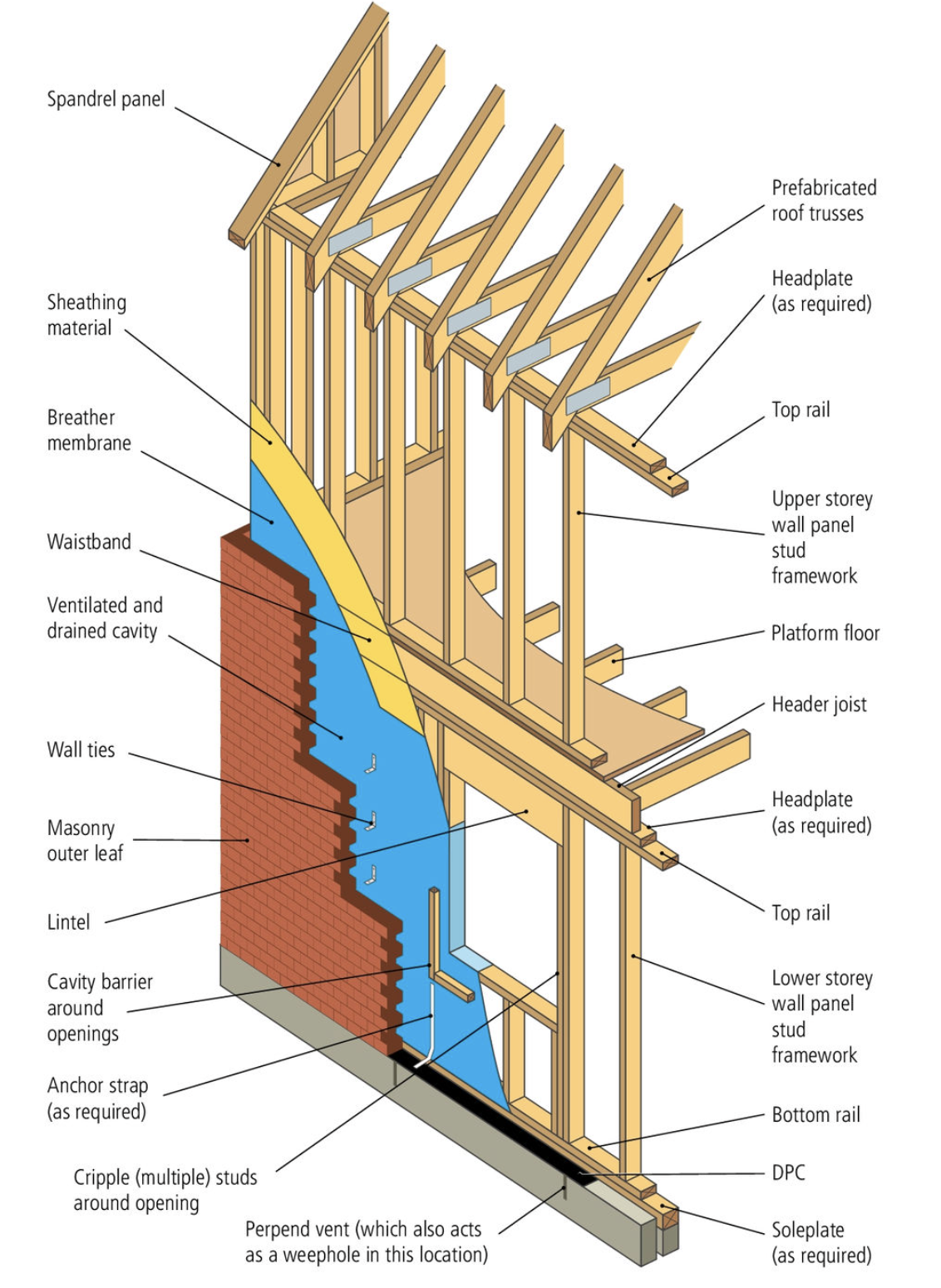
Construction methods
Timber frame buildings use two main construction approaches:
Prebuilt panels: Sections are manufactured off-site in controlled conditions, then transported and assembled on-site. This method ensures greater accuracy and quality control.
On-site construction: Building the framework directly at the construction location. This approach takes more time and may result in less precise assembly compared to prebuilt methods.
Most modern timber frame projects favour the prebuilt panel approach due to its efficiency and precision.
Important
The choice between prebuilt panels and on-site construction significantly impacts project timeline, quality, and cost. Prebuilt panels offer superior quality control but require careful coordination for transportation and crane access.
Key structural components
Timber frame construction involves multiple interconnected elements that work together to create a complete building system.
Foundation and base elements
Soleplate: The bottom timber member that sits on the foundation, providing the base for vertical wall studs.
DPC (Damp proof course): A waterproof barrier that prevents moisture from rising through the foundation into the timber structure.
Anchor straps: Metal fixings that secure the timber frame to the concrete foundation, ensuring structural stability.
Note
The foundation connection is critical - without proper damp proofing and secure anchoring, the entire timber structure can be compromised by moisture damage or structural movement.
Wall framework system
Wall panel stud framework: Vertical timber members (studs) that form the main structural frame of walls, typically spaced at regular intervals.
Top rail and bottom rail: Horizontal timber members at the top and bottom of wall panels that connect and stabilise the vertical studs.
Header joist: Horizontal structural member above openings that carries loads around windows and doors.
Headplate: Timber member at the top of walls that distributes roof loads to the wall framework.
Floor structure
Platform floor: A floor system built as a platform before the next storey walls are erected, creating a stable working surface and structural separation between floors.
Roof components
Prefabricated roof trusses: Factory-made triangulated roof structures that span across the building to support the roof covering.
Spandrel panel: Triangular panels that fill the space between the rectangular wall frame and the sloped roof line.
Wall assembly layers
The complete wall system includes several layers working from inside to outside:
Sheathing material: Structural boarding attached to the timber frame to provide racking resistance and a base for other layers.
Breather membrane: A permeable layer that allows moisture vapour to escape whilst preventing liquid water from entering.
Ventilated and drained cavity: An air gap that allows moisture to drain away and provides thermal separation.
Wall ties: Metal connections that link the timber frame to the external masonry leaf whilst allowing for differential movement.
Masonry outer leaf: The external brick or block wall that provides weather protection and appearance.
Note
The wall assembly works as a complete system - each layer has a specific function, and removing or compromising any layer can affect the performance of the entire wall system.
Opening details
Lintel: A structural beam above windows and doors that carries loads across the opening.
Cavity barrier around openings: Fire-stopping material that prevents fire and smoke spread through cavities around windows and doors.
Cripple studs: Short vertical members around openings that maintain the regular stud spacing.
Specialised components
Waistband: A horizontal member that provides connection between different storeys in multi-storey construction.
Perpend vent: Openings that allow air circulation whilst also serving as weep holes for drainage in some locations.
Advantages of timber frame construction
Timber frame buildings offer several significant benefits compared to traditional concrete and masonry construction methods.
Material handling benefits
Timber provides easier material handling due to its lighter weight compared to concrete blocks or bricks. This reduced weight means construction workers can manage components more easily and use lighter machinery for lifting and positioning. The material can be processed using standard woodworking tools rather than heavy concrete cutting equipment.
Thermal performance
The lower density of timber compared to concrete or masonry means the material heats up more rapidly. This characteristic leads to buildings that respond quickly to heating systems, providing faster warm-up times and improved occupant comfort.
Construction efficiency
Timber frame buildings can be erected much more quickly than traditional masonry construction. The prebuilt panel system particularly speeds up the on-site assembly process, reducing construction time and associated costs.
Note
Speed of construction is not just about cost savings - faster construction means reduced exposure to weather, earlier building occupation, and quicker return on investment for developers.
Energy considerations
Timber frame construction demonstrates superior energy efficiency in two key areas. Firstly, the completed buildings perform better thermally due to the insulation-friendly construction method. Secondly, the production of timber requires significantly less energy than manufacturing concrete or brick materials, making it a more environmentally sustainable choice.
Important
The environmental benefits of timber frame construction extend beyond just energy efficiency - timber is a renewable resource that stores carbon, making it one of the most sustainable construction materials available.
Summary
Key Points to Remember:
- Timber frame construction relies on an internal structural framework, similar to a building's skeleton
- Prebuilt panels offer greater accuracy and speed compared to on-site construction methods
- The wall system includes multiple layers from internal sheathing through to external masonry
- Key structural elements include studs, rails, joists, and trusses working together as a complete system
- Timber frame offers advantages in material handling, construction speed, thermal performance, and energy efficiency