Isometric Scales (Leaving Cert DCG): Revision Notes
📚Revision Notes
Isometric Scales
What is an isometric scale?
When you create technical drawings, you'll often need to compare orthographic projections (like elevations and plans) with isometric projections of the same object. However, there's an important problem to understand: the isometric projection appears larger than it actually should be when compared to the orthographic views.
This happens because of how isometric projection works. The solid appears foreshortened along the three main axes, but when we draw an isometric view, we typically ignore this foreshortening to make the drawing easier to construct. As a result, we need a special measuring tool called an isometric scale to ensure we maintain the correct proportions between different types of drawings.
Note
An isometric scale is essential for maintaining accurate proportional relationships between orthographic and isometric drawings. Without proper scaling, isometric projections can be misleading when compared to their orthographic counterparts.
Understanding distortion in isometric projection
Let's look at a practical example using a cube to understand why we need an isometric scale.
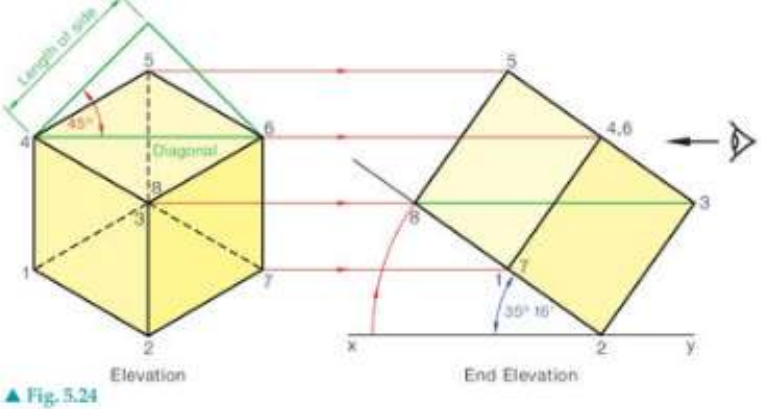
When we examine the orthographic projections of a cube (shown in the elevation and end elevation views above), we can see the true dimensions. However, when the same cube is drawn in isometric projection, something interesting happens to its appearance.
If we take a cube and look at it from an isometric viewpoint, the diagonal of a square face will appear as a horizontal line. This means that when we construct the isometric view having its base on the inclined plane, we need to tilt the cube by 35°16' (35 degrees 16 minutes) to get the correct isometric view.
Important
Key Insight: An isometric cube looks too big and does not represent a true cube of 30mm side. This distortion occurs because we ignore the natural foreshortening that should happen in true isometric projection, making the drawing appear larger than its actual proportions.
Constructing an isometric scale
The scaling factor needed for isometric drawings is constant for all isometric projections and can be derived from geometric principles.
Note
Scale Construction Method
The construction involves creating two key reference lines:
- A 45° line that shows the true length of measurements
- A 30° line that shows their isometric equivalents
When you measure along these lines, you'll discover that lengths measured on the 45° line represent true dimensions, while the corresponding lengths on the 30° line show how those same dimensions appear in isometric projection.
The scaling factor
Through geometric construction and measurement, we find that the isometric scale measurement is 0.816 of the true length distance. This means:
- If you have a true length of 30mm in orthographic projection
- The equivalent length in properly scaled isometric projection should be approximately 24.5mm ()
- This scaling factor applies to all three axes in isometric projection
Example
Worked Example: Applying the Scaling Factor
Original orthographic dimension: 50mm Isometric scale calculation:
This means a 50mm dimension in orthographic projection should be drawn as 40.8mm in a properly scaled isometric view.
Practical application
To use an isometric scale effectively, you need to follow a systematic approach that ensures accuracy and consistency across your technical drawings.
Summary
Isometric Scaling Process:
- Identify true measurements from your orthographic drawings
- Apply the 0.816 scaling factor to convert these to correct isometric proportions
- Use the geometric construction method with 45° and 30° lines for accurate scaling
- Check your proportions by comparing the scaled isometric view with the original orthographic projections
The isometric scale ensures that when you create isometric drawings, they maintain the correct visual relationship with orthographic projections, giving viewers an accurate sense of the object's true proportions.
Key Points to Remember
Understanding isometric scaling is crucial for creating accurate technical drawings that maintain proper proportional relationships.
Summary
Essential Takeaways:
- Isometric projections appear larger than they should when compared to orthographic views
- The scaling factor is always 0.816 - isometric measurements are about 82% of true length
- Use 45° lines for true lengths and 30° lines for isometric equivalents when constructing scales
- Apply scaling to all three axes equally in isometric projection
- The isometric scale helps maintain accurate proportions between different types of technical drawings