The Sphere in Isometric (Leaving Cert DCG): Revision Notes
📚Revision Notes
The Sphere in Isometric
Understanding spheres in isometric projection
When drawing a sphere in isometric projection, we face an important challenge that many students find confusing at first. Unlike other geometric shapes that maintain their basic form, a sphere transforms into an ellipse when represented in isometric view. This fundamental change occurs because isometric projection shows objects at specific angles that distort circular shapes.
Note
The key principle to remember is that while a sphere appears as a perfect circle in orthographic views (front, side, top), it must be drawn as an elliptical shape in isometric projection to accurately represent its three-dimensional form.
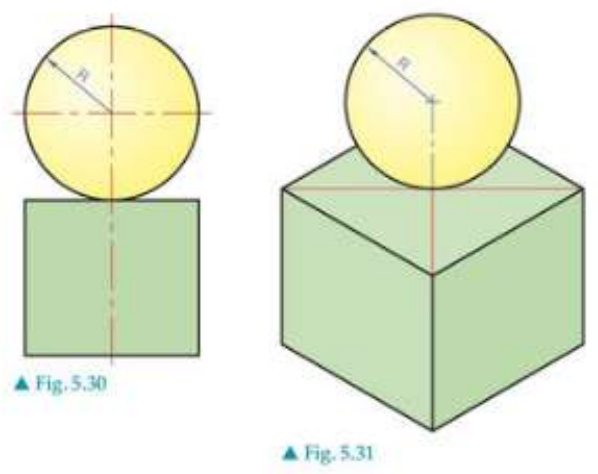
This comparison clearly demonstrates the difference between orthographic and isometric representation. The left figure shows the traditional orthographic view where the sphere appears as a simple circle above a square. The right figure shows the same sphere in isometric view, where it appears as an ellipse positioned on top of a cube.
Visual comparison: orthographic vs isometric representation
Understanding the visual differences between projection methods is crucial for accurate technical drawing. The sphere presents one of the most noticeable changes when moving from orthographic to isometric representation.
There are several important concepts:
- Orthographic projections show the sphere as perfect circles in elevation and plan views
- Sectional views through the centre help understand the three-dimensional form
- Isometric representation shows how the sphere actually appears larger and elliptical
- Size comparison demonstrates that the isometric sphere looks bigger than the orthographic version
Important
The reason for this size difference is that isometric projection uses a specific scale factor that affects how we perceive dimensions. This is not an error - it's an inherent characteristic of the isometric system.
Construction methods for spheres in isometric
There are two main approaches to drawing spheres in isometric projection, each suited to different situations and accuracy requirements.
Basic sphere construction method
Note
The fundamental method involves using the isometric axes to create construction guidelines. You begin by establishing the centre point of the sphere and then work outward to create the elliptical boundary.
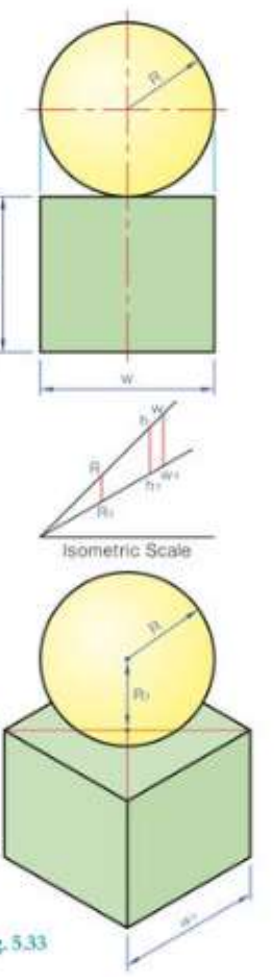
This approach works well when you need a quick representation and don't require precise scaling. The construction lines help maintain proper proportions and ensure the ellipse fits correctly within the isometric framework.
Scaled isometric construction method
Note
For more precise work, especially when measurements are critical, the scaled isometric method provides better accuracy. This technique involves several carefully ordered steps that ensure proper proportions and scaling.
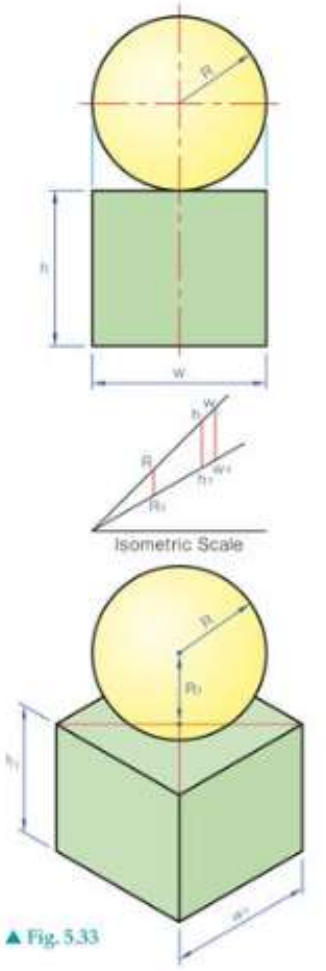
Step-by-step construction process
Example
Worked Example: Scaled Isometric Construction Process
The scaled isometric method follows a logical sequence that builds accuracy through careful measurement and construction:
Step 1: Draw the elevation views first - Start with orthographic projections to establish the true size and proportions of your sphere
Step 2: Set up the isometric scale - Use the proper isometric scale factor to ensure accurate representation
Step 3: Transfer scaled measurements - Convert orthographic dimensions to isometric equivalents using the scale
Step 4: Construct the ellipse - Use the scaled measurements to create the elliptical representation of the sphere
Step 5: Add centre lines and construction lines - Include proper technical drawing conventions
Step 6: Verify proportions - Check that your isometric sphere maintains proper relationships with other objects
Important considerations for accurate representation
Several factors affect the quality and accuracy of sphere representation in isometric projection:
Important
Scale consistency: When using the scaled isometric method, all measurements must be converted using the same scale factor. Mixing scaled and unscaled measurements creates distorted results.
Ellipse construction: The elliptical shape must be drawn carefully to avoid creating an oval or irregular curve. Proper ellipse construction techniques ensure smooth, accurate curves.
Centre line placement: Construction lines and centre lines help maintain accuracy and provide reference points for positioning the sphere correctly within the drawing.
Important
Size relationships: Remember that spheres appear larger in isometric than in orthographic projection. This size difference is mathematically correct and should not be "corrected" by reducing the sphere size.
Practical tips for drawing spheres in isometric
Note
Essential Drawing Tips:
- Always complete your orthographic views before attempting the isometric construction
- Use light construction lines that can be erased after completing the final ellipse
- Practice ellipse construction techniques separately to improve your sphere drawing skills
- Check your work by comparing proportions between the orthographic and isometric views
- Remember that the ellipse represents a circular cross-section viewed at an angle
Exam tip: In Leaving Cert DCG examinations, examiners look for proper construction techniques and accurate proportions. Show your construction lines clearly and ensure your ellipses are smooth and properly shaped.
Summary
Key Points to Remember:
- Spheres appear as ellipses in isometric projection, not circles
- The isometric sphere looks larger than the orthographic version - this is correct, not an error
- Always draw orthographic views first before attempting isometric construction
- Use scaled measurements when precision is required for technical accuracy
- Construction lines and centre lines are essential for proper positioning and proportions