Worked Examples Using Isometric Scales (Leaving Cert DCG): Revision Notes
📚Revision Notes
Worked Examples Using Isometric Scales
Understanding the isometric scaling process
When creating isometric projections from orthographic views, you need to use isometric scales to ensure accurate proportions. This process involves converting measurements from true size to scaled size suitable for isometric drawing.
The key principle is that all measurements in isometric projection must be scaled down from their true dimensions. This scaling ensures that the three-dimensional object appears correctly proportioned in the isometric view.
Note
The isometric scaling process is fundamental to technical drawing accuracy. Without proper scaling, your isometric projections will appear distorted and unprofessional, failing to represent the true proportional relationships of the object.
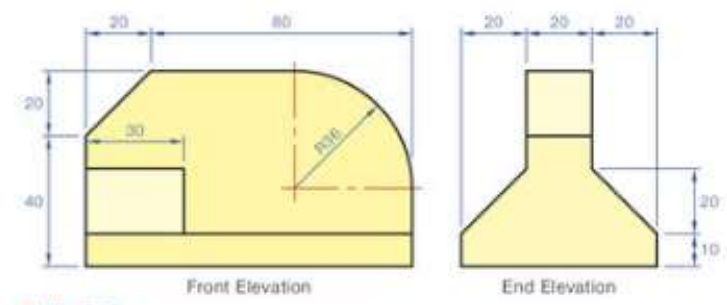
Step-by-step method for creating isometric projections
The systematic approach to creating isometric projections requires careful attention to measurement conversion and proper use of scaling techniques. Follow this proven method to achieve accurate results every time.
Example
Worked Example: Complete Isometric Projection Process
Step 1: Prepare your orthographic views Start with complete front and end elevations of the object you want to draw in isometric. These views show the true measurements and proportions of your object.
Step 2: Set up the isometric scale using a line Create your isometric scale by drawing a reference line. This line is crucial for converting true measurements to isometric measurements.
Step 3: Extract measurements from the corners Take any measurement needed for the isometric drawing from the corners of your orthographic views. Mark these measurements along the scaling line (for example: 10, 20, 30, 36 units).
Step 4: Draw the isometric view Use the scaled measurements obtained from the line to construct your isometric projection. Remember that measurements plotted vertically give you the scaled dimensions needed for the isometric drawing.
Step 5: Handle curves and circles When constructing circles or curves using coordinates, the length of each coordinate must be scaled appropriately. This ensures that curved features maintain their correct proportional relationship in the isometric view.
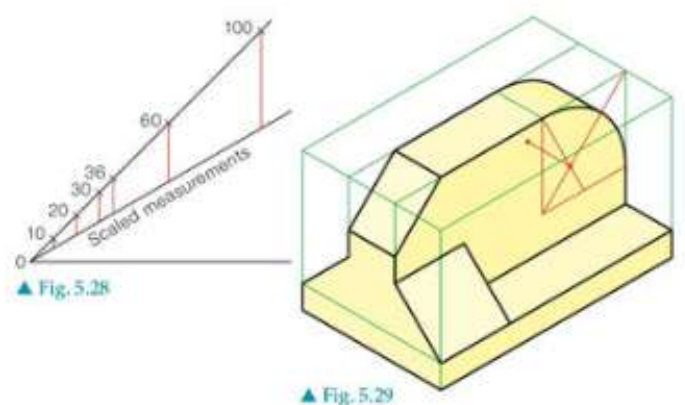
The sphere in isometric projection
Understanding how spheres behave in isometric projection is crucial for accurate technical drawing. Unlike other geometric shapes, spheres present unique challenges that require special consideration.
Understanding sphere distortion
When drawing spheres in isometric projection, you must understand that they don't appear as perfect circles. Instead, spheres appear as ellipses because of the isometric viewing angle.
Important
Critical Sphere Projection Concept
A common mistake is treating spheres like other geometric shapes in isometric projection. Remember: spheres require special handling because they appear distorted in the isometric view, showing as ellipses rather than circles.
Key principles for sphere projection
- A sphere looks the same regardless of which way it's viewed or rotated
- However, in isometric projection, a sphere gives a distorted view - an enlarged view of objects
- Any object containing a sphere, or part of a sphere, should show an enlarged view of that sphere when drawing
- In isometric projection, we must lengthen the radius before we start producing a scaled isometric
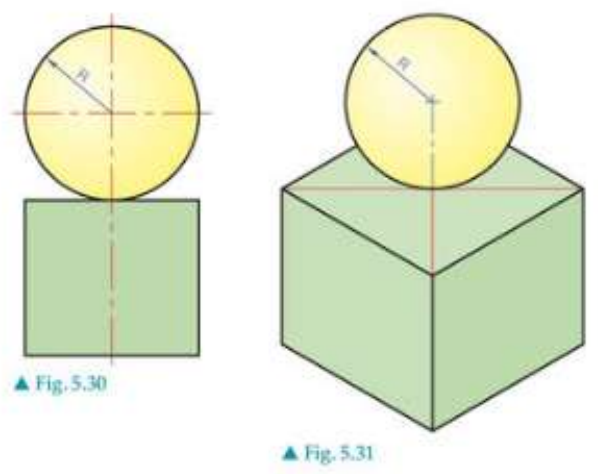
Practical application
The sphere appears too small when drawn using the standard isometric scale. To correct this, you need to adjust the radius to ensure the sphere maintains its proper visual relationship with other elements in the drawing.
Note
This enlargement compensates for the visual distortion inherent in isometric projection, ensuring that spherical elements appear proportionally correct relative to other geometric features in your drawing.
Exam tips
Successful performance in technical drawing examinations requires mastery of key principles and consistent application of proper techniques. Focus on these essential strategies to achieve excellent results.
Summary
Essential Exam Strategies:
- Always use the scaling line when converting measurements
- Check your proportions - objects should look realistic in isometric view
- Remember that circles become ellipses in isometric projection
- Scale all measurements consistently - don't mix true size with scaled measurements
- Practice the step-by-step process until it becomes automatic
Summary
Key Points to Remember:
- Isometric scales are essential for creating accurate proportional drawings from orthographic views
- The reference line is your key tool for converting true measurements to scaled measurements
- You cannot mix true size measurements with isometric measurements
- Spheres appear as ellipses in isometric projection and require special consideration for radius scaling
- Follow the systematic approach of extracting measurements from orthographic views, scaling them, then constructing the isometric projection